Facts
The petitioner is a subsequent purchaser of property (CTS No. 6455, Belagavi), which her vendor had originally acquired via a registered sale deed dated May 15, 1993
Source reference: p. 7On March 20, 2025, and April 17, 2025, the respondents issued a demand notice and made a revenue entry seeking to recover alleged deficit stamp duty relating to the 1993 transaction—nearly 32 years after its execution
Source reference: p. 7–10The petitioner challenged these actions, while the State raised a preliminary objection regarding the maintainability of the writ petition, arguing the existence of an alternative statutory remedy under the Karnataka Stamp Act
Source reference: p. 3Issues
1. Whether the existence of an alternative statutory remedy acts as an absolute bar to writ jurisdiction when the underlying action is challenged as being without jurisdiction
Source reference: p. 3, para. 22. Whether the authorities can initiate recovery proceedings for deficit stamp duty after the expiry of the limitation period prescribed under Section 46A of the Karnataka Stamp Act, 1957
Source reference: p. 4, para. 4Law Applied
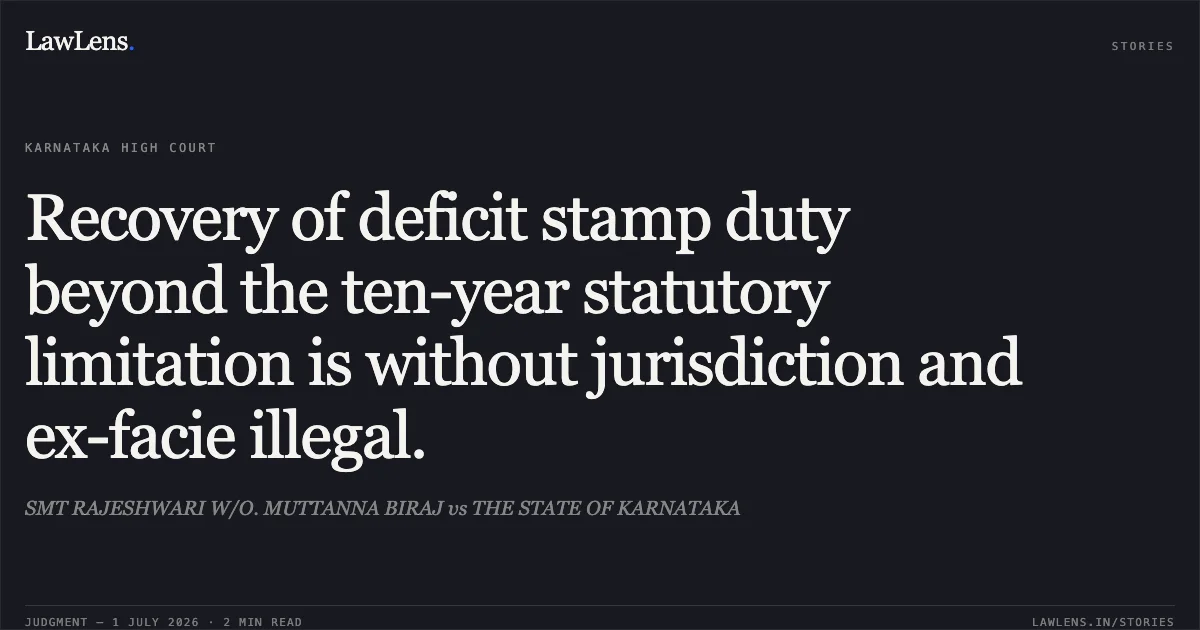
The court primarily applied Section 46A(1) of the Karnataka Stamp Act, 1957, which mandates that proceedings for the recovery of short-levied stamp duty must be initiated within five years from the date the duty became payable
Source reference: p. 4-5The proviso to Section 46A(1) extends this period to ten years in cases involving fraud, collusion, or wilful misstatement
Source reference: p. 5The court applied the principle that an alternative remedy does not bar writ jurisdiction under Article 226 of the Constitution where the impugned action is ex-facie without jurisdiction or barred by limitation
Source reference: p. 3, 9Reasoning
The court rejected the State's preliminary objection, reasoning that the challenge pertained to the very competence of the authority to act after the statutory limitation period had lapsed
Source reference: p. 3Upon interpreting Section 46A(1), the court found the power to recover duty is not "unbridled" and the limitation is not merely procedural but jurisdictional
Source reference: p. 6Even if the extended ten-year limitation for fraud were applied, the proceedings initiated in 2025 for a 1993 deed (a 32-year gap) remained "hopelessly barred"
Source reference: p. 7-8The court further observed that the petitioner, as a subsequent bona fide purchaser, cannot be held liable for the alleged defaults of a vendor from three decades ago, as such actions undermine the sanctity of registered transactions and legislative intent
Source reference: p. 8-9Holding
The court answered the issues in favor of the petitioner, holding that the exhaustion of alternative remedies is not required when an action is demonstrably without jurisdiction
It ruled that any notice issued beyond the maximum ten-year statutory period is functus officio and void
Source reference: p. 6Consequently, the court allowed the petition and quashed the demand notice dated March 20, 2025, and the revenue entry dated April 17, 2025
Source reference: p. 10-11Acts & Sections Cited
1 provisions across 1 statute referred to in this judgment. Linked provisions open on LawLens.
Karnataka Stamp Act, 19571
Original Court PDF
SMT RAJESHWARI W/O. MUTTANNA BIRAJvsTHE STATE OF KARNATAKA
Click to open original judgment
Original judgment, available to read, download and summarize on LawLens.in