Facts
The petitioner, initially appointed as a Constable in 1991, retired on 30 September 2025 as an In-charge Assistant Sub-Inspector, a Class III post.
Source reference: para. 2–4, 10, 12Following a review of his service book, the respondents found that his pay had been incorrectly fixed and, by order dated 7 April 2026, directed recovery of ₹2,43,553 for alleged excess payments made between January 1996 and March 2020.
Source reference: para. 2–4, 10, 12The petitioner challenged the recovery, alleging, among other things, that he had not received a hearing and was not responsible for the fixation error. The State relied on an undertaking the petitioner gave when preparing his pension papers.
Source reference: para. 2–4, 10, 12Issues
Whether recovery of excess pay could be made from the petitioner’s retiral benefits on the basis of an undertaking given at retirement, rather than when the pay benefit was granted.
Source reference: para. 4, 6, 10Whether recovery was impermissible because the petitioner was a retired Class III employee and the excess payments had been made more than five years before the recovery order.
Source reference: para. 7, 11–12Law Applied
Under State of Punjab v. Rafiq Masih (White Washer), recovery of mistaken excess payments is impermissible in specified situations, including recovery from Class III and IV employees, retired employees or those due to retire within one year, and recovery where the excess payment relates to a period more than five years before the recovery order.
Source reference: para. 7The Full Bench in State of Madhya Pradesh v. Jagdish Prasad Dubey held that an undertaking given at the time of pay refixation may support recovery, subject to the applicable hardship principles and time limits, but an undertaking given only when retiral dues are paid cannot be enforced for pay refixations made decades earlier; an undertaking given at the time of granting the benefit is not enforceable if it was not voluntary.
Source reference: para. 6The Court also referred to Jogeswar Sahoo v. District Judge, Cuttack, in which recovery was found unsustainable where the employees had retired from ministerial posts and had not been given an opportunity of hearing.
Source reference: para. 8The petition was brought under Article 226 of the Constitution.
Source reference: para. 1Reasoning
The petitioner had given no undertaking when the pay benefit was extended in 1996; the undertaking relied on by the State was given only at retirement. Applying Jagdish Prasad Dubey, the Court held that this later undertaking did not authorize recovery of excess payments arising from the earlier pay fixation.
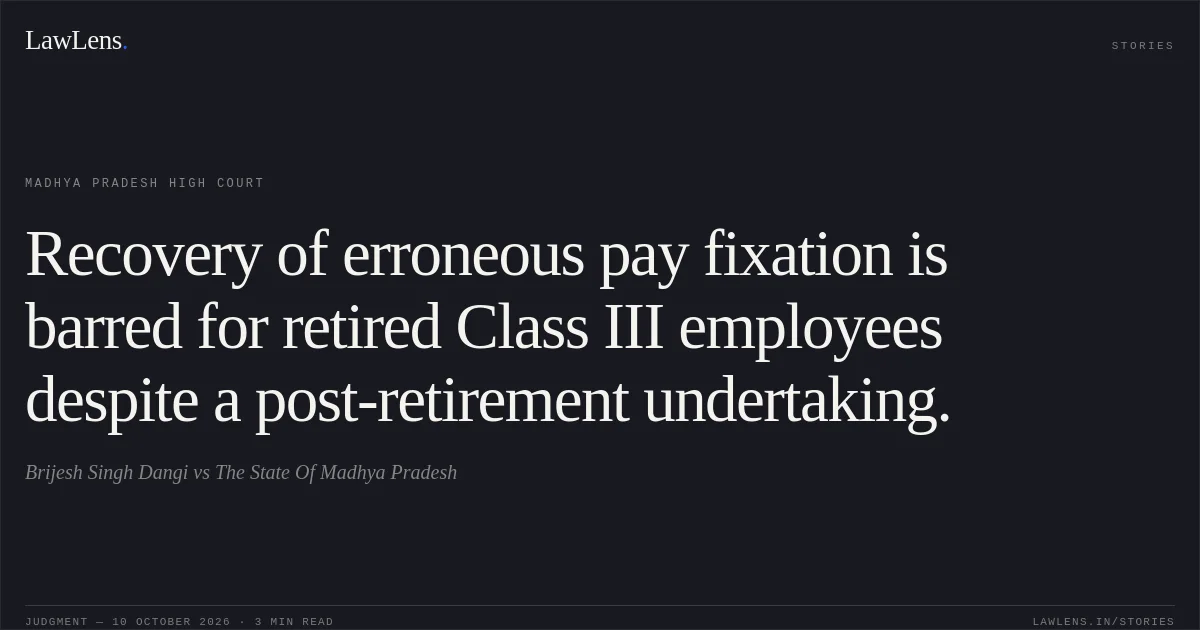
Source reference: para. 10Recovery was also barred under Rafiq Masih: the petitioner was a Class III employee, had retired before the recovery order was issued, and the challenged payments began more than five years before that order. The Court therefore found the recovery impermissible.
Source reference: para. 11–12Although the petitioner had also raised lack of notice and hearing, the relief was resolved on the grounds concerning the undertaking and the Rafiq Masih categories.
Source reference: para. 3, 10–12Holding
The Court allowed the challenge to the recovery order and set aside the direction to recover ₹2,43,553.
If that amount had been recovered from the petitioner’s retiral dues, the respondents were directed to refund it with interest at 6% per annum from the date of retirement until payment; if no recovery had been made, no refund or interest was due.
Source reference: para. 12–14The respondents were given three months from receipt of the certified order to comply, failing which the amount payable would carry interest at 12% per annum from the date of entitlement until actual payment. The petition was accordingly disposed of.
Source reference: para. 12–14Original Court PDF
Brijesh Singh DangivsThe State Of Madhya Pradesh
Click to open original judgment
Original judgment, available to read, download and summarize on LawLens.in