01Facts
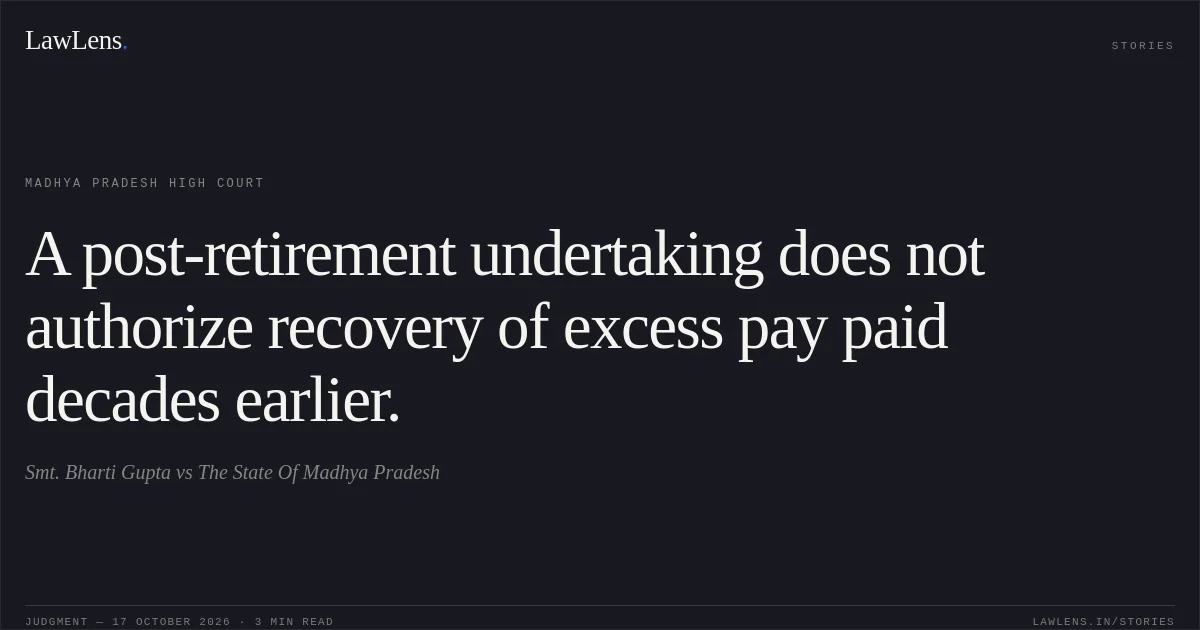
The petitioner, a Class-III Radiographer appointed on 2 March 1982, challenged the order dated 18 January 2016 directing recovery of ₹33,040 for alleged excess payment arising from erroneous fixation of pay under the Sixth Pay Commission for the period from 1 July 2006 to 1 July 2015.
¶ 2The respondents asserted that the petitioner had been paid basic pay of ₹14,620 plus ₹2,800 Grade Pay, whereas he was allegedly entitled to basic pay of ₹11,740, resulting in excess payment of ₹2,880.
¶ 5The pay was retrospectively reduced and the petitioner’s last pay was re-fixed at ₹16,220, affecting his retiral benefits.
¶ 3, 8The recovery was ordered without issuing notice or providing an opportunity of hearing.
The respondents relied upon an indemnity bond/undertaking furnished by the petitioner and Rule 65 of the M.P. Civil Services (Pension) Rules, 1976.
¶ 502Issues
i.Whether the respondents could retrospectively reduce the petitioner’s pay and order recovery of alleged excess payments without issuing notice or providing an opportunity of hearing.
¶ 3–4, 8ii.Whether recovery of alleged excess payments from a Class-III employee, made over a period exceeding five years and sought near retirement, was impermissible under State of Punjab v. Rafiq Masih.
¶ 7–9iii.Whether the indemnity bond/undertaking furnished by the petitioner authorised recovery despite the hardship limitations and procedural requirements governing such recovery.
¶ 5, 10–1103Law Applied
The Court applied the principles of natural justice, holding that an adverse decision affecting pay and retiral benefits cannot ordinarily be made without notice and an opportunity of hearing.
¶ 8Relying on State of Punjab v. Rafiq Masih (White Washer), (2015) 4 SCC 334, it held that recovery is generally impermissible from Class-III/Class-IV employees, retired employees or employees nearing retirement, and where excess payments have been made for more than five years before the recovery order.
¶ 7Although High Court of Punjab & Haryana v. Jagdev Singh, (2016) 14 SCC 267, recognises the relevance of a valid undertaking, the Court relied on the Full Bench decision in The State of M.P. v. Jagdish Prasad Dubey, W.A. No. 815 of 2017, order dated 6 March 2024, which held that an undertaking given at the time of pay refixation cannot automatically defeat the hardship principles in Rafiq Masih, and that recovery under Rules 65 and 66 of the M.P. Civil Services (Pension) Rules, 1976 requires compliance with the prescribed procedure.
¶ 10The Court further relied on Central Inland Water Transport Corporation Ltd. v. Brojo Nath Ganguly, (1986) 3 SCC 156, in holding that a forced undertaking is not enforceable unless shown to have been given voluntarily.
¶ 1104Reasoning
The Court found that the petitioner was a Class-III employee and that the alleged excess payments related to a period substantially exceeding five years before the recovery order. The recovery was also initiated at or near the petitioner’s retirement and affected his retiral dues, thereby squarely attracting categories (i), (ii), and (iii) of Rafiq Masih.
¶ 9There was no allegation or evidence that the petitioner had obtained the higher pay through fraud, misrepresentation, or suppression of material facts.
¶ 8Further, the respondents had retrospectively reduced the petitioner’s pay without issuing notice or granting a hearing, violating natural justice.
¶ 8The indemnity bond could not cure these defects or authorise recovery contrary to the hardship safeguards recognised in Rafiq Masih.
Applying Jagdish Prasad Dubey, the Court held that the undertaking could not be enforced against the petitioner for recovery of payments made years earlier, particularly when the State had not established that it was voluntarily furnished.
¶ 10–1105Holding
The Court held that the recovery order dated 18 January 2016 was legally unsustainable because it was passed retrospectively, without compliance with natural justice, and in circumstances where recovery was impermissible under Rafiq Masih.
¶ 12The impugned recovery order was quashed.
¶ 13The respondents were directed to refund the entire amount sought to be recovered or already recovered from the petitioner within three months from production of a certified copy of the judgment.
¶ 13The writ petition was accordingly disposed of.
¶ 14Original Court PDF
Ram Prakash YadavvsThe State Of Madhya Pradesh
Click to open original judgment
Original judgment, available to read, download and summarize on LawLens.in