Facts
The petitioner, initially appointed as a Constable on 21 December 1982, was promoted as Head Constable and subsequently as Assistant Sub-Inspector.
Source reference: paras. 2–4Pursuant to the State Government policy dated 24 January 2008, he was granted the benefit of the Second Time Scale with effect from 1 April 2006 by order dated 26 November 2012.
Source reference: paras. 2–4The benefit continued until December 2015.
Source reference: paras. 2–4By orders dated 18 January 2016 and 24 October 2016, the respondents withdrew the benefit and directed recovery of the alleged excess payment, including recovery from the petitioner’s retiral dues.
Source reference: paras. 2–4The petitioner challenged the orders under Article 226, alleging violation of natural justice, absence of fraud or misrepresentation, and impermissibility of recovery from a Class-III employee.
Source reference: paras. 2–4The State contended that the amount had been paid in excess pursuant to a treasury objection and was recoverable as having been received without authority of law.
Source reference: para. 5Issues
Whether the respondents could withdraw the Second Time Scale benefit and order recovery of the alleged excess payment without affording the petitioner an opportunity of hearing.
Source reference: paras. 3, 8Whether recovery of the alleged excess payment was permissible when the petitioner, a Class-III employee, had not committed fraud, misrepresentation, or suppression of facts.
Source reference: paras. 4, 9Whether any undertaking or indemnity bond furnished by the petitioner could justify recovery from his salary or retiral dues.
Source reference: paras. 10–11Law Applied
The Court applied Article 226 of the Constitution and the principles of natural justice, holding that withdrawal of a granted monetary benefit and consequential recovery must not ordinarily be undertaken without a fair opportunity of hearing.
Source reference: paras. 3, 8It relied principally on State of Punjab v. Rafiq Masih (White Washer), (2015) 4 SCC 334, which renders recovery of mistaken excess payments impermissible in specified situations, including recovery from Class-III/Class-IV employees, retired employees or those nearing retirement, and cases involving hardship or inequity.
Source reference: para. 7The Court also considered High Court of Punjab and Haryana v. Jagdev Singh, (2016) 14 SCC 267, concerning recovery based on an undertaking.
Source reference: para. 10The Court applied the Full Bench decision in State of Madhya Pradesh v. Jagdish Prasad Dubey, W.A. No. 815 of 2017, decided on 6 March 2024, which held that recovery based on an undertaking remains subject to the hardship principles in Rafiq Masih and that an undertaking given at the stage of pay fixation is generally a forced and unenforceable undertaking unless shown to have been voluntarily given.
Source reference: para. 10The Court further relied on Central Inland Water Transport Corporation Ltd. v. Brojo Nath Ganguly, (1986) 3 SCC 156, regarding the unenforceability of forced undertakings.
Source reference: para. 11Reasoning
The Court found that the Second Time Scale had been granted by the respondents themselves under the applicable policy and had continued for several years; there was no material showing that the petitioner had procured the benefit through fraud, misrepresentation, or concealment.
Source reference: para. 8The withdrawal and recovery orders were issued without providing him an opportunity of hearing, thereby offending natural justice.
Source reference: para. 8Since the petitioner was a Class-III employee and the alleged excess payment was not attributable to any fault on his part, his case squarely fell within the first exception identified in Rafiq Masih.
Source reference: para. 9The Court further held that any undertaking or indemnity bond could not independently validate the recovery because the State had not established that it was voluntarily furnished.
Source reference: paras. 10–11Under Jagdish Prasad Dubey, an undertaking obtained at the time of pay fixation is treated as a forced undertaking and cannot override the protection against inequitable recovery.
Source reference: paras. 10–11Holding
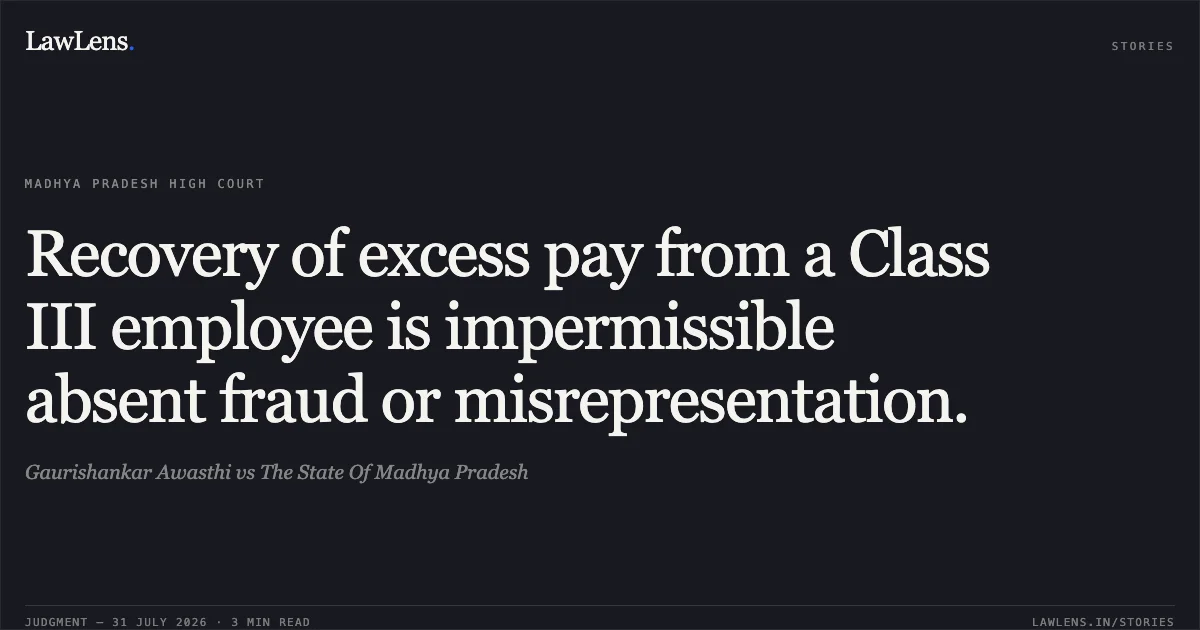
The Court held that the recovery orders dated 18 January 2016 and 24 October 2016 were unsustainable because they were passed without hearing the petitioner and because recovery from him was impermissible under Rafiq Masih and the applicable Full Bench principles.
Both orders were quashed.
Source reference: para. 13The respondents were directed to refund the entire amount sought to be recovered or already recovered pursuant to those orders within three months from production of a certified copy of the judgment.
Source reference: para. 13The writ petition was accordingly disposed of.
Source reference: para. 14Original Court PDF
Gaurishankar AwasthivsThe State Of Madhya Pradesh
Click to open original judgment
Original judgment, available to read, download and summarize on LawLens.in


