Facts
The petitioner was promoted from Upper Division Teacher to Headmaster by order dated 12 February 2026 and retired on 31 May 2026.
Source reference: pp. 2–4On 9 June 2026, after an audit objection, the Block Education Officer ordered recovery of ₹10,93,456, alleging excess payment arising from incorrect pay fixation during 2016–2026.
Source reference: pp. 2–4The petitioner relied on earlier orders confirming his first time-scale pay fixation and challenged the recovery, stating that there had been no misrepresentation or fraud on his part.
Source reference: pp. 2–4The State defended the recovery as following the audit objection.
Source reference: p. 4Issues
1. Whether recovery of alleged excess pay could be made from the petitioner after his retirement, in the absence of fraud or misrepresentation.
Source reference: pp. 4–72. Whether the respondents could reconsider the petitioner’s pay fixation notwithstanding the setting aside of the recovery order.
Source reference: p. 7Law Applied
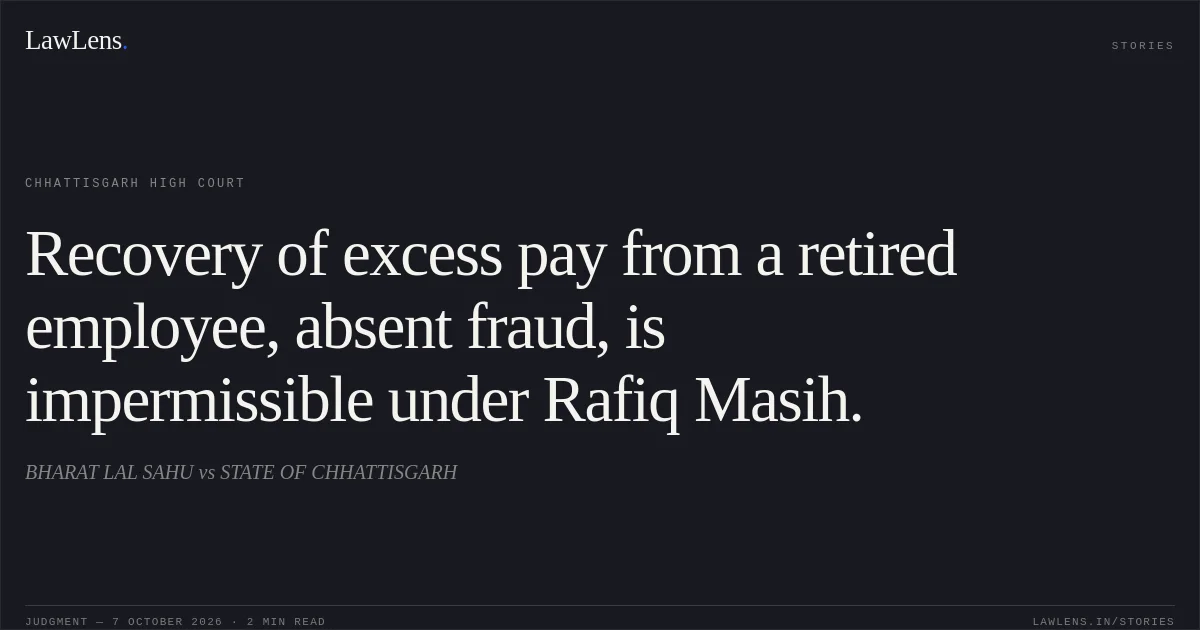
The Court applied State of Punjab v. Rafiq Masih (White Washer), (2015) 4 SCC 334, which identifies circumstances in which recovery of mistaken excess payments is impermissible, including recovery from retired employees, recovery for payments made more than five years before the recovery order, and cases where recovery would be inequitable or harsh.
Source reference: pp. 5–6It also relied on Jogeshwar Sahoo v. District Judge, Cuttack, 2025 INSC, SLP (C) No. 5918 of 2024, concerning recovery from retired employees where the excess payment was not attributable to fraud or misrepresentation and the employee had not been given an opportunity of hearing.
Source reference: p. 5The Court noted that protection from recovery does not prevent the employer from examining pay fixation afresh in accordance with law, provided the employee receives an opportunity of hearing and a reasoned order is passed.
Source reference: p. 7Reasoning
The alleged excess payment arose from the respondents’ pay-fixation decision, and the respondents did not allege that the petitioner had procured it through fraud, misrepresentation, or suppression of facts.
Source reference: p. 6The recovery was ordered after the petitioner’s retirement and related to payments made over a period extending more than five years before the order; the Court therefore held that recovery was impermissible under Rafiq Masih.
Source reference: pp. 5–7However, it did not determine whether the pay fixation itself was correct and left that question open for reconsideration after a hearing.
Source reference: p. 7Holding
The Court allowed the petition and set aside the recovery order dated 9 June 2026 and the consequential recovery of ₹10,93,456.
It reserved liberty to the respondents to reconsider the petitioner’s pay fixation in accordance with law, after providing an adequate opportunity of hearing; any recovery remains subject to Rafiq Masih.
Source reference: p. 7The respondents were directed to refund any amount recovered or withheld under the impugned order, release any remaining admissible retiral dues, and complete the exercise within 50 days of receiving a certified copy of the order.
Source reference: p. 8Original Court PDF
BHARAT LAL SAHUvsSTATE OF CHHATTISGARH
Click to open original judgment
Original judgment, available to read, download and summarize on LawLens.in