Facts
The appellant was convicted by the Special Judge, Sonepur, under Section 354 IPC and sentenced to one year’s rigorous imprisonment; he was acquitted of charges under Section 341 IPC and the SC/ST (Prevention of Atrocities) Act
Source reference: p. 1–2, 6The prosecution alleged that the appellant used criminal force against the victim at a stream, causing her to fall and sustain an abrasion, and fled when her husband arrived
Source reference: p. 2–3On appeal, the High Court upheld the conviction and considered whether the sentence should be modified in light of the long passage of time and the appellant’s lack of recorded criminal antecedents
Source reference: p. 6–7Issues
Whether the evidence justified upholding the appellant’s conviction under Section 354 IPC
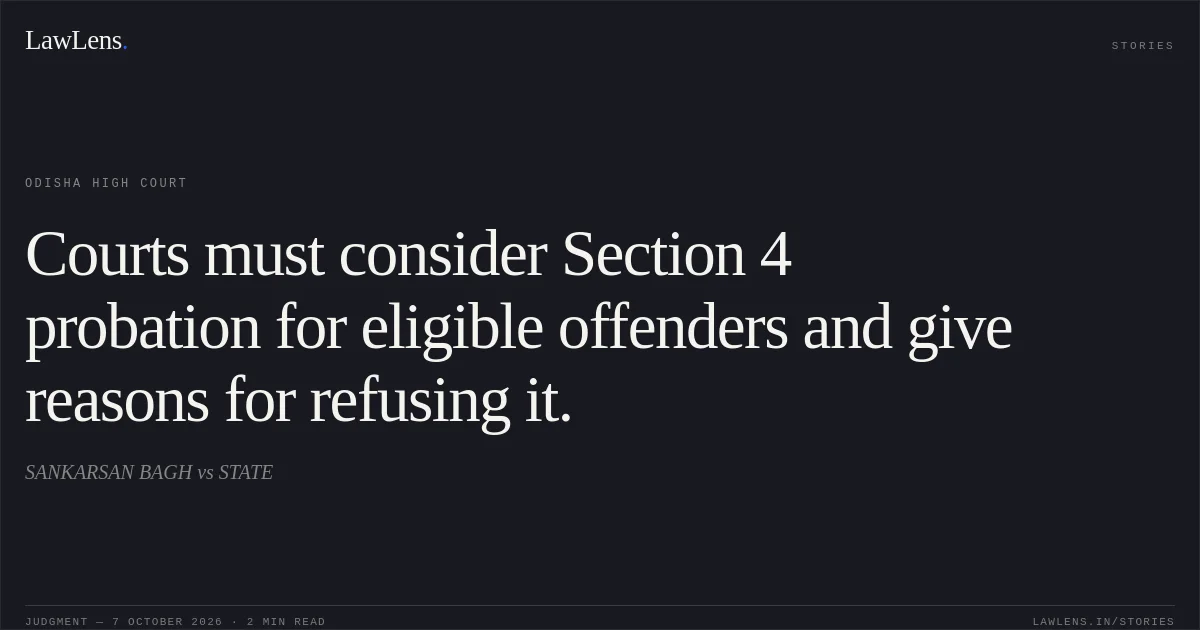
Source reference: p. 6–7Whether, in place of imprisonment, the appellant should receive the benefit of release on probation under Section 4 of the Probation of Offenders Act, 1958
Source reference: p. 7–9Law Applied
Section 354 IPC criminalises assault or use of criminal force against a woman with the requisite intent to outrage her modesty
Source reference: p. 5–6Section 4 of the Probation of Offenders Act, 1958 permits release on probation in qualifying cases and requires the court to consider that option where applicable; under Section 361 CrPC, a court that could have applied the Probation Act but does not do so must record special reasons
Source reference: p. 8–9Relying on Chellammal and Another v. State represented by the Inspector of Police, 2025 INSC 540, the Court stated that probation is not an offender’s right, but the court has a duty to consider its applicability and give reasons if it declines to grant it
Source reference: p. 7–9Reasoning
The Court found the victim’s testimony cogent and consistent. Her account was materially corroborated by her husband, who arrived on hearing her cries and saw the appellant fleeing, and by medical evidence of an abrasion consistent with the occurrence
Source reference: p. 6The defect in the investigation under Rule 7 of the SC/ST Rules supported the acquittal under that special statute but did not undermine the independently established offence under Section 354 IPC
Source reference: p. 6As to sentence, the Court considered the nearly three-decade interval since the occurrence, the prolonged criminal proceedings, the absence of adverse criminal antecedents, and the absence of any indication that the appellant had misused his liberty; it therefore considered probation appropriate
Source reference: p. 7–9Holding
The Court affirmed the conviction under Section 354 IPC but modified the sentence.
It directed the appellant’s release under Section 4 of the Probation of Offenders Act for six months, subject to executing a bond of Rs. 5,000 with one surety for the like amount within one month, undertaking to appear and receive sentence if called upon, maintain peace and good behaviour, and remain under the supervision of the concerned Probation Officer. The appeal was partly allowed
Source reference: p. 10Acts & Sections Cited
7 provisions across 4 statutes referred to in this judgment. Each provision opens on LawLens.
Code of Criminal Procedure, 19733
Indian Penal Code, 18602
Scheduled Castes and the Scheduled Tribes (Prevention of Atrocities) Act, 19891
Probation of Offenders Act, 19581
Original Court PDF
SANKARSAN BAGHvsSTATE
Click to open original judgment
Original judgment, available to read, download and summarize on LawLens.in