Facts
The petitioner, a Class III employee, had his pay fixed by the department over several decades under various pay revision rules
Source reference: para. 2On 13.12.2014, based on an objection by the Joint Director of Treasury, Accounts and Pension, the respondents ordered a re-fixation of his pay and issued an amended fixation order on 23.12.2015, just prior to his retirement on 31.05.2016
Source reference: para. 2This resulted in an order for recovery of alleged excess payments. The petitioner challenged these orders via a writ petition under Article 226 of the Constitution, contending he had not misrepresented any facts and that recovery at the verge of retirement was impermissible
Source reference: para. 3Issues
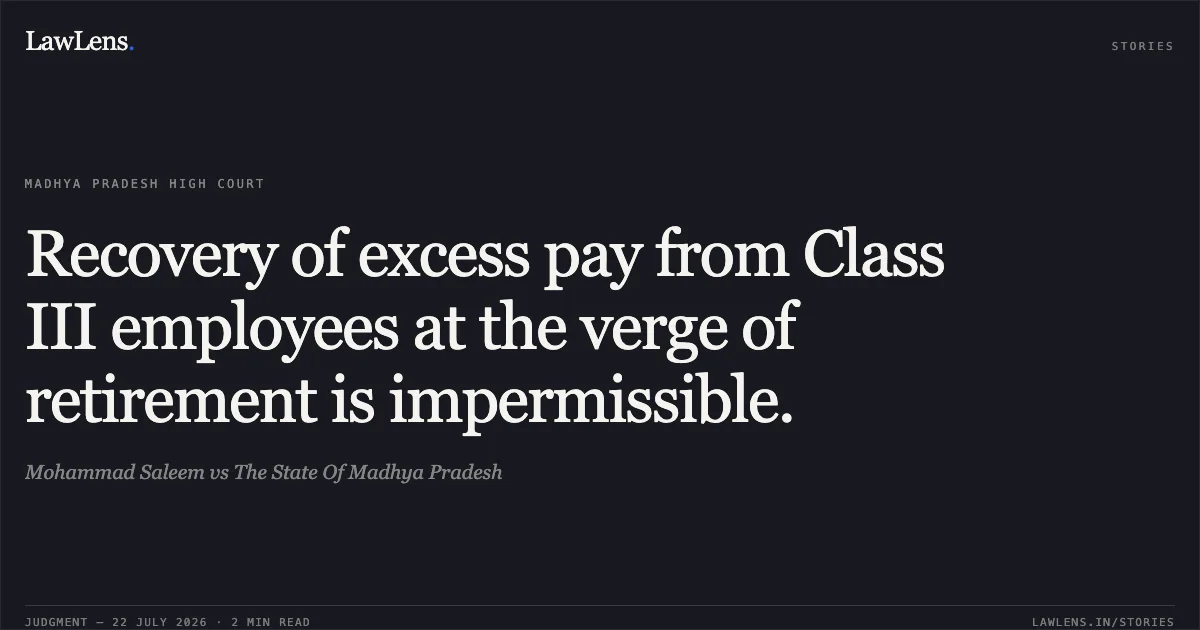
1. Whether the recovery of excess pay from a Class III employee at the verge of his retirement is legally permissible under the principles of equity and hardship
Source reference: para. 6, 72. Whether an undertaking/indemnity bond submitted by an employee at the time of pay fixation justifies the recovery of excess payments made years prior
Source reference: para. 8, 9Law Applied
State of Punjab & Others v. Rafiq Masih (White Washer) & Others (2015), which prohibits recovery from Class III/IV employees or those due to retire within one year of the recovery order
Source reference: para. 6The State of M.P. & Others v. Jagdish Prasad Dubey (2024), which held that undertakings given during pay re-fixation are often "forced" and unenforceable for recovering payments made decades ago
Source reference: para. 8High Court of Punjab and Haryana & Others v. Jagdev Singh (2016) regarding undertakings
Source reference: para. 8Central Inland Water Transport Corp. Ltd. v. Brojo Nath Ganguly (1986) regarding the validity of voluntary versus forced undertakings
Source reference: para. 9Reasoning
The court found that the petitioner squarely fell within the protective ambit of the Rafiq Masih guidelines as a Class III employee facing recovery at the "verge of retirement"
Source reference: para. 7The court noted there was no evidence of fraud or misrepresentation by the petitioner; the excess payment resulted solely from the department’s own mistake
Source reference: para. 7Regarding the State’s argument that the petitioner had signed an indemnity bond, the court applied the Jagdish Prasad Dubey ruling, determining that such undertakings are generally forced and cannot be used to justify recovering amounts paid years prior unless proven to be voluntary
Source reference: para. 9Since the State failed to prove the undertaking was voluntary, it was deemed unenforceable
Source reference: para. 9Holding
The court held that the recovery was iniquitous and legally unsustainable
The court allowed the petition and quashed the impugned orders (Annexures P/1 and P/2) for re-fixation and recovery. The respondents were directed to refund the entire amount recovered or sought to be recovered within two months, failing which the amount would carry interest at 6% per annum
Source reference: para. 10, 11Acts & Sections Cited
2 provisions across 1 statute referred to in this judgment. Linked provisions open on LawLens.
M.P. Civil Services (Pension) Rules, 19762
Original Court PDF
Mohammad SaleemvsThe State Of Madhya Pradesh
Click to open original judgment
Original judgment, available to read, download and summarize on LawLens.in