Facts
The Petitioner, a Constable (Class-III employee) appointed on 09.01.1991, challenged a recovery order dated 08.01.2026 issued by the Senior Superintendent of Police, Raipur.
Source reference: para. 1-2The order sought to recover ₹6,10,111 for excess payments made between January 2006 and December 2025 due to incorrect pay fixation.
Source reference: para. 3, 5It was undisputed that the excess payment was not a result of any fraud or misrepresentation by the Petitioner.
Source reference: para. 5, 11The Respondent-State further sought an undertaking from the Petitioner to deduct this amount from his retiral dues.
Source reference: para. 3, 7Issues
1. Whether the recovery of excess pay from a Class-III employee is legally permissible when the payment was made due to an error by the department and not due to fraud by the employee.
Source reference: para. 2, 62. Whether an undertaking or consent for recovery obtained from a Class-III or Class-IV employee overrides the protections against recovery established by the Supreme Court.
Source reference: para. 7-8Law Applied
The Court primarily applied the principles established in State of Punjab v. Rafiq Masih (White Washer), (2015) 4 SCC 334, which prohibits recovery from Class-III/Class-IV employees or when the excess payment covers a period exceeding five years.
Source reference: para. 6It relied on Thomas Daniel v. State of Kerala, 2022 SCC OnLine SC 536, affirming that relief against recovery is granted not because of a right to the money, but to prevent hardship.
Source reference: para. 2, 6The court applied the clarification from High Court of Punjab and Haryana v. Jagdev Singh, (2016) 14 SCC 267, as interpreted by the Division Bench in State of CG v. Labha Ram Dhruv (WA No. 264/2020), holding that even if an undertaking is given, recovery remains impermissible for Class-III and Class-IV employees.
Source reference: para. 8-9Reasoning
The Court observed that the Petitioner holds a Class-III post and the department admitted the excess payment resulted from their own wrong pay fixation, excluding any element of fraud by the Petitioner.
Source reference: para. 5Applying the Rafiq Masih criteria, the Court found the recovery "iniquitous and harsh" as it targeted a lower-tier employee for a decade-old administrative error.
Source reference: para. 6, 11The Court reasoned that such consent is often obtained under the pressure of withholding retiral dues.
Source reference: para. 7Following the Labha Ram Dhruv precedent, the Court clarified that Jagdev Singh did not overrule Rafiq Masih but merely distinguished it; thus, the protection for Class-III/IV employees remains absolute regardless of an undertaking.
Source reference: para. 8-9Holding
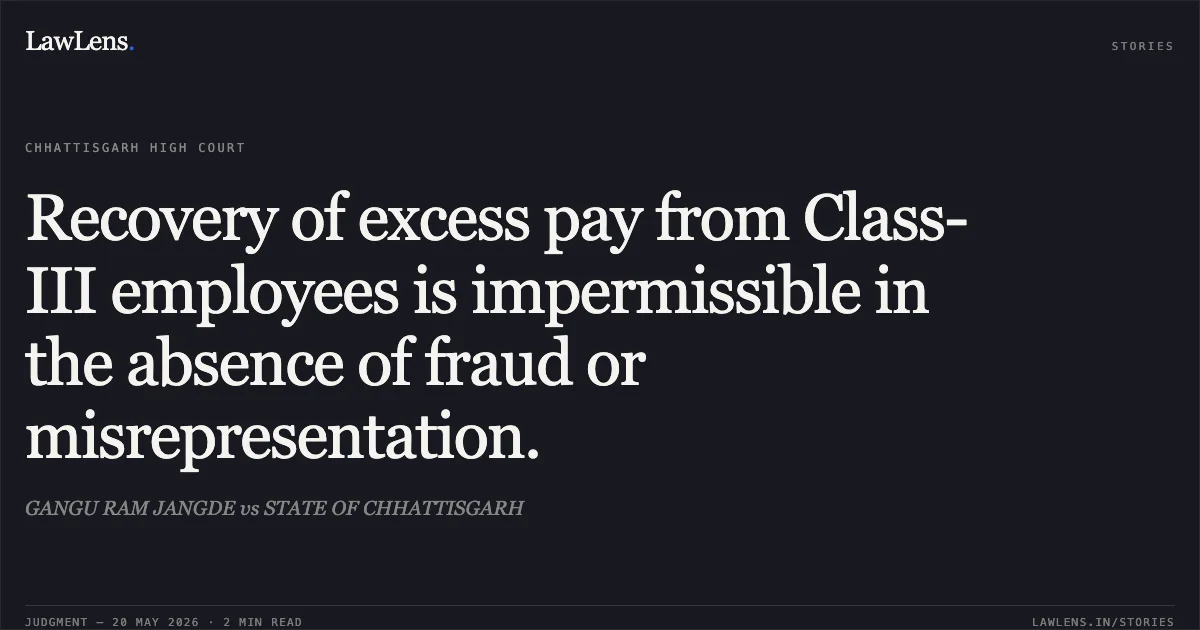
The Court answered that recovery from a Class-III employee in these circumstances is impermissible in law.
The Writ Petition was allowed, and the recovery order dated 08.01.2026 was quashed. The Respondents were directed to refund any recovered or deducted amounts to the Petitioner within four months, failing which the amount would carry an interest of 8% p.a. from the date of the order until realization.
Source reference: para. 13Original Court PDF
GANGU RAM JANGDEvsSTATE OF CHHATTISGARH
Click to open original judgment
Original judgment, available to read, download and summarize on LawLens.in