Facts
The petitioner was appointed as a Constable on 22 June 1984 and subsequently served as an Assistant Sub-Inspector. He retired on attaining the age of superannuation on 31 May 2025.
Source reference: paras. 2–4; p. 1–2Shortly before retirement, the authorities issued the impugned order dated 23 May 2025 and recovered ₹2,18,588 from his retiral benefits, comprising ₹1,04,311 as the alleged excess principal payment and ₹1,14,277 as interest. The petitioner contended that the recovery related to payments made more than five years earlier, resulted from departmental pay fixation, and was not attributable to any fraud or misrepresentation on his part. He further alleged that no show-cause notice or opportunity of hearing was provided and that he was compelled to furnish an undertaking consenting to the recovery.
Source reference: paras. 2–4; p. 1–2Issues
Whether recovery of the alleged excess payment from the petitioner’s retiral benefits was legally permissible when the petitioner was a Class-III employee, had retired, and had neither misrepresented facts nor committed fraud?
Source reference: paras. 6–9; pp. 3–6Whether recovery could be effected without issuing a show-cause notice or affording the petitioner an opportunity of hearing?
Source reference: paras. 2–4; pp. 1–2Whether the petitioner was entitled to refund of the recovered amount with interest?
Source reference: para. 9; p. 6Law Applied
The Court applied the principles laid down by the Supreme Court in State of Punjab v. Rafiq Masih (Whitewasher), (2015) 4 SCC 334, that recovery of excess payments is impermissible, inter alia, from Class III/Class IV employees, from retired employees or employees due to retire within one year, where the excess payment was made for more than five years before the recovery order, and where recovery would be harsh, arbitrary, or iniquitous.
Source reference: para. 7; pp. 3–5The Court further relied on MP Power Transmission Co. Ltd. v. Lalita Rathore, W.A. No. 2772 of 2025, which held that recovery arising from an employer’s erroneous pay fixation, absent fraud or misrepresentation by the employee, is unjustified, particularly where it imposes a substantial burden on a Class-III employee after several years; refund with interest may appropriately be directed.
Source reference: para. 8; pp. 5–6The Court also recognised the general principle of natural justice that an order having civil consequences should not ordinarily be passed without notice and an opportunity of hearing.
Source reference: para. 3; p. 2Reasoning
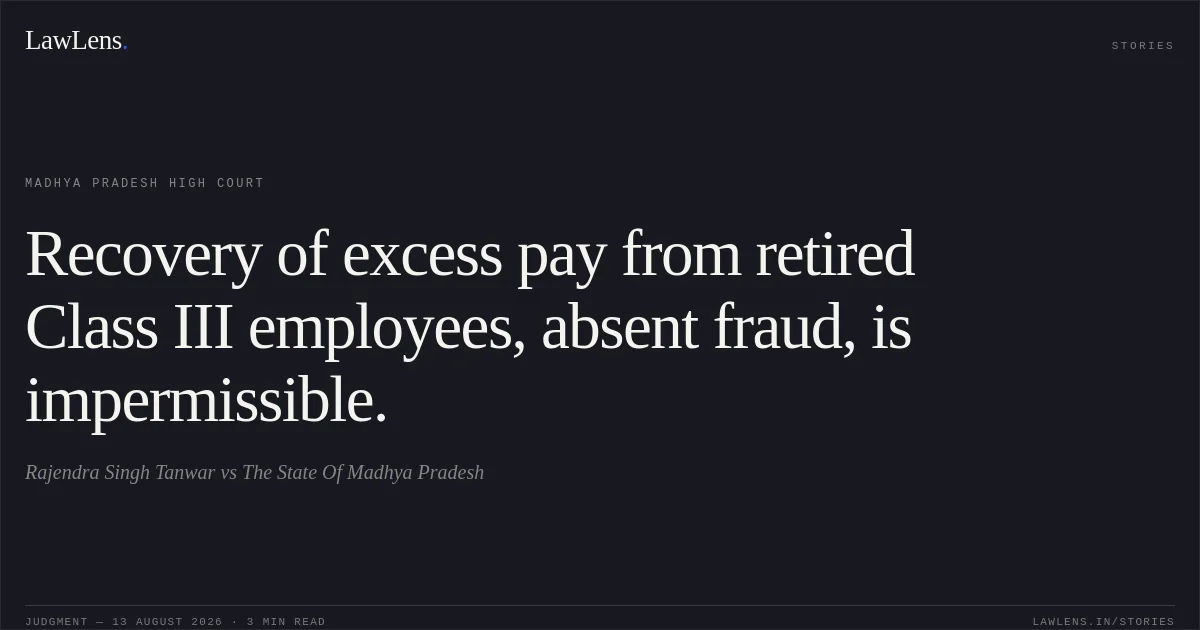
The Court found that the petitioner was a Class-III employee who had retired in 2025 and that the recovery was made from his retiral benefits. It was undisputed that the excess payment resulted from departmental action and that the petitioner had neither misrepresented facts nor committed fraud. Applying Rafiq Masih, the Court held that the recovery fell within multiple impermissible categories: it was made from a Class-III employee, after retirement, and related to payments made more than five years earlier.
Source reference: paras. 6–7; pp. 3–5The requirement that the petitioner furnish an undertaking did not validate an otherwise inequitable recovery, particularly when the amount was deducted from retirement benefits. Consistent with Lalita Rathore, the Court treated the recovery as unjust, improper, and arbitrary because the petitioner was being made to bear the financial consequences of the department’s pay-fixation error.
Source reference: paras. 8–9; pp. 5–6Holding
The Court allowed the petitioner’s challenge to the recovery and held that recovery of ₹2,18,588 from his retiral benefits was ex facie unjust and improper.
The respondents were directed to refund the entire recovered amount within eight weeks from receipt of the certified copy of the order and to pay interest at 6% per annum from the date of recovery until actual payment. The writ petition was disposed of accordingly.
Source reference: para. 9; p. 6Original Court PDF
Rajendra Singh TanwarvsThe State Of Madhya Pradesh
Click to open original judgment
Original judgment, available to read, download and summarize on LawLens.in