Facts
The petitioner, a retired Work Charged Mason Grade-II holding a Class-IV post, retired on 31 May 2025.
Source reference: paras. 1–3, 7Following an objection by the Treasury office during processing of his pension and retiral benefits, the respondents re-examined his 2020 pay fixation and, by order dated 25 March 2026, directed recovery of ₹82,754 as excess salary.
Source reference: paras. 1–3, 7The petitioner challenged the recovery, asserting that the excess payment resulted from the employer’s act, without any fraud or misrepresentation on his part, and that he had received no prior hearing.
Source reference: paras. 1–3, 7He sought, among other relief, quashing of the recovery and release or refund of amounts withheld or recovered
Source reference: paras. 1–3, 7Issues
1. Whether the respondents could recover alleged excess salary from the petitioner after his retirement, where he held a Class-IV post and the alleged excess arose from employer-made pay fixation without fraud or misrepresentation by him
Source reference: paras. 5, 7–82. Whether the impugned pay refixation and recovery orders were sustainable when no show-cause notice or effective opportunity of hearing had been provided
Source reference: paras. 5, 93. Whether the respondents could reconsider the petitioner’s pay fixation notwithstanding that recovery of the alleged excess payment was impermissible
Source reference: para. 10Law Applied
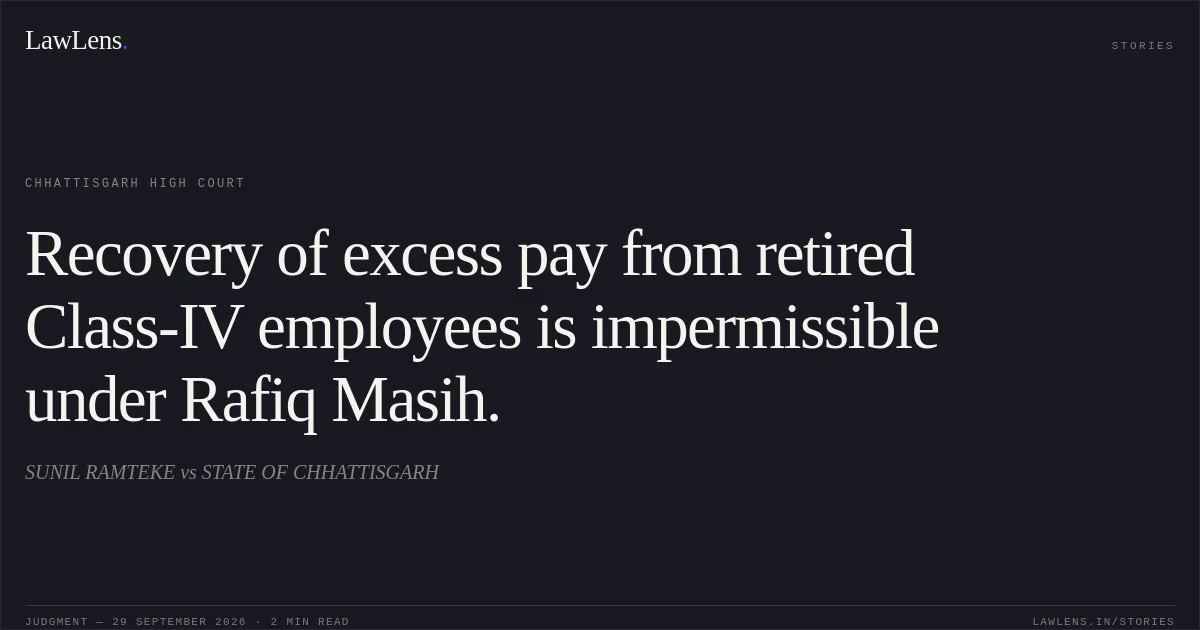
The Court applied State of Punjab v. Rafiq Masih (White Washer), (2015) 4 SCC 334, which identifies circumstances in which recovery of excess payments by an employer is impermissible, including recovery from Class-III or Class-IV employees; retired employees or employees due to retire within one year; and recovery of payments made for a period exceeding five years before the recovery order.
Source reference: para. 6Recovery may also be barred where it would be inequitable, harsh, or arbitrary
Source reference: para. 6The Court also applied the principles of natural justice, requiring an adequate opportunity of hearing before an adverse pay-refixation and recovery decision
Source reference: para. 9Reasoning
The Court found that the petitioner had retired before the recovery order, had held a Class-IV post, and had not procured the alleged excess payment through fraud, misrepresentation, or suppression; the excess, if any, appeared attributable to the employer
Source reference: para. 7It held that the case fell within the protections identified in Rafiq Masih, noting the petitioner’s retired status, Class-IV classification, and the period associated with the disputed pay fixation
Source reference: para. 8Independently, the absence of a show-cause notice or effective hearing vitiated the impugned action
Source reference: para. 9The Court nevertheless distinguished the question of recovery from the correctness of the pay fixation itself: the respondents could examine pay fixation afresh, but only after hearing the petitioner and issuing a reasoned order
Source reference: para. 10Holding
The Court set aside the order dated 25 March 2026 and the consequential recovery of ₹82,754.
It permitted the respondents to reconsider pay fixation in accordance with law after giving the petitioner an adequate hearing, while clarifying that any recovery would remain subject to Rafiq Masih
Source reference: para. 11The respondents were directed to release and refund any amount recovered or withheld pursuant to the impugned order and to release any remaining admissible retiral dues within 50 days of receiving a certified copy of the order.
Source reference: paras. 12–13The petition was disposed of with no order as to costs
Source reference: paras. 12–13Original Court PDF
SUNIL RAMTEKEvsSTATE OF CHHATTISGARH
Click to open original judgment
Original judgment, available to read, download and summarize on LawLens.in