Facts
The applicant, a Senior Telecom Office Assistant (Group ‘C’), retired from service on 30.11.2006 with a last drawn basic pay of Rs. 10,950
Source reference: p. 2Following his superannuation, the respondents alleged that his pay had been erroneously fixed and issued an order on 08.02.2007 revising his pay downward to Rs. 10,725
Source reference: p. 2Consequently, the respondents recovered Rs. 40,915 from the applicant's retiral dues, specifically from his Death-cum-Retirement Gratuity (DCRG) and leave encashment
Source reference: p. 2The applicant contended that the pay fixation was performed by the department itself without any fraud or misrepresentation on his part, and that the recovery and pension reduction were implemented without affording him an opportunity of hearing
Source reference: p. 2-3Issues
1. Whether the recovery of alleged excess payments from the retiral benefits of a Group ‘C’ employee, post-retirement and after a considerable lapse of time, is legally permissible
Source reference: para. 142. Whether the reduction of pension and recovery of dues without affording the employee an opportunity of hearing violates the principles of natural justice
Source reference: para. 15Law Applied
Supreme Court’s decision in State of Punjab v. Rafiq Masih (White Washer) (2015), which established that recovery from retired employees or those belonging to Group ‘C’ and ‘D’ is impermissible in law
Source reference: para. 14Thomas Daniel v. State of Kerala (2022), holding that recovery cannot be sustained in the absence of misrepresentation or fraud by the employee
Source reference: para. 14Jagdish Prasad Singh v. State of Bihar & Others (2024), which mandates that any reduction in pay scale or recovery after a long time gap is arbitrary, iniquitous, and requires adherence to the principles of natural justice
Source reference: para. 12, 15Reasoning
The Tribunal found that the applicant's pay revisions were undertaken sequentially by the department itself, which established that any alleged excess payment arose solely from departmental action rather than any fault of the applicant
Source reference: para. 11The court noted that the respondents did not allege any fraud or misrepresentation by the employee
Source reference: para. 13Applying the Rafiq Masih framework, the Tribunal observed that as a retired Group ‘C’ employee, the applicant was protected against recoveries made after a considerable lapse of time
Source reference: para. 14The court further reasoned that since the reduction of pay and recovery of dues result in "drastic civil as well as evil consequences," such actions are punitive in nature and cannot be sustained if undertaken without a prior hearing
Source reference: para. 15The Tribunal concluded that the department's belated rectification of an internal error at the cost of a retired employee was inequitable
Source reference: para. 12Holding
The Tribunal allowed the Original Application and quashed the impugned order dated 27.09.2016 to the extent that it directed recovery and the fixation of pension on reduced pay
The court held that the applicant's pension must be fixed based on his last drawn pay of Rs. 10,950
Source reference: para. 16The respondents were directed to refund the recovered amount of Rs. 40,915 to the applicant within three months and grant all consequential benefits
Source reference: para. 16Original Court PDF
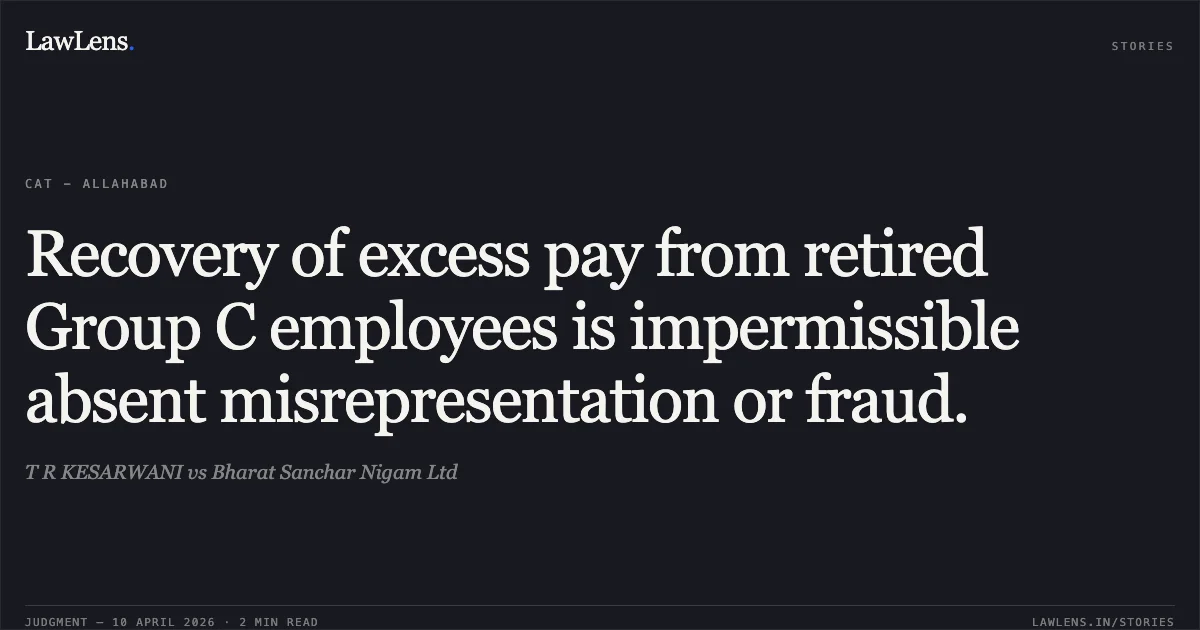
T R KESARWANIvsBharat Sanchar Nigam Ltd
Click to open original judgment
Original judgment, available to read, download and summarize on LawLens.in