Facts
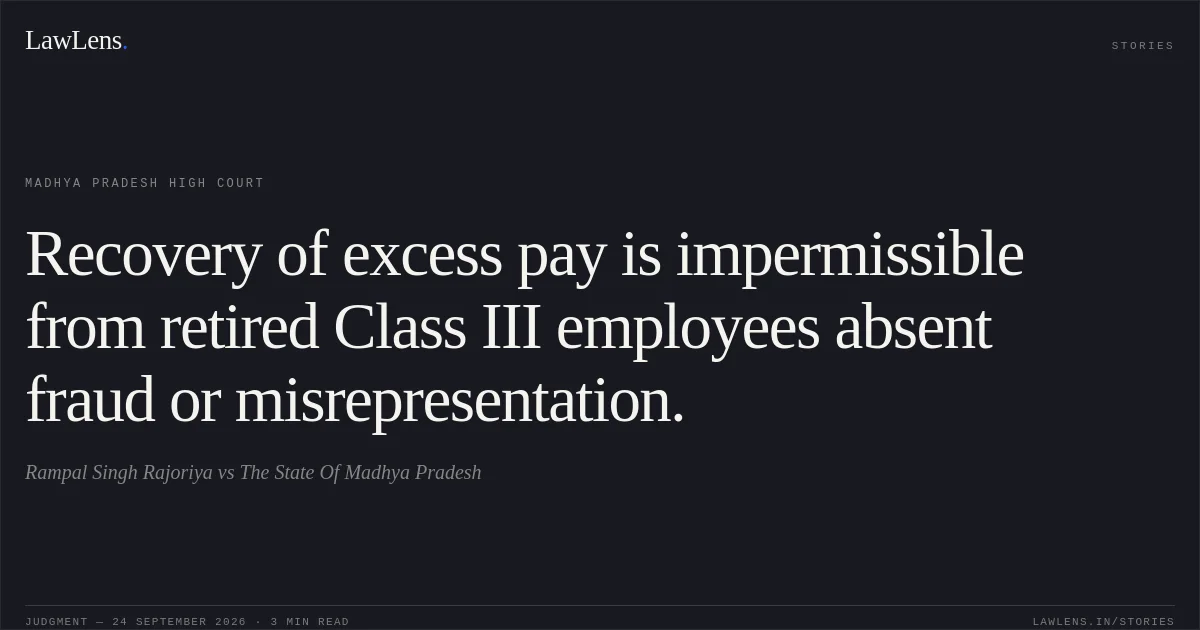
The petitioner was appointed as an Assistant Teacher in 1978 and retired as an Upper Division Teacher (UDT), a Class III post, on 29 February 2024.
Source reference: p.2During preparation of his pension papers, the respondents alleged that his pay had been wrongly fixed from 8 September 1978 onwards and ordered recovery of ₹4,95,052, comprising ₹1,97,215 towards alleged excess payment and ₹2,97,837 as interest.
Source reference: p.2; p.7The recovery was initiated without issuing a show-cause notice or granting an opportunity of hearing.
Source reference: p.2; p.7The petitioner contended that the alleged excess payment resulted from departmental pay fixation, that he had not committed fraud or misrepresentation, and that recovery from a retired Class III employee was impermissible.
Source reference: p.2The petitioner had already deposited ₹2,97,837 through challan.
Source reference: p.7Issues
1. Whether recovery of alleged excess salary paid over several decades could be made from the petitioner, a retired Class III employee, in the absence of fraud, misrepresentation, or a voluntary undertaking.
Source reference: p.3–4, p.6–72. Whether recovery ordered without a show-cause notice or opportunity of hearing violated the principles of natural justice.
Source reference: p.2, p.73. Whether the petitioner’s alleged appointment below the minimum age disentitled him from the protection against recovery recognised in State of Punjab v. Rafiq Masih.
Source reference: p.3, p.6–7Law Applied
The Court applied Article 226 of the Constitution and the principles governing recovery of excess payments laid down in State of Punjab v. Rafiq Masih (White Washer), (2015) 4 SCC 334, under which recovery is ordinarily impermissible from Class III/Class IV employees, retired employees, and where excess payment has continued for more than five years, particularly when recovery would be harsh or inequitable.
Source reference: p.4–5It relied on the Full Bench decision in State of Madhya Pradesh v. Jagdish Prasad Dubey, (2024) 2 M.P.L.J. 198, which held that recovery based on pay refixation undertaken decades earlier cannot ordinarily be enforced through an undertaking given at the stage of retirement, and that recovery under Rules 65 and 66 of the 1976 Rules requires compliance with the prescribed procedure.
Source reference: p.3–4The Court also relied on Jogeswar Sahoo v. District Judge, Cuttack, 2025 (3) M.P.L.J. (S.C.) 25, concerning impermissible recovery from retired ministerial employees absent fraud or misrepresentation and without a hearing.
Source reference: p.4–5The Court also relied on Ravindra Kumar Joshi v. State of Madhya Pradesh, W.P. No. 17831/2019, holding that an undertaking obtained at the time of pay fixation is unenforceable unless shown to have been given voluntarily.
Source reference: p.5–6Reasoning
The alleged excess payment arose from departmental pay fixation carried out continuously from 8 September 1978 until the petitioner’s retirement, and there was no material showing fraud, misrepresentation, concealment, or a voluntary undertaking by the petitioner.
Source reference: p.6–7The petitioner was a retired Class III employee, and the recovery was initiated only at the time of retirement, after more than four decades of service; these circumstances fell squarely within the categories identified in Rafiq Masih as ordinarily barring recovery.
Source reference: p.4–5, p.7The respondents also failed to provide a show-cause notice or hearing, rendering the recovery procedurally defective.
Source reference: p.2, p.7The Court rejected the State’s reliance on the petitioner’s alleged underage appointment, holding that the recovery was based on an alleged pay-fixation error and not on any established fraud or misrepresentation attributable to the petitioner; the legality of the initial appointment could not, by itself, justify recovery of salary paid over several decades.
Source reference: p.6–7Holding
The Court quashed the recovery of ₹4,95,052.
It directed the respondents to refund ₹2,97,837 already deposited by the petitioner through challan, together with interest at 6% per annum from the date of entitlement until actual payment; any further amount recovered was also to be refunded with 6% interest.
Source reference: p.7–8The refund was to be made within 90 days of submission of a certified copy of the order, failing which the entire amount would carry interest at 12% per annum from the date of entitlement until payment.
Source reference: p.8The writ petition was accordingly disposed of.
Source reference: p.8Original Court PDF
Rampal Singh RajoriyavsThe State Of Madhya Pradesh
Click to open original judgment
Original judgment, available to read, download and summarize on LawLens.in