Facts
The applicant, a Stenographer Grade I in Prasar Bharati, challenged recovery orders for ₹5,00,800/-
Source reference: para 1, 9Following a pay re-fixation in 2013, she received arrears and revised salary
Source reference: para 8However, a 2015 clarification led the respondents to re-fix her pay again on 23.02.2016, identifying an excess payment
Source reference: para 8, 9Although the error was detected and a revised order was issued in 2016, the respondents failed to initiate actual recovery until 2021, eventually issuing a final recovery memo on 31.07.2023
Source reference: para 13, 15, 18The applicant retired in February 2026
Source reference: para 15She contended that she had no role in the erroneous fixation and that the recovery after such a delay was prohibited by established judicial precedents
Source reference: para 2, 3Issues
1. Whether the recovery of excess pay is permissible when the error was detected within three years but the recovery was initiated after a further delay of seven years
Source reference: para 15, 182. Whether the recovery is iniquitous and harsh under the principles laid down in the Rafiq Masih case, given the applicant's Group B status and the timing of the recovery order
Source reference: para 17, 18Law Applied
The court primarily applied the principles established by the Hon'ble Supreme Court in State of Punjab v. Rafiq Masih (White Washer) (2015) 4 SCC 334, which prohibits recovery in specific situations where it would be "iniquitous or harsh"
Source reference: para 9, 16Specifically, Para 18(v) of the judgment provides a residual category where recovery is impermissible if it outweighs the equitable balance of the employer’s right to recover
Source reference: para 16, 17The court also referenced Thomas Daniel v. State of Kerala (2022) and Syed Abdul Qadir v. Union of India (2009) regarding the protection of employees against recovery when they are not at fault for the administrative error
Source reference: para 2i, 10Reasoning
The Tribunal observed that while the applicant’s case did not strictly fall under Para 18(i), (ii), or (iii) of Rafiq Masih—as she was a Group B employee and the error was technically detected within three years of the 2013 fixation—the subsequent administrative conduct was decisive
Source reference: para 17, 18The respondents identified the overpayment in February 2016 but remained inactive for seven years without satisfactory explanation
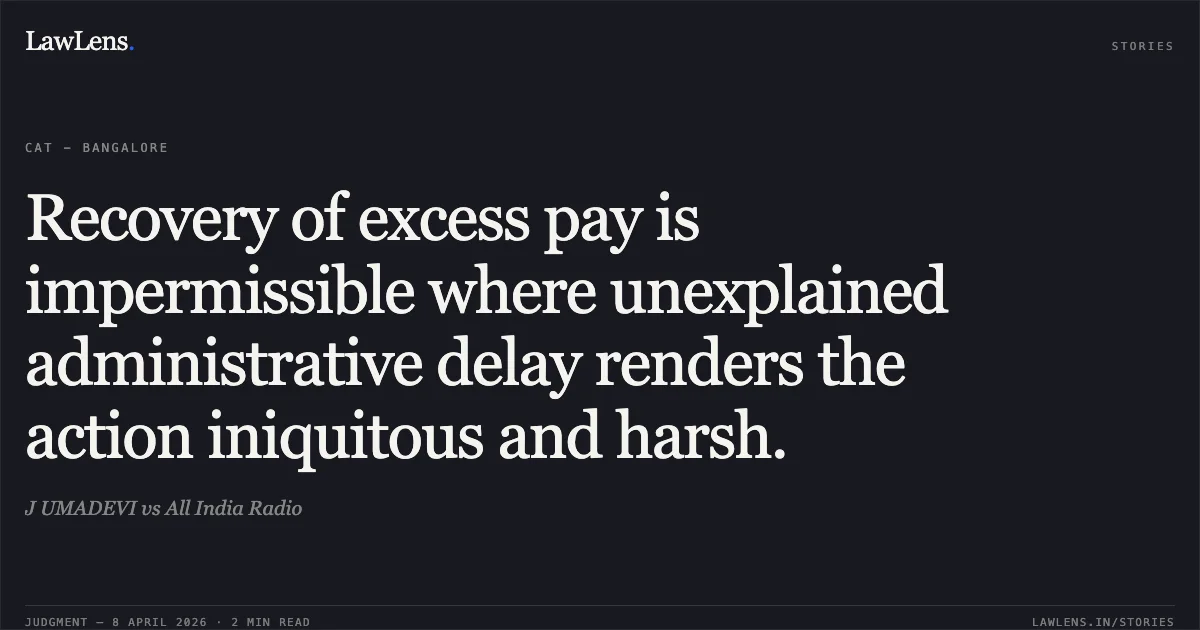
Source reference: para 16, 18The Tribunal held that this "delay and laches" shifted the balance of convenience in favor of the applicant under Para 18(v) of Rafiq Masih
Source reference: para 18It reasoned that since the applicant was not at fault for the erroneous payment, recovering a large sum after such a long interval, especially post-retirement, would be arbitrary and harsh
Source reference: para 19, 20Holding
The Tribunal allowed the Original Application and set aside the recovery memo dated 31.07.2023
It directed the respondents to refund any amount already recovered from the applicant within twelve weeks
Source reference: para 21The Tribunal further held that the respondents are at liberty to conduct an inquiry to fix responsibility and recover the amount from the officials whose inaction caused the seven-year delay in affecting the recovery
Source reference: para 20, 21No order as to costs was made
Source reference: para 21Acts & Sections Cited
1 provisions across 1 statute referred to in this judgment. Each provision opens on LawLens.
Administrative Tribunals Act, 19851
Original Court PDF
J UMADEVIvsAll India Radio
Click to open original judgment
Original judgment, available to read, download and summarize on LawLens.in