Facts
The petitioner was appointed as a Constable on January 21, 1985.
Source reference: para 2Over his tenure, he received benefits under the 5th Central Pay Commission, Kramonnati, and Time Scale of Pay, eventually being promoted to ASI in 2016.
Source reference: para 2In 2022, the Treasury Department raised an objection regarding an alleged wrong pay fixation dating back to January 23, 1999.
Source reference: para 3Consequently, the respondents issued an amended pay fixation and recovery order (Annexure P/1) without providing a show-cause notice or an opportunity for a hearing.
Source reference: para 2, 5An amount of Rs. 75,000/- was subsequently recovered based on undertakings previously signed by the petitioner in 1998 and 2017.
Source reference: para 3The petitioner challenged these orders as illegal and violative of natural justice.
Source reference: para 1Issues
1. Whether the recovery of excess payments from a Class-III employee, relating to an error occurring over five years prior, is legally permissible.
Source reference: para 62. Whether the recovery order passed without notice or hearing violates the principles of natural justice.
Source reference: para 5, 73. Whether an undertaking given by an employee under unequal bargaining power can authorize the recovery of payments made due to the employer's mistake.
Source reference: para 8Law Applied
The court primarily applied the principles established by the Supreme Court in State of Punjab & Others v. Rafiq Masih (White Washer) (2015) 4 SCC 334, which prohibits recovery from Class-III/IV employees and in cases where excess payment was made more than five years prior to the recovery order.
Source reference: para 6It further relied on Central Inland Water Transport Corporation Ltd. v. Brojo Nath Ganguly (1986) 3 SCC 156, regarding the enforceability of contracts/undertakings involving unequal bargaining power.
Source reference: para 8The coordinate bench ruling in Ravindra Kumar Joshi v. State of M.P. (W.P. No. 17831/2019), which mandates that the State prove an undertaking was voluntary rather than forced.
Source reference: para 8Reasoning
The Court observed that the petitioner is a Class-III employee and the alleged pay fixation error began in 1999, far exceeding the five-year limit established in Rafiq Masih.
Source reference: para 6, 7The Court found that the respondents admitted to issuing the recovery order without a show-cause notice, thereby violating the principles of natural justice.
Source reference: para 5, 7Regarding the undertakings (dated 1998, 2009, and 2013), the Court noted they did not specifically relate to the 1999 pay fixation.
Source reference: para 7Furthermore, applying the Brojo Nath Ganguly doctrine, the Court held that such undertakings are often obtained through coercion or unequal bargaining power; since the State failed to prove the undertaking was voluntary, it was deemed "forced" and legally unenforceable for the purpose of recovery.
Source reference: para 8Holding
The Court allowed the writ petition, quashing the impugned amended pay fixation and recovery order.
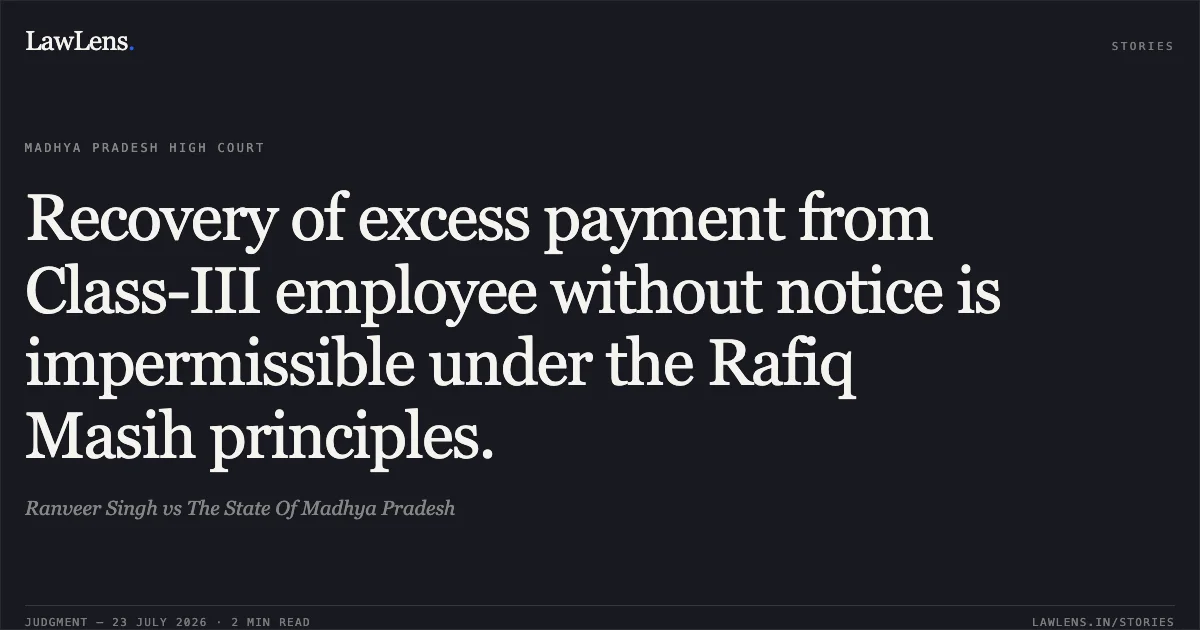
The Court held that recovery from a Class-III employee for a decades-old error without following natural justice is impermissible.
Source reference: para 9The respondents were directed to refund the recovered Rs. 75,000/- with 6% interest per annum.
Source reference: para 9(ii)While the recovery was quashed, the Court granted the State liberty to refix the petitioner's pay strictly in accordance with law after providing him a fair hearing.
Source reference: para 9(iii)Original Court PDF
Ranveer SinghvsThe State Of Madhya Pradesh
Click to open original judgment
Original judgment, available to read, download and summarize on LawLens.in