Facts
The petitioner, a Class-IV employee serving as a Process Server at the District and Sessions Court, Mungeli, challenged a recovery order issued by respondent authorities.
Source reference: para. 2Due to an administrative error, the petitioner’s pay scale was wrongly fixed at a higher rate in April 2003, which continued until October 2016.
Source reference: para. 2Upon detecting the error, Respondent No. 3 issued an order on February 8, 2022, to recover the excess payment amounting to Rs. 38,928/-.
Source reference: para. 2The petitioner contended that the recovery, initiated 16 years after the mistake, was legally barred as he was a Class-IV employee who had not committed any misrepresentation.
Source reference: para. 2, 6Issues
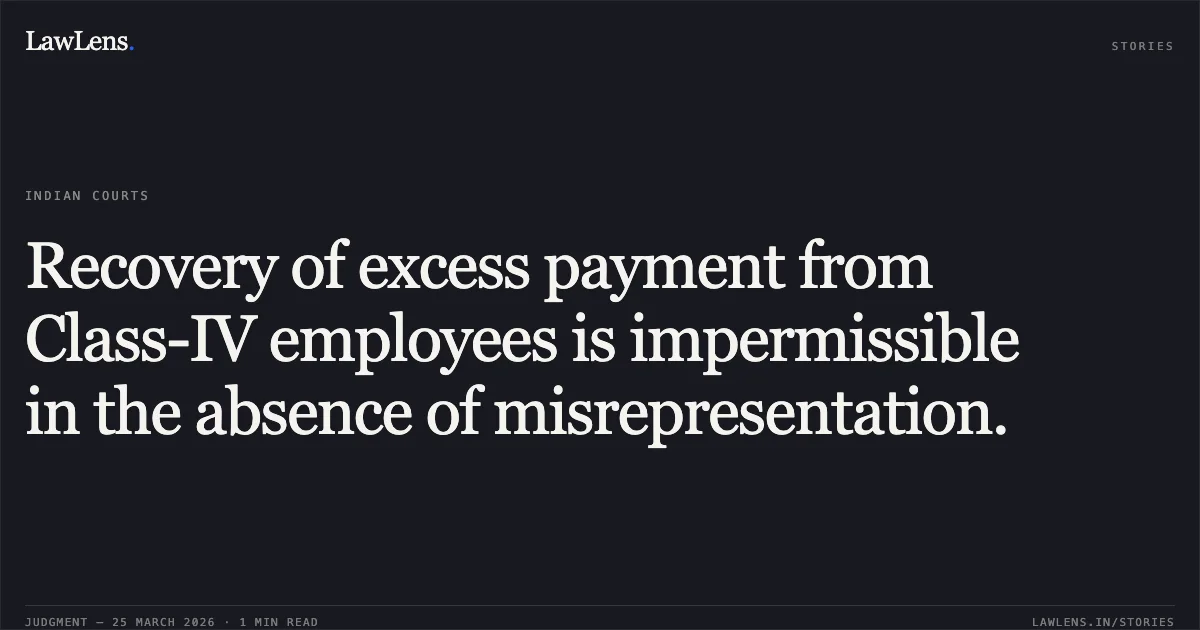
Whether the recovery of excess salary paid due to an administrative mistake is permissible from a Class-IV employee after a lapse of 16 years.
Source reference: para. 2, 5Law Applied
The Court primarily applied the legal principles established by the Hon’ble Supreme Court in State of Punjab v. Rafiq Masih (White Washer) and others (2015) 4 SCC 334.
Source reference: para. 2, 5This precedent clarifies that recovery from employees is impermissible in specific hardship situations, most notably: (i) recovery from Class-III and Class-IV (Group C and D) employees; and (ii) cases where excess payment was made for a period exceeding five years before the recovery order was issued.
Source reference: para. 5The rule holds that such recovery is iniquitous and arbitrary, outweighing the employer's right to recover.
Source reference: para. 5Reasoning
The Court analyzed the facts against the Rafiq Masih criteria and determined that the petitioner’s case was squarely covered by the protective guidelines.
Source reference: para. 7It was noted that the petitioner is a Class-IV employee and played no role in the misrepresentation or the error in pay fixation.
Source reference: para. 6The Court emphasized that the mistake persisted for 16 years (2003 to 2016) before the recovery order was issued in 2022.
Source reference: para. 2, 6Applying the Supreme Court's doctrine, the Court reasoned that enforcing recovery from a low-income employee after such a significant delay for a purely administrative error would be harsh and legally unsustainable.
Source reference: para. 7Holding
The Court allowed the writ petition and quashed the recovery order dated February 8, 2022 (Annexure P/2) and the related communication dated May 31, 2020.
It held that as a Class-IV employee from whom recovery was sought for a period exceeding five years without any fault on his part, the petitioner was entitled to relief under the law laid down in Rafiq Masih.
Source reference: para. 7Original Court PDF
RAMESH SINGH SHRINETvsSTATE OF CHHATTISGARH
Click to open original judgment
Original judgment, available to read, download and summarize on LawLens.in