Facts
The petitioner’s husband, Late Dr. Pradeep Kumar Khare, served as a Medical Officer and was later promoted to Specialist (Orthopedics).
Source reference: para. 2He was granted Selection Grade in the pay scale of Rs. 15,600–39,100 with a Grade Pay of Rs. 7,600/-.
Source reference: para. 2He died in service on April 14, 2015.
Source reference: para. 2Posthumously, the respondents withheld his Death-cum-Retirement Gratuity (DCRG), claiming an excess payment of Rs. 5,52,286/- due to erroneous pay fixation between 2006 and 2015.
Source reference: para. 3Including interest, the respondents sought to recover Rs. 8,02,524/- from the gratuity.
Source reference: para. 3During the pendency of the petition, the interest amount was refunded per an interim order, leaving only the principal amount of Rs. 5,52,286/- in dispute.
Source reference: para. 7Issues
1. Whether the respondents are legally permitted to recover excess payments from the terminal benefits of a deceased employee when such payments were made due to the employer’s own erroneous fixation and not due to fraud or misrepresentation by the employee.
Source reference: para. 4 / para. 132. Whether the recovery is sustainable in light of the guidelines established by the Supreme Court regarding hardship to employees.
Source reference: para. 6 / para. 11Law Applied
State of Punjab & Others v. Rafiq Masih (White Washer) & Others, (2015) 4 SCC 334.
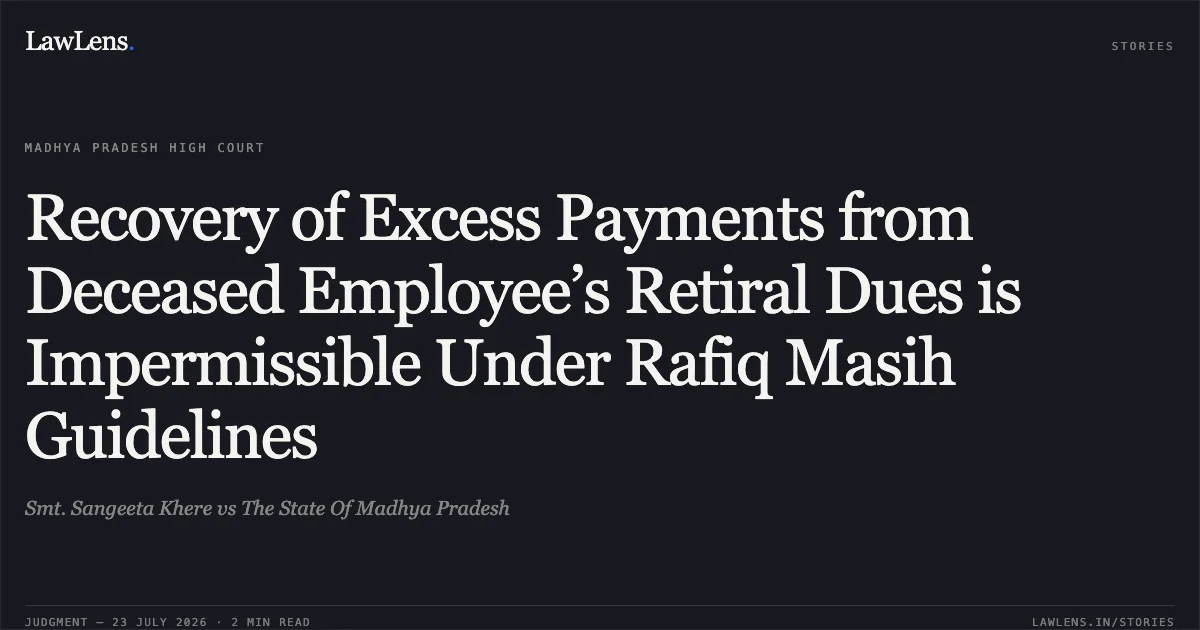
Source reference: para. 6Recovery is impermissible where it is iniquitous or harsh, specifically categorizing five situations where recovery is barred, including: (i) recovery from Class-III/IV employees; (ii) recovery from retired employees or those due to retire within one year; and (iii) recovery where excess payment was made for a period exceeding five years before the recovery order is issued.
Source reference: para. 11Reasoning
The court examined the timeline of the husband’s service and the alleged overpayment. It was noted that the pay fixation and grant of Selection Grade were performed by the respondents themselves, and there was no evidence of fraud or misrepresentation by the deceased.
Source reference: para. 4The court found that the excess payments spanned the period from January 1, 2006, until the employee’s death in April 2015.
Source reference: para. 12Since the recovery sought to claw back payments made more than five years prior to the recovery order (September 2015), the court determined that the petitioner’s case fell squarely within category (iii) of the Rafiq Masih guidelines.
Source reference: para. 12Consequently, the court held that forcing a widow to suffer financial hardship due to an administrative error made over a decade prior was legally unsustainable.
Source reference: para. 13Holding
The court answered the issues in favor of the petitioner, holding that the recovery was arbitrary and illegal.
It quashed the recovery order dated September 11, 2015 (Annexure P/1) and the consequential PPO dated September 21, 2015 (Annexure P/2). The respondents were directed to refund the entire principal amount of Rs. 5,52,286/- within three months from the date of the order.
Source reference: para. 13The petition was allowed to that extent.
Source reference: para. 14Original Court PDF
Smt. Sangeeta KherevsThe State Of Madhya Pradesh
Click to open original judgment
Original judgment, available to read, download and summarize on LawLens.in