Facts
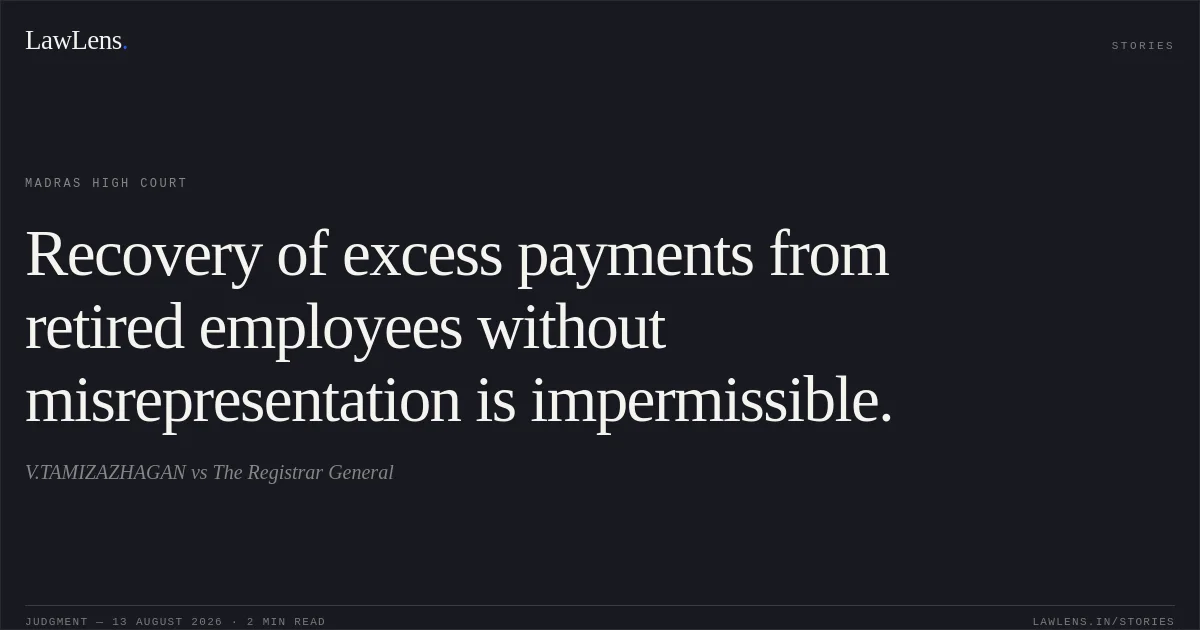
The petitioner, who had rendered unblemished service in the Judicial Department, retired as a Copy Examiner on 31 May 2022.
Source reference: p.2, para.2During processing of his pensionary benefits, the respondents recovered Rs.1,54,257/- from his Death-cum-Retirement Gratuity (DCRG), alleging excess payment in respect of a GPF Part Final withdrawal.
Source reference: p.2, para.2The recovery was made pursuant to proceedings in D.No.748/2023 dated 7 November 2023.
Source reference: p.2, para.2The petitioner submitted representations seeking refund, contending that the recovery was contrary to G.O.Ms.No.286, Finance (Pension) Department, dated 28 August 2018, and that there had been no fraud or misrepresentation on his part.
Source reference: p.2, para.2As the representations received no response, he filed the writ petition seeking refund with interest.
Source reference: p.2, para.2Issues
Whether the respondents could recover the alleged excess amount of Rs.1,54,257/- from the petitioner’s DCRG when there was no misrepresentation or fraud on his part and he had already retired?
Source reference: p.2, para.2; p.3, paras.4–6Whether the respondents’ entitlement to correct or revise an erroneous pay or benefit fixation also authorised recovery of the amount already paid to the petitioner?
Source reference: p.3, paras.3–6Law Applied
The Court applied the principle that public authorities may rectify an erroneous fixation of pay or benefits in accordance with the applicable Pay Rules and Government Orders, but recovery of excess payment may nevertheless be impermissible where it would cause undue hardship and the employee was not responsible for the error.
Source reference: p.3, para.3It relied on State of Punjab v. Rafiq Masih, (2015) 4 SCC 334, which identifies circumstances in which recovery is impermissible, including recovery from retired employees, recovery relating to payments made for more than five years before the recovery order, and cases where recovery would be inequitable, harsh or arbitrary.
Source reference: p.3, para.5; p.4The Court also considered the petitioner’s reliance on G.O.Ms.No.286, Finance (Pension) Department, dated 28 August 2018, concerning recovery in the absence of fraud or misrepresentation.
Source reference: p.2, para.2Reasoning
The Court distinguished between correcting an erroneous fixation and recovering amounts already paid. It held that the respondents could maintain any revision of pay or benefits required under the applicable rules, since unjust enrichment from public funds could not be permitted.
Source reference: p.3, para.3However, the respondents failed to establish that the petitioner had made any misrepresentation during the fixation or receipt of the relevant amount.
Source reference: p.3, paras.4–5Since the petitioner had retired and the error was attributable to the establishment, recovery from his DCRG after retirement would impose undue hardship and was contrary to the principles stated in Rafiq Masih.
Source reference: p.3, paras.4–5Accordingly, although any revised fixation pursuant to the audit objection could stand, the recovery itself was held invalid.
Source reference: p.4, para.6Holding
The writ petition was allowed in part.
The Court confirmed that any revision of pay or benefits effected pursuant to the audit objection could continue, but held that recovery of Rs.1,54,257/- from the petitioner’s DCRG pursuant to proceedings dated 7 November 2023 was legally invalid.
Source reference: p.4, para.6The respondents were directed to repay the recovered amount to the petitioner within 12 weeks from the date of receipt of a copy of the order.
Source reference: p.4, para.7No separate direction granting interest was issued, and there was no order as to costs.
Source reference: p.4, para.7Original Court PDF
V.TAMIZAZHAGANvsThe Registrar General
Click to open original judgment
Original judgment, available to read, download and summarize on LawLens.in