Facts
The applicant retired as a Lower Selection Grade (LSG) Supervisor from the Department of Posts on October 31, 2007
Source reference: p. 2Based on a 2018 Office Memorandum, he was granted a Fixed Medical Allowance (FMA) of ₹1,000 per month as he resided more than 5 km from the CGHS Wellness Centre in Trichy
Source reference: p. 2In September 2024, the respondents stopped the FMA, asserting that the applicant’s residential pincode fell within a CGHS-covered area
Source reference: p. 3Following an internal audit objection in 2024, the 2nd respondent issued an order dated March 14, 2025, directing the recovery of ₹60,000 in monthly installments of ₹3,000 from the applicant’s pension
Source reference: p. 3The applicant challenged this recovery, citing a lack of misrepresentation on his part and the absence of a prior show-cause notice
Source reference: p. 3, 4Issues
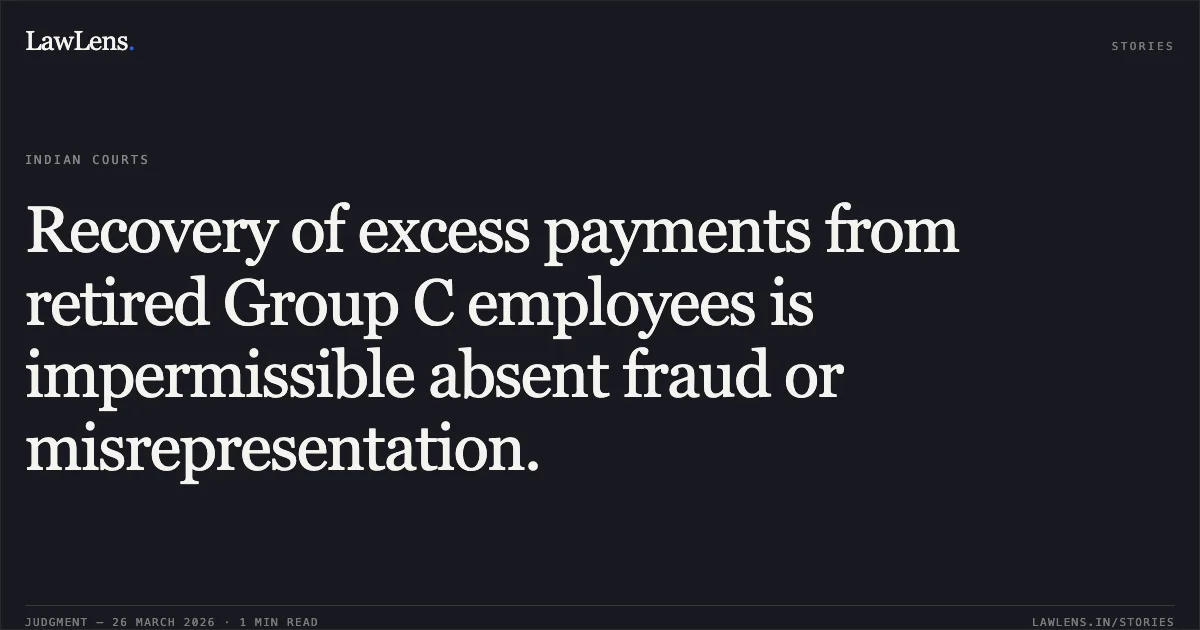
Whether the respondents can recovery alleged excess payments of Fixed Medical Allowance (FMA) from a retired employee in the absence of fraud, misrepresentation, or prior notice
Source reference: p. 4, para 7Law Applied
The court primarily applied the principles governing the recovery of excess payments from employees as established by the Supreme Court in State of Punjab v. Rafiq Masih (White Washer) (2015), which prohibits recovery from retired employees or Group C/Class III employees when the payment was not due to the employee's fraud or misrepresentation
Source reference: p. 6, para 13The Tribunal further relied on Jogeswar Sahoo & Others v. The District Judge, Cuttack (2025) and Sahib Ram v. State of Haryana (1995), which held that if an excess payment results from an employer’s wrong interpretation of rules rather than an employee’s fault, such amounts are not recoverable on the grounds of equity and judicial discretion
Source reference: p. 5, paras 8-10Reasoning
The Tribunal observed that the applicant was a retired Group C employee who had superannuated in 2007, nearly 18 years before the recovery order was issued in 2025
Source reference: p. 7, para 9There was no evidence on record suggesting that the payment of FMA was obtained through fraud or misrepresentation by the applicant
Source reference: p. 7, para 9Furthermore, the respondents failed to provide the applicant with a show-cause notice or an opportunity for a hearing before initiating the recovery, violating principles of natural justice
Source reference: p. 4, para 4; p. 7, para 9Applying the Rafiq Masih criteria, the Tribunal reasoned that recovery from a retired Group C employee is "iniquitous and arbitrary" as the hardship caused to the pensioner outweighs the employer's right to recover
Source reference: p. 6, para 13; p. 8, para 9Holding
The Tribunal held that the recovery was unsustainable and unjustifiable under the law
The impugned order dated March 14, 2025, regarding the recovery was set aside
Source reference: p. 8, para 10The Tribunal directed the respondents to refund any amount already recovered from the applicant’s pension within two months, without interest
Source reference: p. 8, para 10The Original Application (OA) was allowed specifically regarding the recovery, though not regarding the continued entitlement to FMA
Source reference: p. 8, para 10, 11Original Court PDF
C NeelamegamvsDEPARTMENT OF POSTS
Click to open original judgment
Original judgment, available to read, download and summarize on LawLens.in