Facts
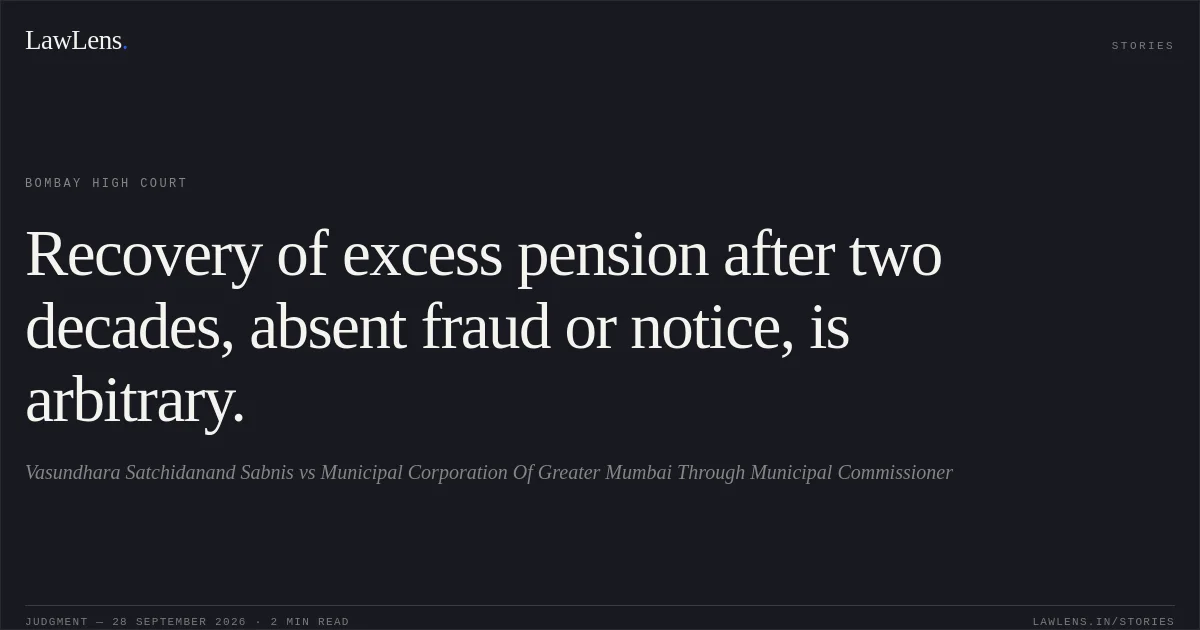
The Petitioner, the widow of a former MCGM Chief Medical Officer, received family pension after her husband’s death in 2003.
Source reference: pp. 2–4, paras. 3–9In March 2022, MCGM stopped her pension and demanded repayment of ₹37,02,596, alleging that she had been paid pension at a higher rate than admissible from May 2003 to February 2022.
Source reference: pp. 2–4, paras. 3–9MCGM later recovered amounts from her pension and caused her bank account to be blocked; ₹2,66,214 was also withdrawn from the account.
Source reference: pp. 2–4, paras. 3–9The Petitioner challenged the demand and recovery, stating that she had neither misrepresented facts nor been given the calculation or an opportunity to respond.
Source reference: pp. 2–4, paras. 3–9MCGM relied on Rule 26(A) of the Municipal Pension Rules, 1953, and the Petitioner’s undertaking to refund excess payments.
Source reference: pp. 2–4, paras. 3–9Issues
Whether MCGM could recover alleged excess family pension paid over nearly two decades when the excess payment was not attributed to any fraud or misrepresentation by the Petitioner.
Source reference: pp. 5–6, paras. 11–14Whether MCGM could stop the Petitioner’s pension and recover amounts directly from her bank account without notice, a hearing, or lawful authority.
Source reference: pp. 5–6, paras. 13–14Law Applied
In State of Punjab v. Rafiq Masih, (2014) 8 SCC 883, the Supreme Court held that recovery of excess payments may be impermissible where it would be iniquitous or arbitrary, including where the recipient was not responsible for the error and recovery would cause undue hardship or follows a substantial lapse of time.
Source reference: p. 5, paras. 11–12The Court also applied the principles of natural justice and Article 14 of the Constitution, holding that recovery must not be arbitrary and must follow due process.
Source reference: p. 6, paras. 13–14MCGM relied on Rule 26(A) of the Municipal Pension Rules, 1953, and the Petitioner’s undertaking to refund excess pension; the Court nevertheless assessed the recovery against the governing principles of fairness and legality.
Source reference: p. 4, para. 9Reasoning
The Court found that the Petitioner had received pension at the higher rate for almost two decades, with no allegation that she had caused the error by fraud or misrepresentation.
Source reference: pp. 5–6, paras. 13–14MCGM demanded repayment only in 2022 and recovered money without giving her a hearing or explaining the calculation; the Court held that this was contrary to natural justice and arbitrary.
Source reference: pp. 5–6, paras. 13–14It further held that MCGM had no authority to withdraw funds directly from her bank account, and that the internal accounting note did not establish that the Petitioner had been informed of the alleged overpayment.
Source reference: p. 6, para. 14Holding
The Court allowed the petition and quashed and set aside the letter dated 23 May 2022 demanding repayment.
MCGM was directed to return ₹3,24,174, or any additional amount recovered from the Petitioner’s family pension, within four weeks.
Source reference: p. 7, OrderMCGM may determine the pension payable under the applicable rules and law after giving the Petitioner’s representative an opportunity to be heard, but there must be no default in pension payments.
Source reference: p. 7, OrderRule was made absolute, with no order as to costs.
Source reference: p. 7, OrderOriginal Court PDF
Vasundhara Satchidanand SabnisvsMunicipal Corporation Of Greater Mumbai Through Municipal Commissioner
Click to open original judgment
Original judgment, available to read, download and summarize on LawLens.in