Facts
The petitioner is the widow of Late Ramkhilawan Sharma, a retired Patwari who stood retired on 15.07.1989.
Source reference: para. 2Due to an administrative error, the deceased was paid an excess pension totaling ₹4,52,592/- between March 2014 and February 2018.
Source reference: para. 2Upon detection, the deceased signed an undertaking and a certificate authorizing the Respondent-Bank to deduct ₹4,500/- per month from his pension and to adjust excess payments from his successors.
Source reference: para. 2, 4Following the husband's death on 27.04.2021, the Respondent-Bank continued to deduct the said amount from the petitioner’s family pension.
Source reference: para. 2The petitioner challenged these deductions as illegal and sought a refund of the amount already recovered.
Source reference: para. 1, 3Issues
1. Whether an undertaking signed by a deceased pensioner during his lifetime to recover excess payments remains enforceable against his successor receiving family pension.
Source reference: para. 72. Whether the recovery of excess pension paid to a deceased employee can be adjusted/deducted from the family pension of the widow.
Source reference: para. 7, 8Law Applied
The court applied the principle that an undertaking signed by a pensioner for the recovery of excess payments is personal to the individual and loses its legal efficacy upon the death of the signatory.
Source reference: para. 7The doctrine that family pension is a distinct right of the survivor, and excess payments made to a deceased employee during his lifetime cannot be recovered or adjusted from the family pension of the successor, as such actions are deemed illegal and arbitrary.
Source reference: para. 7, 8Reasoning
The court examined the Respondent-Bank's contention that the deceased had provided a certificate specifically allowing adjustments from his successors.
Source reference: para. 4The court reasoned that the undertaking signed by Late Ramkhilawan Sharma ceased to have effect upon his death on 27.04.2021.
Source reference: para. 7The court emphasized that family pension is intended for the survival of the widow—in this case, a 72-year-old lady.
Source reference: para. 3It determined that the legal obligation or consent of the deceased to repay excess amounts cannot be transferred to the family pensioner.
Source reference: para. 7Since the overpayment was a result of the bank’s own mistake and not due to any fraud or misrepresentation by the petitioner, the court concluded that shifting the burden of recovery to the petitioner’s family pension was without legal basis.
Source reference: para. 7, 8Holding
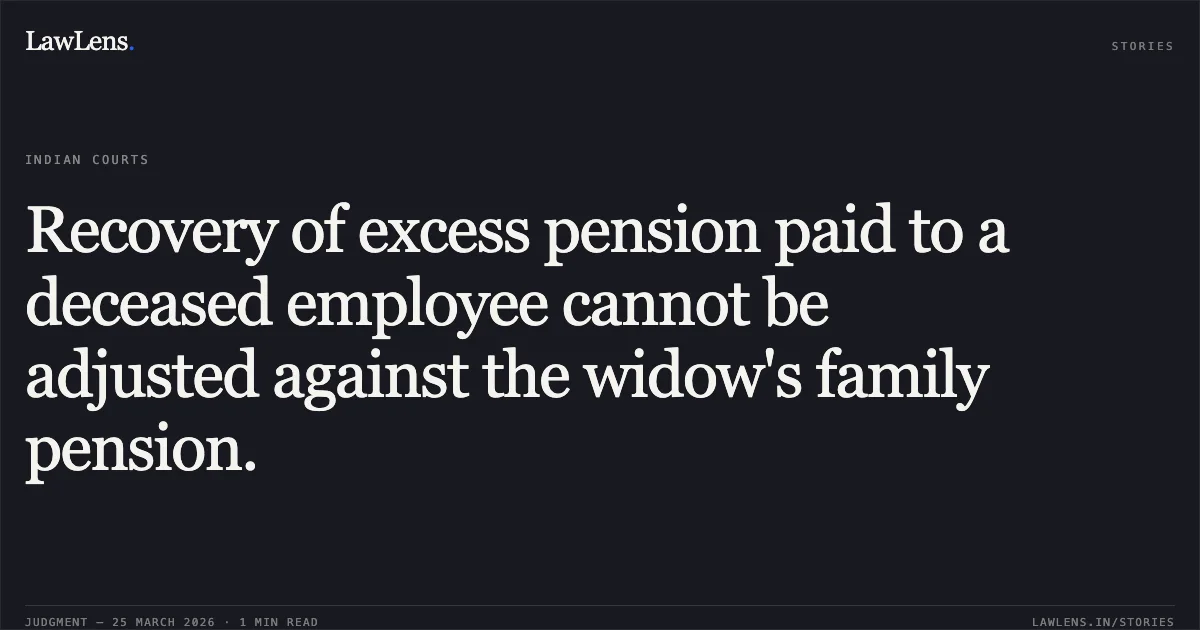
The High Court allowed the petition, holding that the decision to recover excess pension from the petitioner’s family pension was illegal and arbitrary.
The Court directed the Respondent-Bank to: 1. Immediately stop the deductions and restore the petitioner’s full family pension.
Source reference: para. 82. Refund the amount already recovered from the family pension within 30 days from the date of the order.
Source reference: para. 83. Pay interest at the rate of 6% per annum on the refunded amount.
Source reference: para. 8Original Court PDF
AMOLA BAIvsSTATE OF CHHATTISGARH
Click to open original judgment
Original judgment, available to read, download and summarize on LawLens.in