01Facts
The petitioner, an employee belonging to Group B service, had received pay fixation under the applicable Pay Rules and Government Orders.
p. 2 · ¶ 1Subsequently, an internal audit conducted by the High Court found that her pay had been incorrectly fixed and that one additional increment had been granted beyond her entitlement.
p. 2 · ¶ 1The authorities consequently ordered re-fixation of her pay and recovery of the excess salary paid to her.
p. 2 · ¶ 1The petitioner challenged the recovery notice dated 2 June 2026 under Article 226 of the Constitution, contending that the recovery was unlawful and inequitable.
p. 1The respondents were unable to establish any misrepresentation by the petitioner or any undertaking executed by her agreeing to repay excess payments.
p. 2 · ¶ 202Issues
i.Whether recovery of excess salary paid pursuant to an erroneous pay fixation could be sustained in the absence of misrepresentation by the employee or an undertaking to repay the excess amount
p. 2 · ¶ 2ii.Whether recovery of excess salary after a prolonged period, despite the validity of the corrective re-fixation, would be harsh, inequitable, or impermissible in law
pp. 2–3 · ¶ 2–3iii.Whether the authorities’ re-fixation of the petitioner’s pay in accordance with the applicable Pay Rules and Government Orders was liable to be interfered with
p. 4 · ¶ 403Law Applied
The Court applied the applicable Pay Rules and Government Orders governing pay fixation, under which an erroneous additional increment could be corrected through re-fixation.
p. 2, 4 · ¶ 1, 4It also relied on State of Punjab v. Rafiq Masih, (2015) 4 SCC 334, which recognises that recovery of excess payments may be impermissible where it causes undue hardship, is inequitable or arbitrary, or where the excess payment has continued for more than five years; the decision also identifies categories such as recovery from retired employees, employees nearing retirement, and lower-level employees as generally impermissible.
pp. 2–3 · ¶ 3In the present case, the Court particularly applied the principles that recovery without employee misrepresentation or an undertaking, and recovery after a prolonged period causing hardship, cannot ordinarily be sustained.
p. 2 · ¶ 204Reasoning
The Court distinguished between correction of an erroneous pay fixation and recovery of amounts already paid.
It accepted that the petitioner’s additional increment was beyond her entitlement and therefore upheld the authorities’ power to re-fix her pay in accordance with the Pay Rules and Government Orders.
p. 2, 4 · ¶ 1, 4However, the respondents could not show that the petitioner had obtained the excess payment through misrepresentation or had undertaken to refund it.
In light of the prolonged interval and the hardship that recovery of the excess increment would cause, the Court applied the equitable principles in Rafiq Masih and held that recovery could not be sustained, even though the petitioner was a Group B employee.
p. 2 · ¶ 2–3Accordingly, the corrective re-fixation was maintained, but the financial recovery was set aside.
p. 4 · ¶ 405Holding
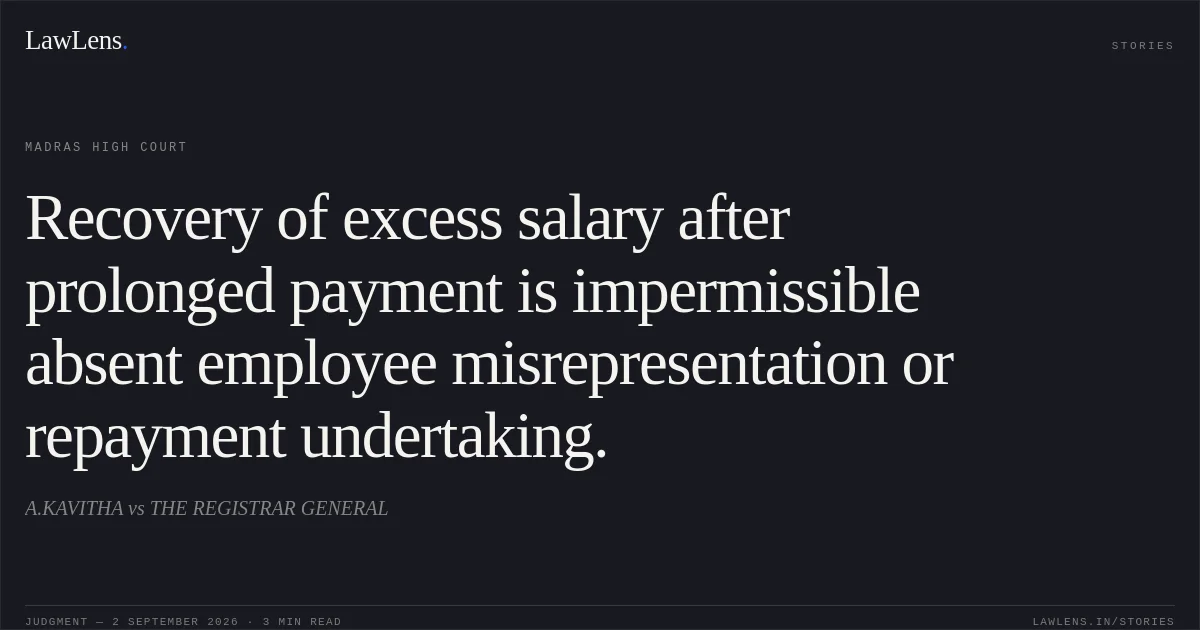
The writ petition was allowed in part.
p. 4 · ¶ 4The Court upheld the re-fixation of the petitioner’s pay and the consequential correction of her entitlement under the applicable Pay Rules and Government Orders.
p. 4 · ¶ 4However, it quashed the recovery of excess salary because there was no misrepresentation or repayment undertaking and recovery after a prolonged period would cause undue hardship.
p. 4 · ¶ 4Any amount already recovered from the petitioner was directed to be refunded within twelve weeks from receipt of a copy of the order.
p. 4 · ¶ 5No costs were awarded.
p. 4 · ¶ 5Original Court PDF
A.KAVITHAvsTHE REGISTRAR GENERAL
Click to open original judgment
Original judgment, available to read, download and summarize on LawLens.in