Facts
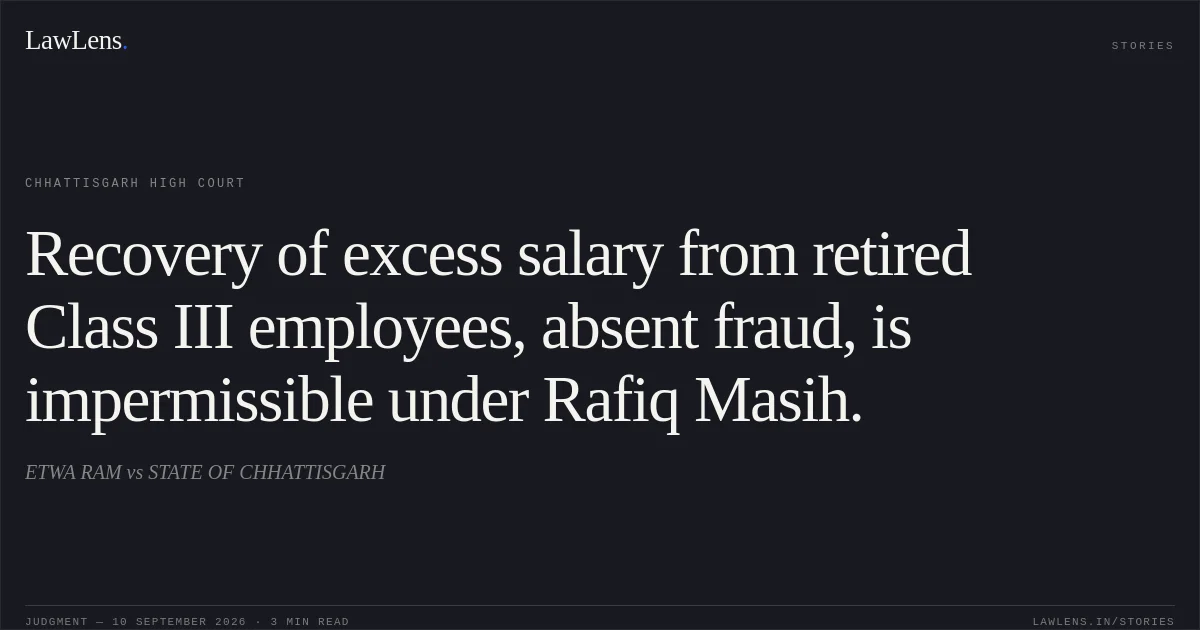
The petitioner, Etwa Ram, a retired Head Constable holding a Class-III post, challenged the recovery order dated 31 October 2023 by which ₹4,02,197 was sought to be recovered on the ground of excess payment arising from erroneous pay fixation.
Source reference: para. 2He contended that the pay and allowances had been drawn from 2000 to 2023 without any fraud, misrepresentation, or concealment on his part, and that the alleged excess payment resulted solely from the employer’s error.
Source reference: para. 2He further alleged that no show-cause notice or opportunity of hearing was granted before the pay was re-fixed and recovery was ordered.
Source reference: para. 2The respondents stated that, while processing the petitioner’s pension and retiral benefits, the Treasury, Accounts and Pension authorities objected to the pay fixation granted in 2000.
Source reference: para. 3Upon recalculation, an excess payment of ₹4,02,197 was determined and recovery was directed.
Source reference: para. 3The Court noted that the petitioner had retired before the impugned recovery and that the alleged excess payment related to a period commencing in 2000.
Source reference: para. 7Issues
Whether recovery of alleged excess salary from the petitioner, a retired Class-III employee, was legally permissible when the alleged excess payment related to a period commencing in 2000 and was not attributable to fraud or misrepresentation by him?
Source reference: paras. 5, 7–8Whether the respondents could revise the petitioner’s pay fixation and order recovery without issuing a show-cause notice or affording an effective opportunity of hearing?
Source reference: paras. 5, 9Whether the respondents could undertake a fresh examination of the petitioner’s pay fixation after setting aside the recovery order?
Source reference: para. 10Law Applied
The Court applied the principles laid down by the Supreme Court in State of Punjab v. Rafiq Masih (White Washer), (2015) 4 SCC 334, under which recovery of excess payments is ordinarily impermissible where it is sought from retired employees, employees due to retire within one year, Class-III or Class-IV employees, or where the excess payment was made for a period exceeding five years before the recovery order; recovery is also impermissible where it would be inequitable, harsh, or arbitrary.
Source reference: para. 6The Court also applied the principles of natural justice, holding that adverse pay re-fixation and consequential recovery require prior notice and an effective opportunity of hearing.
Source reference: para. 9At the same time, the Court recognised that the employer could examine the correctness of pay fixation afresh in accordance with law, provided that the petitioner was heard and a reasoned order was passed.
Source reference: para. 10Reasoning
The petitioner fell within multiple protective categories identified in Rafiq Masih: he was a retired employee, had held a Class-III post, and the alleged excess payment related to a period substantially exceeding five years before the recovery order.
Source reference: paras. 7–8There was no material showing fraud, misrepresentation, or suppression by the petitioner; the excess, if any, appeared to have resulted from the employer’s own pay-fixation error.
Source reference: para. 7Accordingly, recovery of ₹4,02,197 could not be sustained.
Source reference: paras. 7–8Independently, the absence of a show-cause notice or effective hearing rendered the pay re-fixation and consequential recovery procedurally invalid for violation of natural justice.
Source reference: para. 9However, setting aside the recovery did not prevent the respondents from reconsidering the pay fixation, subject to compliance with due process and the restrictions governing recovery under Rafiq Masih.
Source reference: para. 10Holding
The High Court allowed the challenge to the extent that it set aside the recovery order dated 31 October 2023 and the consequential recovery of ₹4,02,197.
The respondents were granted liberty to conduct a fresh examination of the petitioner’s pay fixation after providing him an adequate opportunity of hearing and passing a reasoned order; any recovery would remain subject to Rafiq Masih.
Source reference: para. 11The respondents were directed to refund or release any amount recovered or withheld pursuant to the impugned order and to release all remaining admissible retiral dues within 50 days of receiving the certified copy of the order.
Source reference: para. 12The writ petition was disposed of without an order as to costs; no separate compensation or interest at 18% per annum was awarded.
Source reference: para. 13Original Court PDF
ETWA RAMvsSTATE OF CHHATTISGARH
Click to open original judgment
Original judgment, available to read, download and summarize on LawLens.in