Facts
The applicant was appointed as a Junior Statistical Investigator in 2006.
Source reference: p. 2After a brief stint as an Inspector in the Central Board of Excise and Customs (keeping lien in his parent department), he rejoined his parent department as a Junior Statistical Investigator on May 16, 2011, where his pay was fixed by the department.
Source reference: p. 2On September 22, 2023—twelve years after the re-joining pay fixation—the respondents issued an order to recover ₹11,37,852/- in 56 installments, citing an error in pay fixation dating back to 2011.
Source reference: p. 2-3The respondents argued that the applicant was a Group B officer and had been drawing "wrong pay" for years.
Source reference: p. 3The applicant challenged the recovery, asserting there was no fraud or misrepresentation on his part and that the recovery was initiated after an excessive delay.
Source reference: p. 2, 4Issues
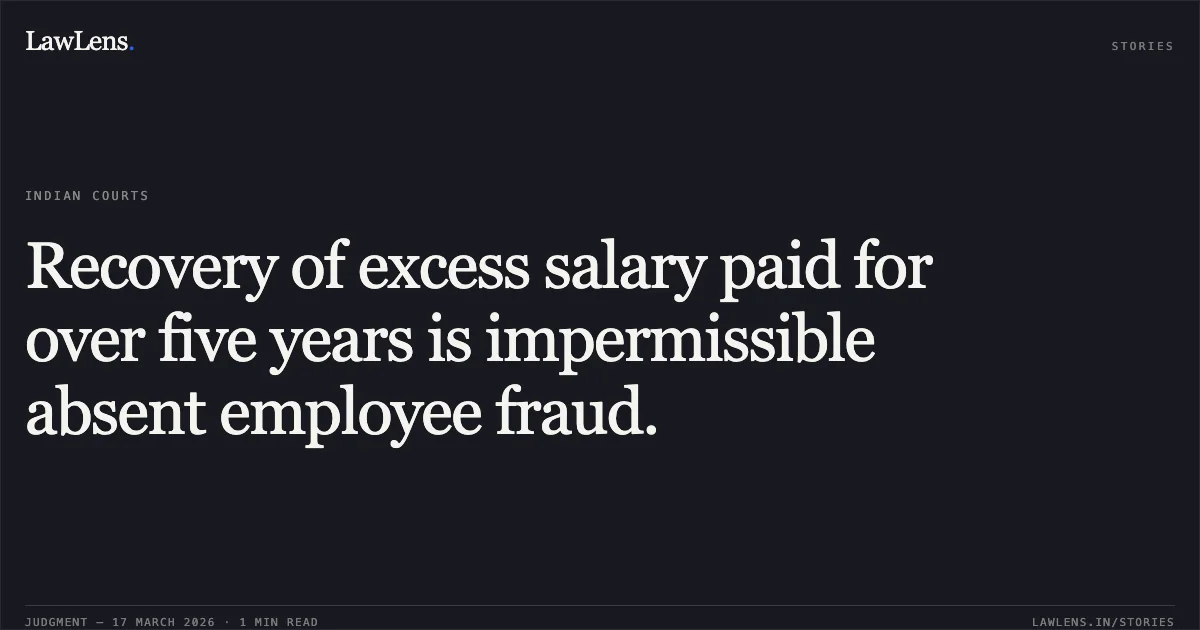
Whether the recovery of excess salary is permissible when the payment resulted from a departmental mistake and the recovery order was issued more than five years after the alleged error.
Source reference: p. 4, 6Whether the recovery is sustainable in the absence of any fraud or misrepresentation by the employee.
Source reference: p. 6-7Law Applied
State of Punjab and Others v. Rafiq Masih (White Washer) (2015), which established that recoveries are impermissible if the excess payment was made for a period in excess of five years before the order of recovery is issued.
Source reference: p. 4-5High Court of Punjab and Haryana v. Jagdev Singh, noting that recovery is only permissible if an undertaking was provided by the employee to refund excess payments.
Source reference: p. 5Janardan Prasad Srivastava v. State of U.P. that errors committed by respondents without employee fraud cannot lead to recovery once the funds are consumed.
Source reference: p. 6Reasoning
The Tribunal observed that the pay fixation was performed entirely by the respondent department, and there was no evidence or allegation that the applicant misrepresented facts or committed fraud to obtain the higher pay.
Source reference: p. 7The Tribunal found that the present case was squarely covered by Clause (iii) of the Rafiq Masih judgment, as the recovery order was passed in 2023 for a pay fixation that occurred in 2011—a gap of more than ten years.
Source reference: p. 6-7The court rejected the respondents' contention that the applicant's Group B status or the gross amount of his current salary justified the recovery, emphasizing that the lapse of time and the lack of employee fault made the recovery "iniquitous and arbitrary" under the established legal framework.
Source reference: p. 5, 7Holding
The Tribunal allowed the Original Application and quashed the impugned recovery order dated September 22, 2023.
It held that the recovery was contrary to the law established in Rafiq Masih due to the significant time lapse and absence of fraud.
Source reference: p. 7The respondents were directed to refund the amount already recovered from the applicant's salary, along with interest at the existing bank rate, within a period of three months.
Source reference: p. 7Original Court PDF
SUNNY SONIvsSOCIAL STATISTICS DIVISION
Click to open original judgment
Original judgment, available to read, download and summarize on LawLens.in