Facts
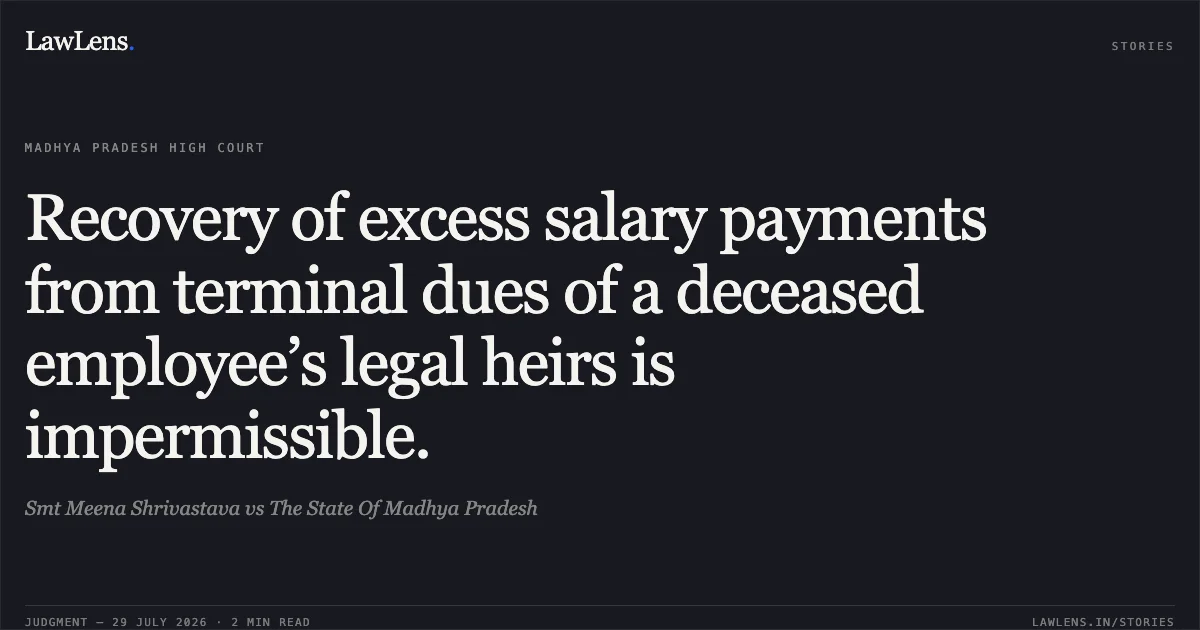
The petitioner is the widow of a deceased Panchayat Coordinator Officer who passed away in service on November 7, 2022.
Source reference: para. 2Following his death, the petitioner requested terminal dues; however, the respondent department deducted ₹3,51,463/- from the Death-cum-Retiral Gratuity (DCRG) under orders dated July 28, 2023, and August 17, 2023.
Source reference: para. 2The State contended the recovery was authorized under Rule 65 of the M.P. Civil Services (Pension) Rules, 1976, as it constituted ascertainable government dues resulting from excess payments made during the employee’s service.
Source reference: para. 3The petitioner challenged these orders via a writ petition under Article 226 of the Constitution.
Source reference: para. 1Issues
1. Whether the State can legally recover excess salary payments from the gratuity/terminal dues payable to the widow of a deceased employee in the absence of misrepresentation or fraud.
Source reference: paras. 2, 92. Whether such recovery violates the protective guidelines established by the Supreme Court regarding hardship to employees/heirs.
Source reference: paras. 5, 8Law Applied
The court primarily relied on the Supreme Court’s decision in State of Punjab v. Rafiq Masih (White Washer), which prohibits recoveries from Class-III/IV employees or when such recovery would be iniquitous or harsh.
Source reference: para. 5It further applied the principle from Thomas Daniel v. State of Kerala, stating recovery is impermissible absent fraud or misrepresentation by the employee.
Source reference: para. 2, 9The court also invoked the Full Bench decision in State of M.P. v. Jagdish Prasad Dubey, regarding the non-enforceability of "forced undertakings".
Source reference: para. 7Clause 6 of the Government Circular dated May 31, 2011, which explicitly prohibits recovery from legal heirs after an employee's death.
Source reference: para. 8Reasoning
The Court observed that the deceased employee did not engage in any fraud or misrepresentation to obtain the excess payment.
Source reference: para. 2, 9Applying the Rafiq Masih and Thomas Daniel precedents, the Court reasoned that recovering funds from a widow’s DCRG decades after the initial pay fixation—or after the employee's death—is inherently harsh and arbitrary.
Source reference: para. 5, 9Specifically, the Court noted that both the State’s own Circular (31.05.2011) and the decision in Smt. Chandravati Bairagi v. State of M.P. clarify that once an employee passes away, recoveries cannot be transferred to legal representatives.
Source reference: para. 8The Court found the facts of the present case to be at par with prior judicial protections afforded to ministerial staff and their families.
Source reference: para. 6, 8Holding
The Court held that recovery from the DCRG of a deceased employee’s widow is unsustainable in law.
The Court allowed the petition and quashed the impugned recovery orders dated July 28, 2023, and August 17, 2023. The respondents were directed to refund the recovered amount of ₹3,51,463/- with 6% interest per annum within three months; failure to comply will increase the interest rate to 12% per annum. The Court also ordered the continued disbursement of the petitioner's regular pension.
Source reference: para. 10, 11Acts & Sections Cited
1 provisions across 1 statute referred to in this judgment. Linked provisions open on LawLens.
Circular dated 31.5.20111
Original Court PDF
Smt Meena ShrivastavavsThe State Of Madhya Pradesh
Click to open original judgment
Original judgment, available to read, download and summarize on LawLens.in