Facts
The petitioners are either retired government servants or legal representatives of deceased government servants from various departments (Education, Health, etc.) in Chhattisgarh
Source reference: p. 4-5After the employees attained the age of superannuation or passed away, the respondent authorities issued recovery orders seeking the return of General Provident Fund (GPF) amounts
Source reference: p. 5-6The respondents alleged that the petitioners had withdrawn GPF funds in excess of their entitlement during their service
Source reference: p. 6In all seven cases listed, the recovery orders were issued significantly after the date of superannuation or death—ranging from months to several years later
Source reference: p. 4-5The petitioners challenged these orders on the grounds that they were issued in violation of statutory limitation periods and without an opportunity for a hearing
Source reference: p. 5-6Issues
1. Whether the respondent authorities are empowered to recover alleged overpayments of GPF/Government dues after the expiry of the statutory period prescribed under the Pension Rules
Source reference: p. 10 / para. 112. Whether the impugned recovery orders, issued post-retirement without prior notice during service, are legally sustainable under the Chhattisgarh Civil Services (Pension) Rules, 1976
Source reference: p. 11 / para. 13Law Applied
Rules 65 and 66 of the Chhattisgarh Civil Services (Pension) Rules, 1976, which mandate that efforts to assess and adjust recoverable government dues must be completed within six months of retirement; thereafter, it is presumed no claim exists except for house rent and water charges (recoverable within one year)
Source reference: p. 8-10, paras. 8-9Rule 14(7) of the Chhattisgarh General Provident Fund Rules, 1955, which permits recovery of overdrawn GPF amounts through lump-sum repayment or salary deduction
Source reference: p. 7, para. 6Precedent Dharmu Ram Mandavi v. State of Chhattisgarh (WPS No. 2617 of 2013), which established that these rules do not authorize the State to adjust dues from pension or gratuity after the stipulated expiry periods
Source reference: p. 11, para. 12Reasoning
The court harmonized the GPF Rules with the Pension Rules, reasoning that while Rule 14(7) of the 1955 Rules allows for the recovery of excess withdrawals, this power is restricted by the procedural timeline set in the 1976 Pension Rules
Source reference: p. 10-11, para. 11Under Rule 66(3)(a) of the 1976 Rules, the department is duty-bound to raise any claim for government dues within six months of retirement
Source reference: p. 9The court observed that in all the presented petitions, the government failed to raise such claims within the six-month window
Source reference: p. 11, para. 13Consequently, a legal presumption arises that no dues are outstanding
Source reference: p. 11, para. 11The court emphasized that Rules 65 and 66 do not provide an open-ended license to the State to recover funds from a pensioner’s terminal benefits once the statutory limitation for assessment has lapsed
Source reference: p. 10, para. 10Holding
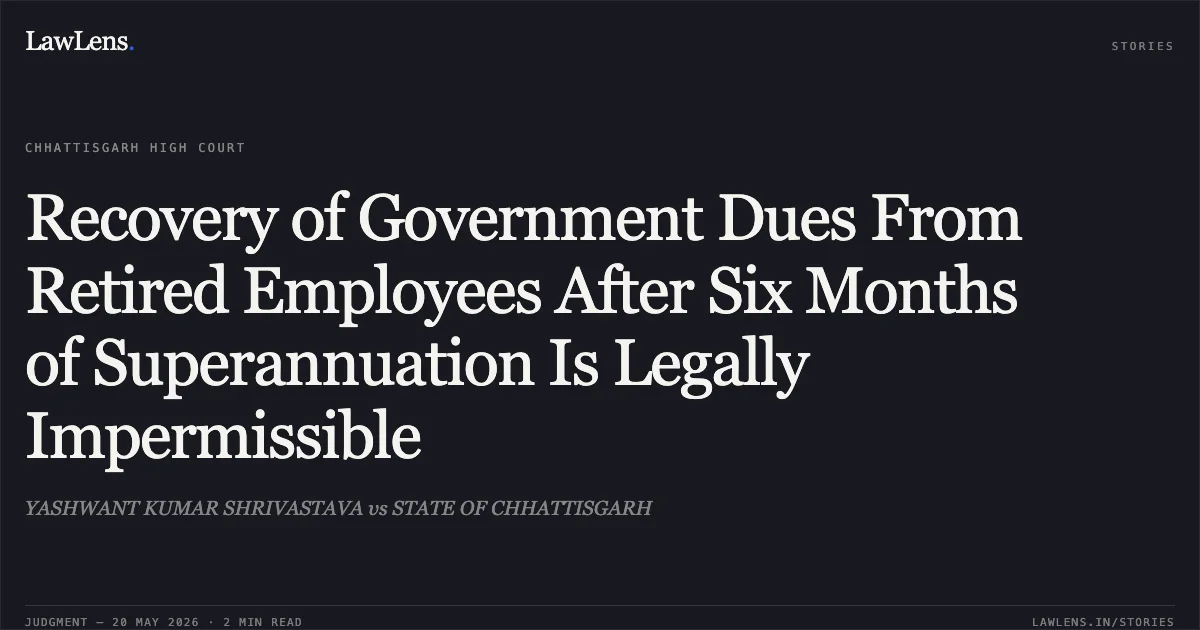
The court answered that the recovery orders were unsustainable as they were issued beyond the six-month statutory period prescribed by Rule 66(3)(a) of the Pension Rules, 1976
The High Court quashed all impugned recovery orders and directed the respondents to forthwith refund any amounts already recovered from the petitioners, along with interest at the rate of 5% per annum
Source reference: p. 11-12, paras. 13-14Original Court PDF
YASHWANT KUMAR SHRIVASTAVAvsSTATE OF CHHATTISGARH
Click to open original judgment
Original judgment, available to read, download and summarize on LawLens.in