Facts
The applicant’s husband, a Senior Loco Inspector (Class III employee) with the Railways, took voluntary retirement in 1997 and received a pension until his death on October 25, 2003
Source reference: p. 2The applicant claimed she submitted his death certificate to both the Railways and Punjab National Bank (Respondent No. 4) in December 2003 to initiate family pension
Source reference: p. 3The Bank inadvertently continued to disburse the full pension of the deceased husband to the applicant for ten years (2003–2013) instead of the reduced family pension rate. In 2013, following an audit objection, the Bank calculated an excess payment of ₹12,72,726 and subsequently recovered ₹5,48,810 from the applicant’s accounts, including withholding her matured Fixed Deposits
Source reference: p. 3-4The applicant challenged the recovery, citing her status as a widow of a Class III employee and her lack of fault in the error
Source reference: p. 4Issues
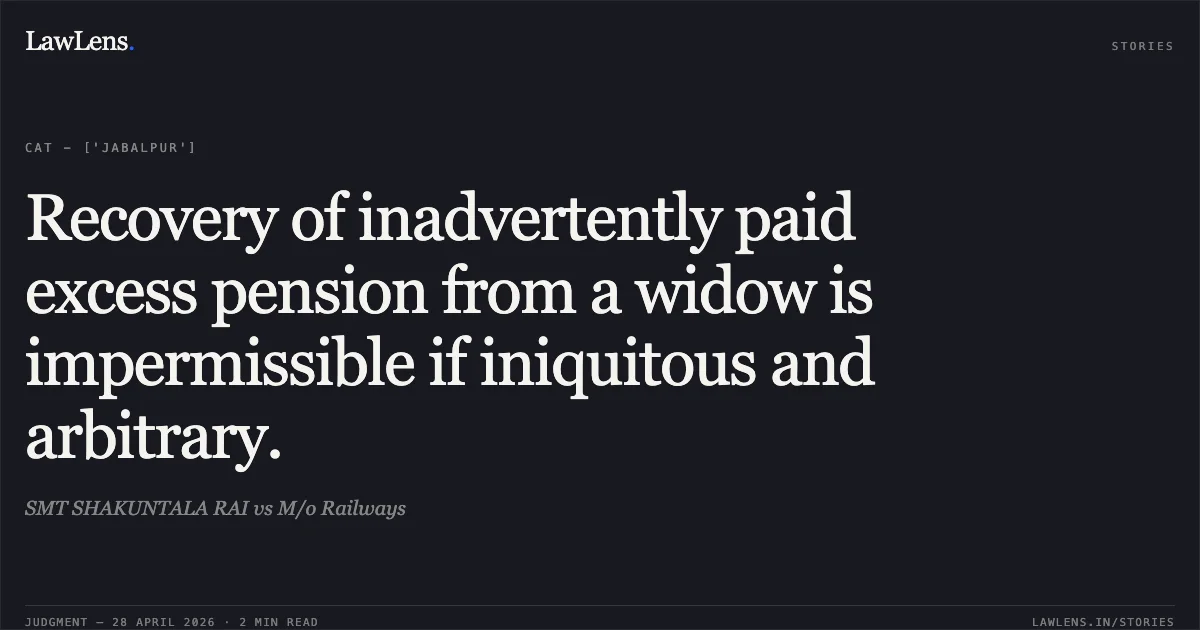
1. Whether the recovery of excess pension payments from the widow of a deceased Class III employee is legally permissible when the overpayment resulted from the bank's negligence rather than the beneficiary's fraud or misrepresentation
Source reference: p. 5/62. Whether the mandate of providing annual Life Certificates shifts the burden of detecting a pensioner's death onto the disbursing bank
Source reference: p. 5/6Law Applied
The Tribunal primarily applied the legal principles established by the Hon’ble Supreme Court in State of Punjab and others x. Rafiq Masih (White Washer) and others (2015) 4 SCC 334, which prohibits recoveries that are iniquitous, harsh, or arbitrary
Source reference: p. 4/6Specifically, the court relied on the five situations summarized in Para 18 of Rafiq Masih, most notably: (i) recovery from Class III and IV employees; (ii) recovery from retired employees; and (v) cases where recovery would be iniquitous or far outweigh the equitable balance of the employer’s right to recover
Source reference: p. 7Reasoning
The Tribunal found that the overpayment was not due to any fraud or misrepresentation by the applicant, who lacked access to official records to realize she was being overpaid
Source reference: p. 6It criticized Respondent No. 4 for negligence, noting that since a "Life Certificate" is a mandatory annual requirement for pension disbursement, the Bank should have detected the pensioner's death much earlier than ten years
Source reference: p. 5/6The Tribunal held that the Bank’s failure to stop the pension or ask for certificates made the subsequent recovery from a widow "iniquitous" and "harsh"
Source reference: p. 6Applying the Rafiq Masih guidelines, the Tribunal determined that the applicant, as the widow of a Class III employee, was protected from recovery because the administrative lapse was entirely on the part of the disbursing agency
Source reference: p. 6/7Holding
The Tribunal allowed the Original Application, answering the issues in favor of the applicant
The Tribunal directed Respondent No. 4 (the Bank) to refund the recovered amount to the applicant within 90 days from the receipt of the order, though it declined to grant interest on the refunded amount
Source reference: p. 7Acts & Sections Cited
1 provisions across 1 statute referred to in this judgment. Each provision opens on LawLens.
Administrative Tribunals Act, 19851
Original Court PDF
SMT SHAKUNTALA RAIvsM/o Railways
Click to open original judgment
Original judgment, available to read, download and summarize on LawLens.in