Facts
The applicant, Vijay Kumar Verma, was a Chief Controller in the East Central Railway who superannuated on February 29, 2024.
Source reference: no citationDuring his service, he received three minor penalties of stoppage of increments (without cumulative effect), effective from June 1, 1991, July 1, 1994, and July 1, 1997, respectively.
Source reference: p.2He claimed that after the expiry of each punishment period, his pay was restored as if no punishment had been imposed, and his last basic pay at retirement was Rs. 95,800/-.
Source reference: p.2, p.3About 9-10 days before his superannuation, on February 13, 2024 (served on February 19, 2024), an order was issued refixing his pay retrospectively from August 1, 1996, reducing his last basic pay from Rs. 95,800/- to Rs. 93,000/-.
Source reference: p.3This led to a calculation of Rs. 4,67,448/- as overpayment, which was recovered from his DCRG (Death-cum-Retirement Gratuity).
Source reference: p.3His representation dated February 20, 2024, was rejected by an order dated April 23, 2024.
Source reference: p.3The respondents contended that a scrutiny before his retirement revealed improper implementation of past punishments, leading to excess drawal of pay, and the refixation was a corrective measure.
Source reference: p.5-6Issues
1. Whether the retrospective reduction of the applicant's basic pay from Rs. 95,800/- to Rs. 93,000/- and the recovery of Rs. 4,67,448/- from his DCRG, based on detected improper implementation of previous non-cumulative punishments, were arbitrary, illegal, and violative of principles of natural justice?
Source reference: p.42. Whether the recovery of the alleged overpayment from the applicant's retiral dues is permissible, considering the absence of misrepresentation or fraud on his part and in light of the judgment in State of Punjab vs. Rafiq Masih?
Source reference: p.4-5Law Applied
The court applied Section 19 of the Administrative Tribunals Act, 1985 for the tribunal's jurisdiction.
Source reference: p.2It also considered the Railway Servant (Disciplinary & Appeal) Rules, 1968, regarding the implementation and effect of disciplinary punishments, specifically stoppage of increments without cumulative effect.
Source reference: p.2The principles regarding the recovery of excess payments, particularly from retired employees in the absence of misrepresentation or fraud, as established in State of Punjab vs. Rafiq Masih (2014) and subsequent Department of Personnel & Training Office Memorandum dated March 2, 2016, and Railway Board order dated June 22, 2016, were also considered.
Source reference: p.4-5Reasoning
The Tribunal found that the action taken by the respondents was corrective, not punitive, aimed at giving proper effect to the penalties already imposed on the applicant during his service.
Source reference: p.8, p.9The punishments, though without cumulative effect, required correct adjustment of increments during their operative periods.
Source reference: p.8The respondents' scrutiny revealed that these punishments were not properly implemented, leading to the applicant drawing excess pay.
Source reference: p.6, p.8The court noted that no fresh penalty was imposed, and the pay was merely refixed based on service records, distinguishing it from a new punitive action.
Source reference: p.8, p.9Therefore, the argument regarding the violation of natural justice, such as lack of show cause, was deemed unsustainable, especially since the applicant was informed and his representation was considered.
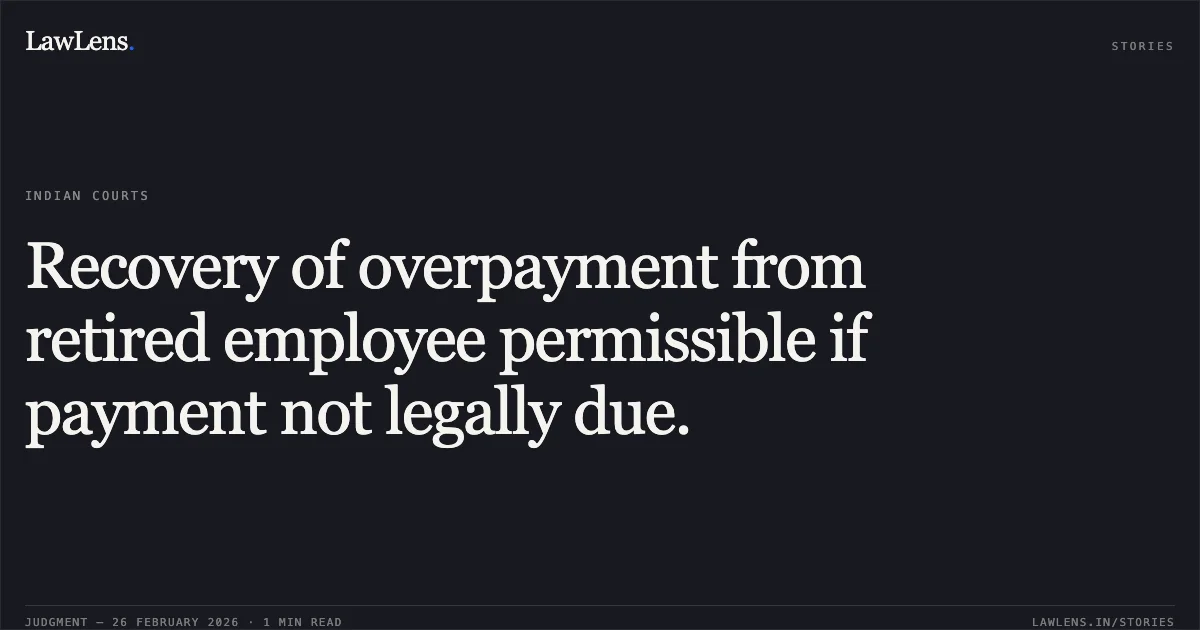
Source reference: p.9Regarding the recovery, the Tribunal distinguished the case from Rafiq Masih, stating that the present situation was not one of innocent overpayment but a monetary translation of the punishment of withholding increments, where the employee was not legally entitled to the excess amount.
Source reference: p.7, p.9The Tribunal further noted the applicant's awareness of the punishments inflictive on him and his omission in not pointing out the extra salary he was getting.
Source reference: p.10Holding
The Tribunal held that there was no arbitrariness, illegality, or mala fide intention in the respondents' actions, nor was there any violation of the principles of natural justice.
The retrospective reduction of the applicant's pay and the recovery of the overpayment were deemed justified as a rectification of an improper implementation of earlier punishments, not a fresh penalty.
Source reference: p.9The Rafiq Masih judgment was found to be inapplicable as the overpayment stemmed from the applicant not being legally entitled to the higher pay due to the incorrect application of penalties.
Source reference: p.9The Original Application was dismissed as completely devoid of merit.
Source reference: p.10Acts & Sections Cited
1 provisions across 1 statute referred to in this judgment. Each provision opens on LawLens.
Administrative Tribunals Act, 19851
Original Court PDF
Vijay Kumar Verma v. The Union of India through the General Manager, East Central Railway, Hajipur
Click to open original judgment
Original judgment, available to read, download and summarize on LawLens.in