Facts
The petitioner was appointed as a Rural Agriculture Extension Officer (RAEO) on June 11, 1981
Source reference: para. 2Under a 2002 State policy, employees were entitled to a first higher pay scale (Kramonnati) upon completing 12 years of service; accordingly, the petitioner was granted this benefit effective from April 19, 1999, based on his 1981 appointment
Source reference: para. 2Though the petitioner earned a graduation degree in 1998, he continued in the same cadre
Source reference: para. 2On May 18, 2016, the respondents issued an impugned order withdrawing the benefit and directing recovery of "excess" salary, contending that the 17 years of service prior to his graduation (1981–1998) should not count toward seniority for higher pay scales
Source reference: para. 2-3The petitioner challenged this on grounds of violation of natural justice and the protection afforded to Class-III employees against recovery
Source reference: para. 3Issues
1. Whether the respondents were legally justified in withdrawing the benefit of the first higher pay scale by excluding service rendered prior to the acquisition of a graduation degree?
Source reference: para. 6-72. Whether the recovery of the enhanced salary from a Class-III employee is permissible under the settled principles of law?
Source reference: para. 3, 8Law Applied
recovery from salary constitutes a punishment requiring a detailed inquiry, per H.L. Trehan v. Union of India and Delhi Transport Corporation v. D.T.C. Mazdoor Congress
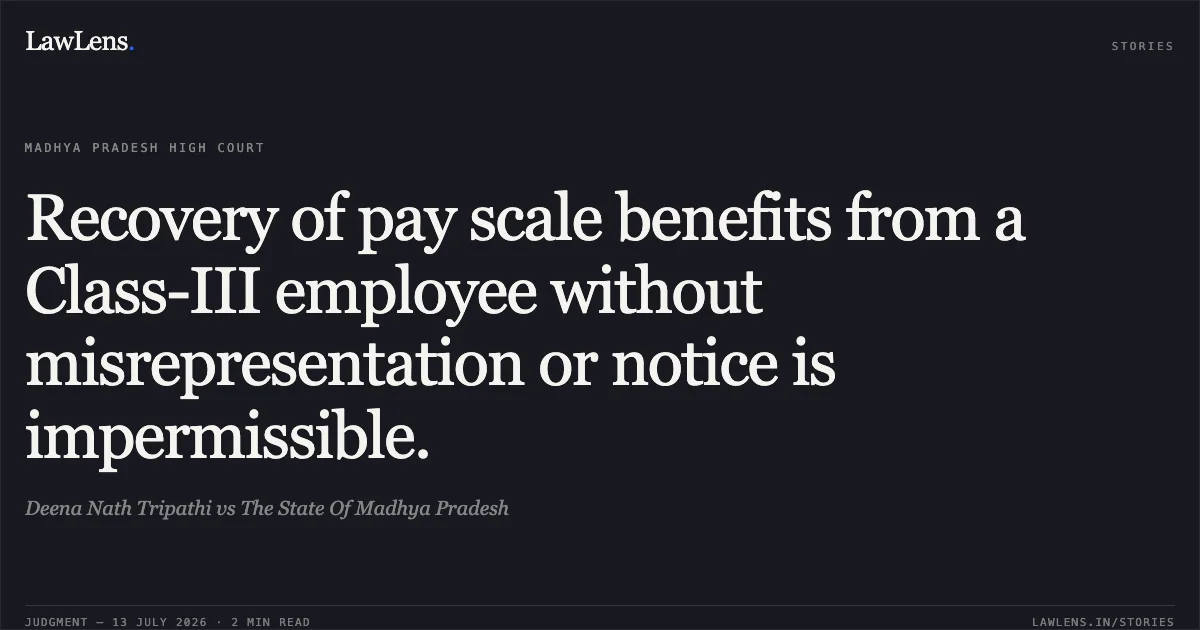
Source reference: para. 3prohibits recovery from Class-III/Class-IV employees when the payment was not due to the employee's misrepresentation [State of Punjab v. Rafiq Masih (White Washer) (2015)]
Source reference: para. 3principle of non-retrospectivity regarding administrative circulars, noting that a 2013 circular cannot strip away benefits granted under a 1999 policy
Source reference: para. 6Reasoning
The Court observed that the petitioner’s initial 1981 appointment did not distinguish between graduate and non-graduate categories for the purpose of the basic pay scale
Source reference: para. 6The benefit of Kramonnati was granted based on the 1999 policy requiring 12 years of service, a milestone the petitioner reached in 1993; thus, the grant in 1999 was delayed but lawful
Source reference: para. 6The Court rejected the State's argument that the 12-year clock should reset upon graduation in 1998, noting that the petitioner was granted the benefit based on his original 1981 pay scale, not the enhanced graduate scale
Source reference: para. 7State failed to provide a show-cause notice or hearing before initiating recovery
Source reference: para. 3the 2013 circular clarifying cadre distinctions could not be applied retrospectively to a status settled in 1999
Source reference: para. 6Holding
The Court answered in the negative, holding that the respondents committed a grave error by issuing a recovery order dehors the rules
The High Court quashed the impugned orders dated May 18, 2016, and January 28, 2013; directed that the petitioner shall continue to receive the extended pay scale and ordered the refund of any amounts recovered; directed to consider the petitioner's representation for the second and third Kramonnati benefits
Source reference: para. 8-9Original Court PDF
Deena Nath TripathivsThe State Of Madhya Pradesh
Click to open original judgment
Original judgment, available to read, download and summarize on LawLens.in