Facts
On October 14, 2012, police conducted a raid on a maize field in Village Dhauria based on secret information that the respondent was cultivating cannabis.
Source reference: para. 2The police allegedly recovered nine cannabis plants growing amidst the maize crop.
Source reference: para. 2Following investigation, the respondent was charged under Sections 8(b) and 20(a)(ii) of the NDPS Act, 1985.
Source reference: para. 3On December 30, 2016, the Special Judge (NDPS Act), Seoni, acquitted the respondent, leading the State to file this appeal assailing the acquittal.
Source reference: para. 1, 5Issues
1. Whether the prosecution established the identity, conscious possession, and deliberate cultivation of the contraband by the respondent beyond a reasonable doubt
Source reference: para. 8-152. Whether the procedural discrepancies regarding the seizure, sealing, and safe custody of the contraband vitiated the prosecution’s case
Source reference: para. 10-113. Whether the high court should interfere with a trial court’s order of acquittal where the view taken by the trial court is plausible
Source reference: para. 17-20Law Applied
The court applied Section 8(b) and Section 20(a)(ii) of the NDPS Act, 1985, which prohibit the cultivation of cannabis plants.
Source reference: para. 3It relied on the precedent Nanda Sakhaji Mal v. State of M.P. (2008), which held that stray growth or a small number of plants without evidence of systematic cultivation does not satisfy the burden of proof for "cultivation".
Source reference: para. 13Chhotelal Lodh v. State of M.P. (2012) was cited to emphasize that mere location of plants in a field does not prove conscious cultivation or exclusive possession.
Source reference: para. 14Regarding appellate jurisdiction, the court followed H.D. Sundara v. State of Karnataka (2023) and Mallappa v. State of Karnataka (2024), establishing that an acquittal cannot be overturned if the trial court's view is "legal and plausible," even if an alternative view exists.
Source reference: para. 17-19Reasoning
The Court observed that the independent witness (PW-7) turned hostile, claiming his signatures were obtained without any seizure occurring in his presence.
Source reference: para. 8The Court noted significant procedural lapses: the crime number appeared on seizure memos prepared before the FIR was registered, and the contraband packet reached the Malkhana in a partially open/unsealed state.
Source reference: para. 10-11Crucially, the land (Survey No. 90) was jointly owned by three persons, and the prosecution failed to prove the respondent’s exclusive possession of the specific 0.03 R.A. where the plants were found.
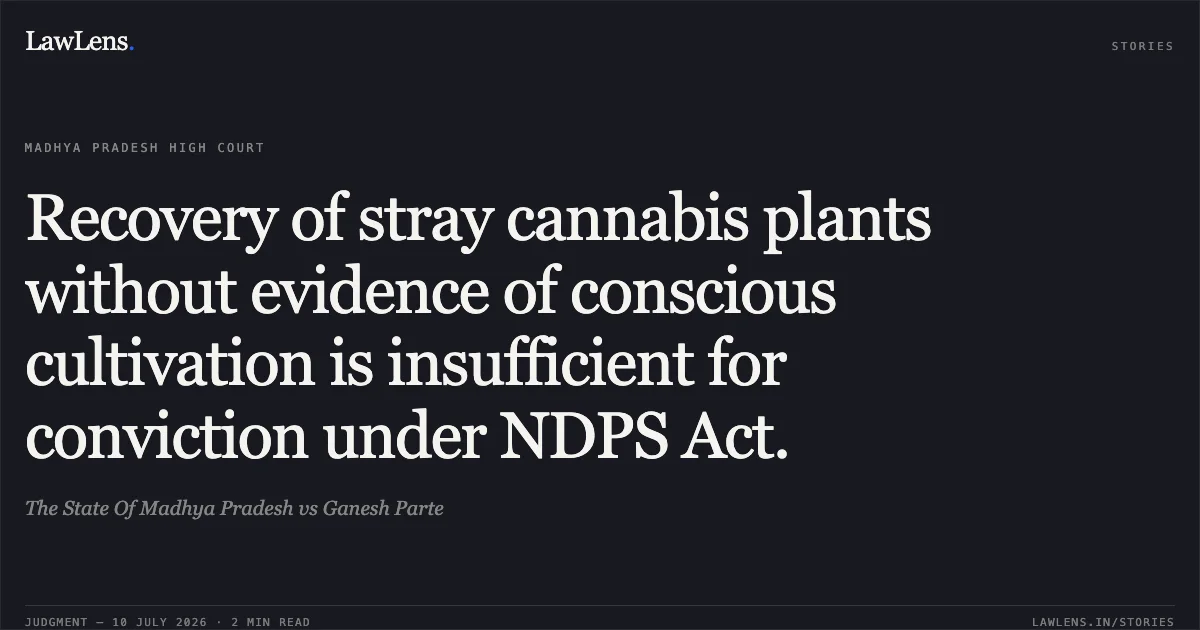
Source reference: para. 15Applying the "cultivation" test, the court held that nine stray plants in a maize field could constitute wild or spontaneous growth; without evidence of agricultural techniques or systematic rows, "conscious cultivation" under the NDPS Act was not established.
Source reference: para. 12-13Holding
The High Court dismissed the appeal and affirmed the judgment of acquittal.
It held that the prosecution failed to prove exclusive possession or deliberate cultivation by the respondent.
Source reference: para. 15The breaks in the chain of custody and procedural irregularities regarding the sealing of samples created reasonable doubt.
Source reference: para. 11The Court concluded that the trial court's findings were not perverse or illegal, and in accordance with the principles of appellate review of acquittals, no interference was warranted.
Source reference: para. 20Acts & Sections Cited
5 provisions across 2 statutes referred to in this judgment. Each provision opens on LawLens.
Code of Criminal Procedure, 19731
Narcotic Drugs and Psychotropic Substances Act, 19854
Original Court PDF
The State Of Madhya PradeshvsGanesh Parte
Click to open original judgment
Original judgment, available to read, download and summarize on LawLens.in