Facts
The complainant, a partner in a firm, alleged that the appellant, a First Division Assistant in the District Registrar’s office, demanded ₹500 to process documents relating to dissolution of the partnership, despite payment of the prescribed fee. Following a complaint, Lokayukta police conducted a trap and recovered the currency notes.
Source reference: pp. 3–4, para. 3The Trial Court convicted the appellant under Sections 7 and 13(1)(d), read with Section 13(2), of the Prevention of Corruption Act, 1988. She appealed under Section 374(2) Cr.P.C.
Source reference: pp. 2–5, paras. 1, 4Issues
Whether the prosecution proved beyond reasonable doubt that the appellant demanded illegal gratification, as required to establish the charged offences.
Source reference: pp. 8–10, paras. 13–14; pp. 12–13, paras. 22–23Whether the recovery of the currency notes and the other trap evidence were sufficient to sustain the conviction in the absence of reliable proof of demand.
Source reference: pp. 12–13, paras. 19–23Law Applied
The Court considered Sections 7 and 13(1)(d), read with Section 13(2), of the Prevention of Corruption Act, 1988.
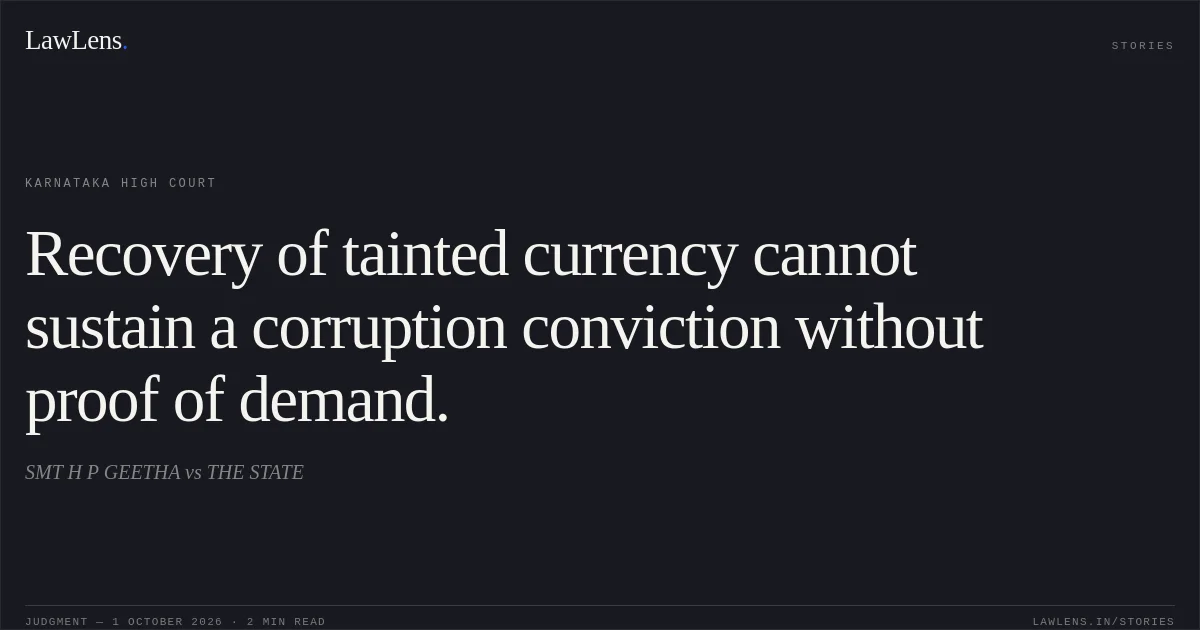
Source reference: pp. 8–10, paras. 13–14Relying on the Supreme Court authorities discussed in State of U.P. v. A.K. Gaba, including P. Satyanarayana Murthy v. State of A.P. and B. Jayaraj v. State of A.P., it applied the rule that proof of demand of illegal gratification is indispensable to establish the offences; mere acceptance or recovery of money, without proof of demand, is insufficient.
Source reference: pp. 8–10, paras. 13–14The Court also noted that the presumption under Section 20 arises only after demand is proved.
Source reference: pp. 8–10, paras. 13–14Reasoning
The complainant supported the prosecution in his examination-in-chief but, in cross-examination, was unable to identify when the alleged demand was made; the Court found no corroboration for his account.
Source reference: pp. 11–12, para. 19The shadow witness testified to a demand and payment, but the Court considered his evidence unreliable, noting that he had been partly treated as hostile and was an official witness.
Source reference: pp. 12–13, paras. 20–21The Court further observed that the money was kept in the complainant’s file and that the accused’s hand-wash solution did not turn pink.
Source reference: p. 13, para. 22On the evidence as a whole, it held that demand had not been established; consequently, recovery of the money could not sustain the conviction or trigger the Section 20 presumption.
Source reference: pp. 12–13, paras. 22–24Holding
The High Court allowed the appeal, set aside the conviction and sentence dated 27 November 2012, and acquitted the appellant of the offences under Sections 7 and 13(1)(d), read with Section 13(2), of the Prevention of Corruption Act, 1988.
Any bail bonds were cancelled.
Source reference: p. 14, para. 25Acts & Sections Cited
4 provisions across 2 statutes referred to in this judgment. Each provision opens on LawLens.
Code of Criminal Procedure, 19731
Prevention of Corruption Act, 19883
Original Court PDF
SMT H P GEETHAvsTHE STATE
Click to open original judgment
Original judgment, available to read, download and summarize on LawLens.in