Facts
The petitioner, an ex-Sarpanch, challenged recovery orders dated August 13, 2021, issued by the Sub-Divisional Officer (Revenue), Pakhanjur.
Source reference: para. 1These orders directed the recovery of ₹53,85,444/-, ₹10,730/-, and ₹2,262/- based on a Social Audit conducted under the Mahatma Gandhi National Rural Employment Guarantee Act (MGNREGA), 2005.
Source reference: para. 1Previously, an inquiry by the Rural Engineering Services had recommended a significantly lower recovery of ₹7,01,760/-.
Source reference: para. 2The petitioner alleged that the social audit was biased, conducted by political rivals, and executed without a show-cause notice or an opportunity for a hearing.
Source reference: para. 3Following an interim order by the High Court on September 9, 2021, no further proceedings were pursued by the respondents.
Source reference: para. 7Issues
1. Whether the recovery orders based on the MGNREGA Social Audit were vitiated by a violation of the principles of natural justice and procedural irregularity.
Source reference: para. 2–32. Whether the writ petition remained maintainable for adjudication on merits given that no final adverse action had been taken following the court's interim stay.
Source reference: para. 7–8Law Applied
Chhattisgarh Panchayat Raj Adhiniyam, 1993, specifically Section 40, which governs the inquiry and removal of office-bearers, and Section 92(4), which mandates the procedure for the recovery of money or records.
Source reference: para. 7Fundamental principle of audi alteram partem, noting that the prescribed authority is legally bound to issue a proper notice and afford a due opportunity of hearing before fastening financial liability.
Source reference: para. 3, 7Statutory mechanism for transparency and accountability under the Mahatma Gandhi National Rural Employment Guarantee Act, 2005 regarding Social Audits.
Source reference: para. 5Reasoning
The Court observed that since the grant of the interim order in 2021, the proceedings against the petitioner had effectively stalled, and no final order had been passed by the prescribed authority.
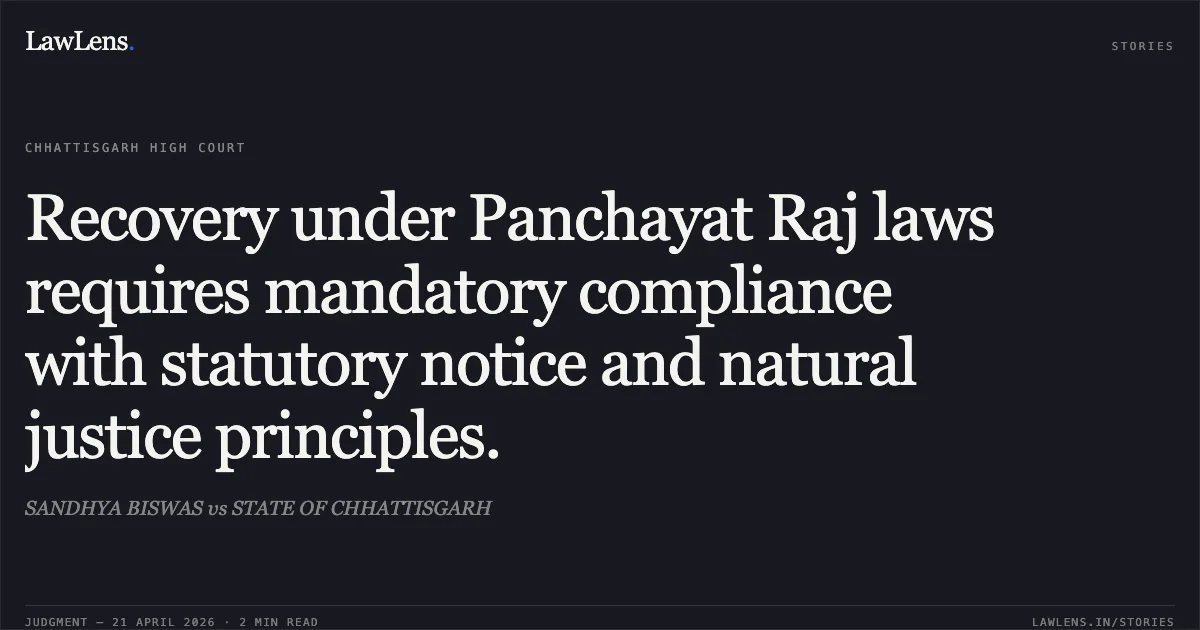
Source reference: para. 7The Court reasoned that under the Chhattisgarh Panchayat Raj Adhiniyam, 1993, any recovery or disciplinary action must strictly follow the dual requirements of a formal notice and a hearing as per Sections 40 and 92(4).
Source reference: para. 7Since the petitioner’s counsel admitted that there was currently no final adverse order warranting immediate judicial intervention, the Court determined that the petition did not require adjudication on the merits at this specific juncture.
Source reference: para. 8The Court focused on the prematurity of the grievance following the interim stay rather than the underlying factual disputes regarding the audit's validity.
Source reference: no citationHolding
The High Court of Chhattisgarh disposed of the writ petition, holding that the matter did not survive for consideration on merits at the current stage.
The Court reserved the petitioner’s liberty to challenge any future adverse order passed by the competent authority through appropriate legal remedies, including re-approaching the High Court.
Source reference: para. 8–9No specific relief regarding the quashing of the initial awards was granted, as the Court deemed the proceedings incomplete.
Source reference: para. 9Acts & Sections Cited
2 provisions across 1 statute referred to in this judgment. Linked provisions open on LawLens.
Chhattisgarh Panchayat Raj Adhiniyam, 19932
Original Court PDF
SANDHYA BISWASvsSTATE OF CHHATTISGARH
Click to open original judgment
Original judgment, available to read, download and summarize on LawLens.in