Facts
The complainant, Rajendra Singh Rajput, reported a robbery at his residence on the night of July 12-13, 2023, where unknown offenders assaulted his parents, resulting in his father’s death and the theft of jewelry, cash, and firearms.
Source reference: para. 2.APolice registered an FIR under Sections 392, 394, 397, 302, 307, and 460 of the IPC.
Source reference: para. 2.AFollowing a fingerprint match and the apprehension of co-accused Brajesh and Chintu, the police were informed that the stolen ornaments were sold to the petitioner, Mahesh, a jeweler.
Source reference: para. 2.AUpon his arrest on April 4, 2025, Mahesh stated he had melted the ornaments; subsequently, a 300-gram silver brick was recovered at his instance.
Source reference: para. 2.AA final report was submitted against the petitioner for the offence under Section 412 of the IPC (dishonestly receiving property stolen in the commission of a dacoity).
Source reference: para. 2.AThe petitioner sought quashing of the FIR, contending false implication based solely on co-accused statements and the professional nature of his silver possession.
Source reference: para. 3Issues
1. Whether the FIR and subsequent criminal proceedings against the petitioner should be quashed under Section 482 of the CrPC (now Section 528 of the Bharatiya Nagarik Suraksha Sanhita, 2023) on the grounds of insufficient evidence and false implication.
Source reference: para. 1, 82. Whether the recovery of a silver brick and the seizure of bill books constitute sufficient material to proceed with a trial for an offence under Section 412 of the IPC.
Source reference: para. 7Law Applied
The court primarily applied Section 482 of the CrPC/Section 528 of the BNSS regarding the inherent powers of the High Court to prevent abuse of the process of law.
Source reference: para. 1It relied on the landmark guidelines for quashing established in State of Haryana v. Ch. Bhajan Lal (AIR 1992 SC 604), which categorize instances where inherent powers may be exercised.
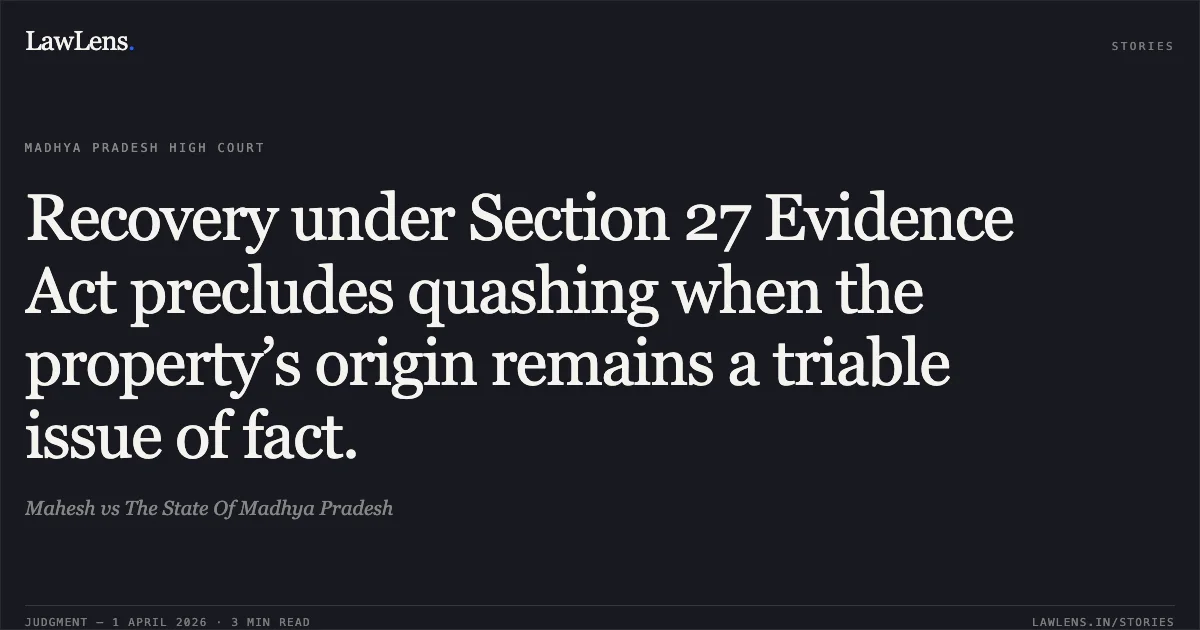
Source reference: para. 6The court applied Section 27 of the Evidence Act regarding the relevancy of information leading to the discovery of a fact, supported by the precedent in Mehboob Ali v. State of Rajasthan (2016) 14 SCC 640.
Source reference: para. 7The substantive charge involved Section 412 of the IPC.
Source reference: para. 2.AReasoning
The court examined the case diary and observed that the molten silver was recovered based on information provided by the petitioner following disclosures by co-accused, making the discovery relevant under Section 27 of the Evidence Act.
Source reference: para. 7The court noted that bill books seized during the investigation suggested the petitioner's complicity.
Source reference: para. 4, 7Regarding the petitioner's defense—that the silver was professional stock rather than stolen property—the court held that such a determination is a matter of evidence to be decided during the trial, not in a quashing petition.
Source reference: para. 7The court further reasoned that the petitioner’s claim of false implication could not be inferred merely from complaints made to police authorities and must be established through evidence.
Source reference: para. 7Applying the Bhajan Lal standards, the court found that the allegations were not "absurd" or "inherently improbable," nor was there a legal bar to the proceedings; thus, it could not be concluded that the chances of conviction were bleak.
Source reference: para. 7Holding
The High Court dismissed the petition, holding that no grounds were made out to invoke inherent jurisdiction to quash the FIR or subsequent proceedings.
The court concluded that the truth of the allegations and the validity of the petitioner’s defense are triable issues that must be determined through the examination of evidence during the trial.
Source reference: para. 7-8Relief was denied, and the prosecution was allowed to proceed.
Source reference: para. 8Acts & Sections Cited
11 provisions across 3 statutes referred to in this judgment. Each provision opens on LawLens.
Indian Penal Code, 18607
Code of Criminal Procedure, 19733
Bharatiya Nagarik Suraksha Sanhita, 20231
Original Court PDF
MaheshvsThe State Of Madhya Pradesh
Click to open original judgment
Original judgment, available to read, download and summarize on LawLens.in