Facts
The Respondent No. 1 (Assistant PF Commissioner) determined a provident fund liability of ₹8,52,33,497 against the Petitioner for the period 2011–2016 via an order dated May 4, 2017, under Section 7-A of the Employees Provident Fund and Miscellaneous Provisions Act, 1952 ("the Act")
Source reference: para 3.iiiA recovery notice under Section 8-F was issued on June 14, 2017
Source reference: para 3.ivFollowing a prior Writ Petition, the Petitioner filed an appeal before the EPF Tribunal in August 2022, which was subsequently dismissed in default on October 15, 2025
Source reference: para 3.vi-ixWhile an application for restoration of the appeal was pending, the Respondent No. 2 (Recovery Officer) issued a fresh recovery order on December 8, 2025, under Section 8-F(3)(i) of the Act
Source reference: para 3.xiOn December 9, 2025, the Respondents unilaterally withdrew ₹3,65,86,242 from the Petitioner’s bank accounts
Source reference: para 3.xiiThe Petitioner challenged the December 8 recovery order and the dismissal of the appeal
Source reference: para 3.xvIssues
1. Whether the recovery order passed under Section 8-F(3)(i) of the Act is sustainable when issued without fresh notice or an opportunity for a hearing
Source reference: para 4, 102. Whether a notice issued eight years prior (June 14, 2017) constitutes "reasonable notice" for executing a recovery order in December 2025
Source reference: para 11Law Applied
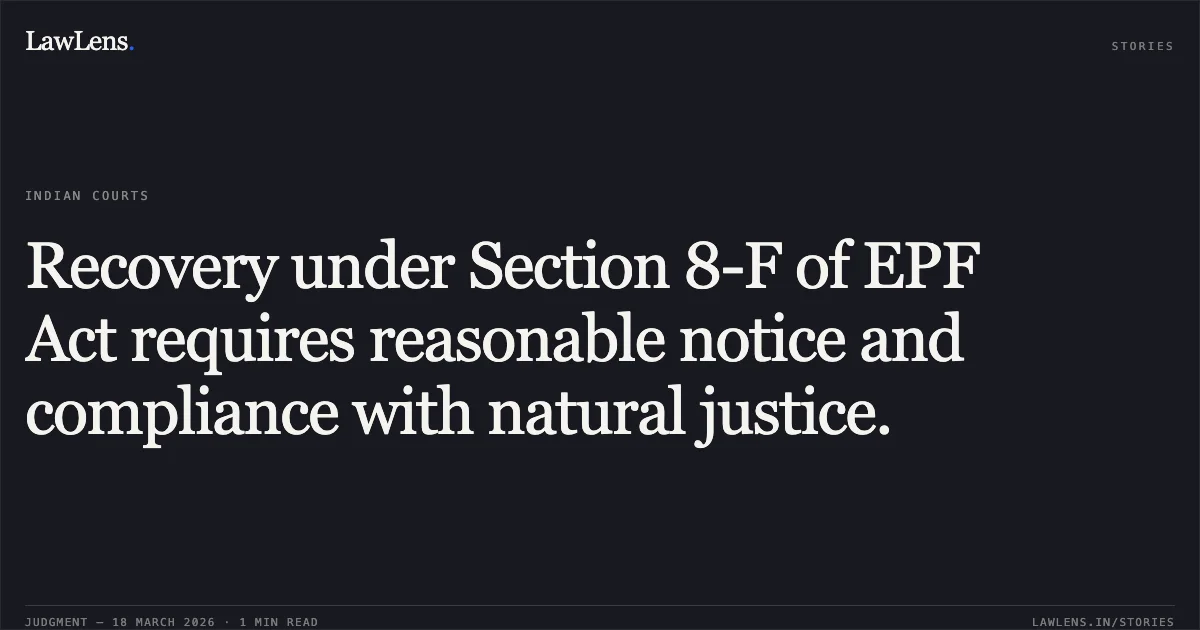
The court primarily applied Section 8-F of the Act, which governs "other modes of recovery" of provident fund dues
Source reference: para 2, 14It relied on the principle that proceedings under Section 8-F are quasi-judicial and necessitate adherence to natural justice, specifically the requirement of reasonable notice and an opportunity to be heard
Source reference: para 5, 14The court applied the precedent from B.T. Kadlag Constructions v. EPFO, which established that a Recovery Officer must first give notice and consider any statement on oath before issuing prohibitory orders
Source reference: para 14The court cited Delhi Development Authority v. Ram Prakash, holding that even in the absence of a prescribed limitation period, statutory authorities must act within a "reasonable time"
Source reference: para 12Reasoning
The court observed that the impugned recovery order dated December 8, 2025, failed to reference any contemporary notice, relying instead on a "stale" notice issued in 2017
Source reference: para 8, 11The court reasoned that the eight-year gap between the notice and the recovery action violated the requirement of "reasonable proximity" between the notice and the final order
Source reference: para 11It characterized the freezing of 25 bank accounts and the unilateral recovery of over ₹3.65 Crores as "arbitrary" and "hasty," particularly because the Petitioner’s restoration application for the main appeal was still pending before the Tribunal
Source reference: para 13, 15The court emphasized that the Recovery Officer is statutorily enjoined to follow the procedure under Section 8-F(3)(i), and the failure to provide a fresh opportunity to contest the demand constituted a significant infraction of the statutory mandate
Source reference: para 14Holding
The High Court allowed the writ petition and quashed the impugned recovery order dated December 8, 2025
The court held that a notice issued eight years prior cannot serve as a valid legal basis for drastic recovery actions
Source reference: para 11While the court did not rule on the restoration of the appeal (Prayer Clause b), it granted the Petitioner liberty to apply for a refund of the recovered amount (₹3,65,86,242) by filing an appropriate application before the Central Government Industrial Tribunal (CGIT), Nagpur, where the restoration application remains pending
Source reference: para 15, 17.IIIRule was made absolute with no order as to costs
Source reference: para 18Acts & Sections Cited
7 provisions across 1 statute referred to in this judgment. Linked provisions open on LawLens.
Employees’ Provident Funds And Miscellaneous Provisions Act, 19527
Original Court PDF
MUNICIPAL COUNCIL PUSAD, THR. CHIEF OFFICER, YAVATMALvsASSISTANT PROVIDENT FUND, COMMISSIONER, AKOLA AND ANR.
Click to open original judgment
Original judgment, available to read, download and summarize on LawLens.in