Facts
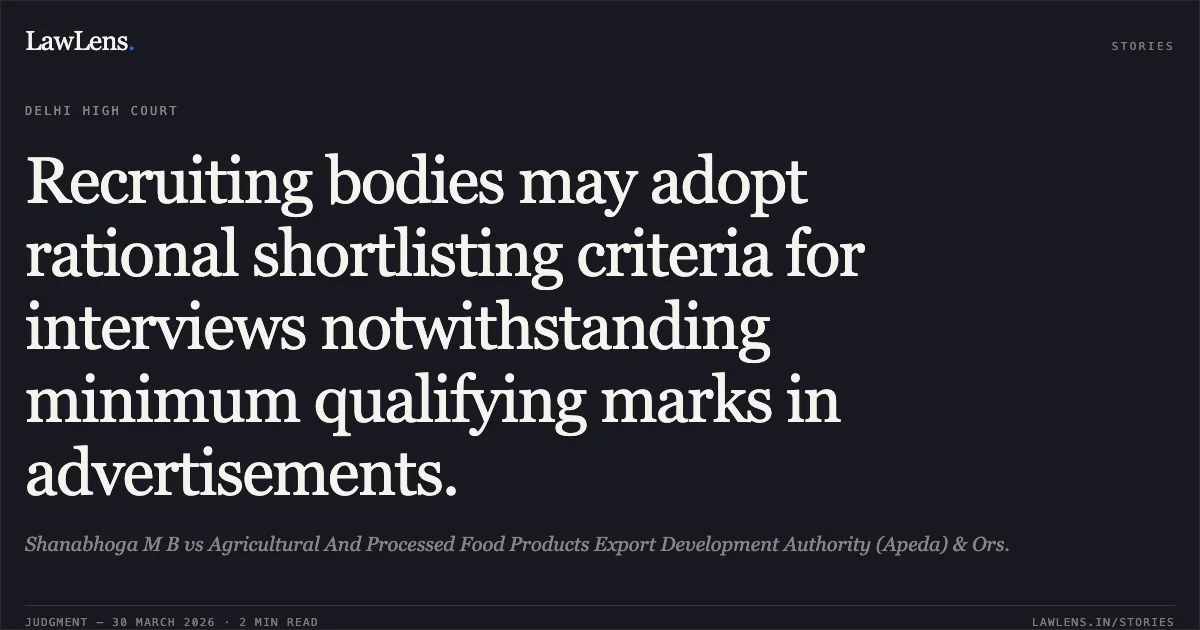
The appellant challenged the recruitment process conducted by Respondent No. 1 (APEDA) for the post of Assistant General Manager (Agriculture) under an advertisement dated 14.06.2025.
Source reference: p. 2The advertisement stipulated a 60% qualifying mark in the written test for unreserved candidates for shortlisting purposes.
Source reference: p. 3The appellant secured 61.75%, surpassing the threshold, but was not called for an interview.
Source reference: p. 3The respondent restricted interview calls to candidates scoring 63.5% or above, representing five times the number of available vacancies (25 candidates for 5 posts).
Source reference: p. 3A Single Judge dismissed the appellant's writ petition on 08.01.2026, citing delay and the conclusion of the recruitment process.
Source reference: p. 1-2, 4The appellant moved the Division Bench, arguing that the respondents "changed the rules of the game" by introducing the "five times the vacancy" criteria post-advertisement and violated Regulation 28(4) of the APEDA Regulations, 1999.
Source reference: p. 3, 10Issues
1. Whether the respondent’s decision to shortlist candidates by calling only five times the number of vacancies, despite no such specific mention in the advertisement, was arbitrary or illegal.
Source reference: p. 4-5 / para. 112. Whether the recruitment process violated Regulation 28(4) of the APEDA Regulations, 1999.
Source reference: p. 10 / para. 21Law Applied
Principles established in Tej Prakash Pathak v. Rajasthan High Court & Ors. (2025) 2 SCC 1, which permits recruitment bodies to devise appropriate procedures—including shortlisting—provided they are transparent, non-discriminatory, and rational.
Source reference: para. 14, 16, 17Union of India v. T. Sundararaman (1997) 4 SCC 664 and M.P. Public Service Commission v. Navnit Kumar Potdar (1994) 6 SCC 293, affirming that recruiting agencies may adopt a rational procedure to limit interviewees when the number of qualified applicants is large.
Source reference: para. 14, 15, 17Regulation 28(4) of the APEDA Regulations, 1999, which mandates recruitment for Group-A posts be based on selection from candidates fulfilling minimum eligibility criteria as advertised on an All India basis.
Source reference: para. 22-23Reasoning
The Court observed that while the appellant met the 60% benchmark, he did not meet the higher shortlisting threshold of 63.5% applied by the respondents to manage administrative exigencies.
Source reference: para. 10-12The Court held that shortlisting is a "trite law" for administrative reasons to narrow the zone of consideration when faced with many applicants.
Source reference: para. 12, 17The Court rejected the "change of rules" argument, noting that the respondent did not alter eligibility but applied a rational filter.
Source reference: para. 14, 18Crucially, the Court found no evidence of malice or mala fides in the selection process, and no candidate with lower marks than the appellant in his category was interviewed.
Source reference: para. 13, 19Regarding Regulation 28(4), the Court clarified that "minimum eligibility criteria" in advertisements relates to the threshold for participation, but does not prohibit the selection body from applying further objective shortlisting criteria for interviews to conclude the process successfully.
Source reference: para. 23-24Holding
The Court dismissed the intra-court appeal, holding that the shortlisting criteria adopted by APEDA was a bona fide administrative decision and did not suffer from arbitrariness or illegality.
The Court concluded that Regulation 28(4) was not violated as the minimum eligibility criteria were followed, and the selection body retained the inherent power to shortlist candidates to a manageable number.
Source reference: para. 24-25The delay of 2 days in filing the appeal was condoned, but no relief was granted on merits.
Source reference: para. 1-2, 26Original Court PDF
Shanabhoga M BvsAgricultural And Processed Food Products Export Development Authority (Apeda) & Ors.
Click to open original judgment
Original judgment, available to read, download and summarize on LawLens.in