Facts
The Petitioners, candidates on the UPSC "Pratibha Setu" Civil Services Examination (CSE) 2024 disclosure list, challenged the Mera Yuva Bharat Recruitment Rules, 2026 and a recruitment notification dated May 12, 2026.
Source reference: para 1In 2025, the respondent (MY Bharat) conducted its first recruitment for Assistant Directors using the borrowed recruitment rules of the Nehru Yuva Kendra Sangathan (NYKS), which required a Post-Graduate degree.
Source reference: paras 5-6The 2025 instructions noted that unfilled vacancies (from a pool of 358) would be filled from subsequent years' Pratibha Setu lists.
Source reference: para 5On May 6, 2026, the Respondent notified new rules (the 2026 Rules) which lowered the qualification to Graduation and raised the age limit.
Source reference: para 9The Petitioners contended that since recruitment steps (emails and a webinar) occurred in April 2026, the process had "commenced" before the new rules, and therefore the old Post-Graduate requirement should apply to the remaining 2025 vacancies.
Source reference: paras 2, 8, 12Issues
1. Whether the identification of vacancies in 2025 and the mention of future lists created a continuing recruitment process governed by the old NYKS Rules.
Source reference: para 23(i)2. Whether administrative communications (emails/webinars) and CPGRAMS responses in April 2026 constituted the legal "commencement" of recruitment.
Source reference: para 23(ii)3. Whether applying the 2026 Rules to the May 12, 2026 notification amounted to an impermissible midstream change of the "rules of the game."
Source reference: para 23(iii)Law Applied
Recruitment commences only when an employer sets the process in motion by inviting applications via a formal notification.
Source reference: para 25While the "rules of the game" cannot be changed midstream, the rules in force on the date of the recruitment notification govern the process (Tej Prakash Pathak v. Rajasthan High Court).
Source reference: paras 15, 27-28There is no universal rule requiring vacancies to be filled under the rules existing on the date they arose; rather, the right to be considered arises under the rules in force at the time of actual consideration (State of H.P. v. Raj Kumar).
Source reference: para 36Reasoning
The Court reasoned that the Pratibha Setu portal is merely a "source pool" and not a recruitment agency; thus, the availability of a list does not trigger a recruitment process.
Source reference: para 26The Court rejected the Petitioners' claim that recruitment began in April 2026, clarifying that informal emails and webinars were "anticipatory" and lacked the legal finality of a formal notification inviting applications, which only occurred on May 12, 2026.
Source reference: paras 29-31Regarding the 2025 vacancy pool, the Court held that a statement to use future lists is a "source identification" and does not freeze eligibility criteria or fetter the government's rule-making power.
Source reference: paras 33-34The Court observed that the 2026 Rules were prospective and actually "liberalized" the criteria (Graduation instead of Post-Graduation), which is a policy decision within the employer's domain.
Source reference: paras 40-41The Court noted that since the Petitioners applied under the new notification, they could not easily challenge the process after it had significantly progressed.
Source reference: para 47Holding
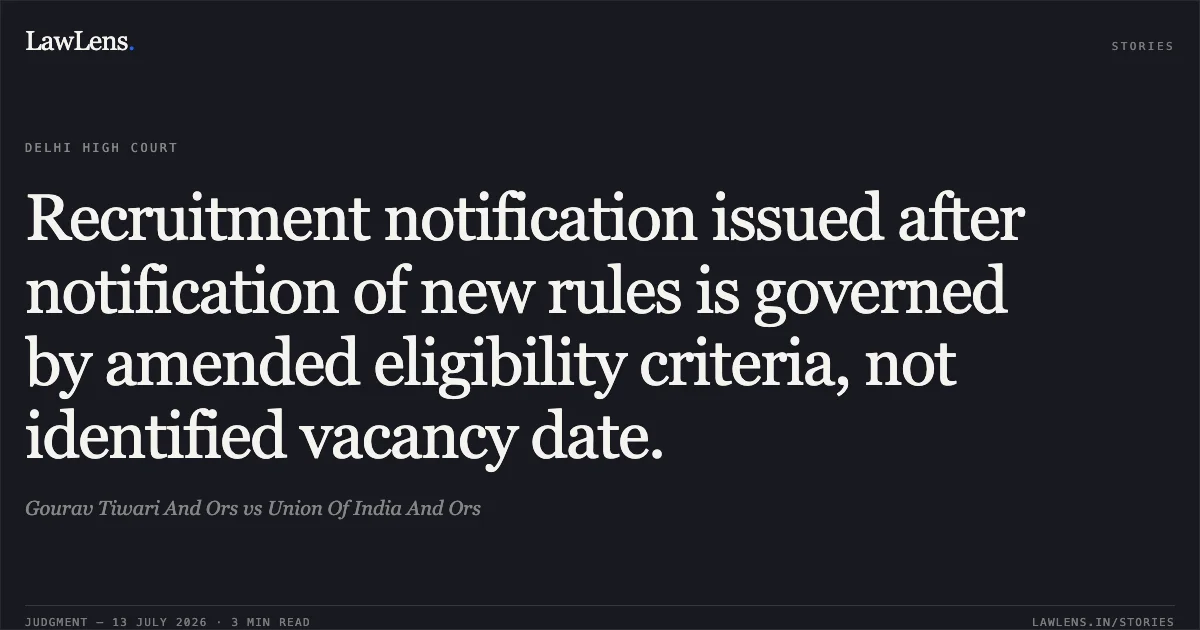
The Court held that the recruitment process for the CSE-2024 list commenced only on May 12, 2026, by which time the 2026 Rules were already in force, meaning there was no "midstream change".
The Court further held that candidates have no vested right to be governed by old rules for vacancies arising prior to an amendment, especially when the new rules are prospective and non-arbitrary; consequently, the writ petition and the challenge to the 2026 Rules and the May 12 notification were rejected.
Source reference: paras 49, 50-51, 53Original Court PDF
Gourav Tiwari And OrsvsUnion Of India And Ors
Click to open original judgment
Original judgment, available to read, download and summarize on LawLens.in


