Facts
The petitioners, five successful candidates in a written examination held on 15.09.2022 for the post of Chief Law Assistant under a 60% Departmental Promotion quota, challenged the wholesale cancellation of the recruitment process.
Source reference: p. 2-3Following initial results, the Railways rectified procedural errors (non-publication of answer keys and evaluation defects) via re-evaluation.
Source reference: p. 3-4Citing "suspicion" raised by a Re-evaluating Officer regarding handwriting variations and alignment differences in the answer scripts of two specific candidates, the competent authority cancelled the entire examination on 05.02.2024.
Source reference: p. 4-5The Central Administrative Tribunal (CAT), Guwahati Bench, upheld this cancellation on 08.12.2025, prompting this writ petition.
Source reference: p. 2, 5Issues
1. Whether the cancellation of an entire selection process is legally sustainable when irregularities are restricted to a segregable number of candidates.
Source reference: p. 5-72. Whether the decision to cancel the examination satisfied the tests of reasonableness and proportionality under Article 14 of the Constitution of India.
Source reference: p. 6, 8Law Applied
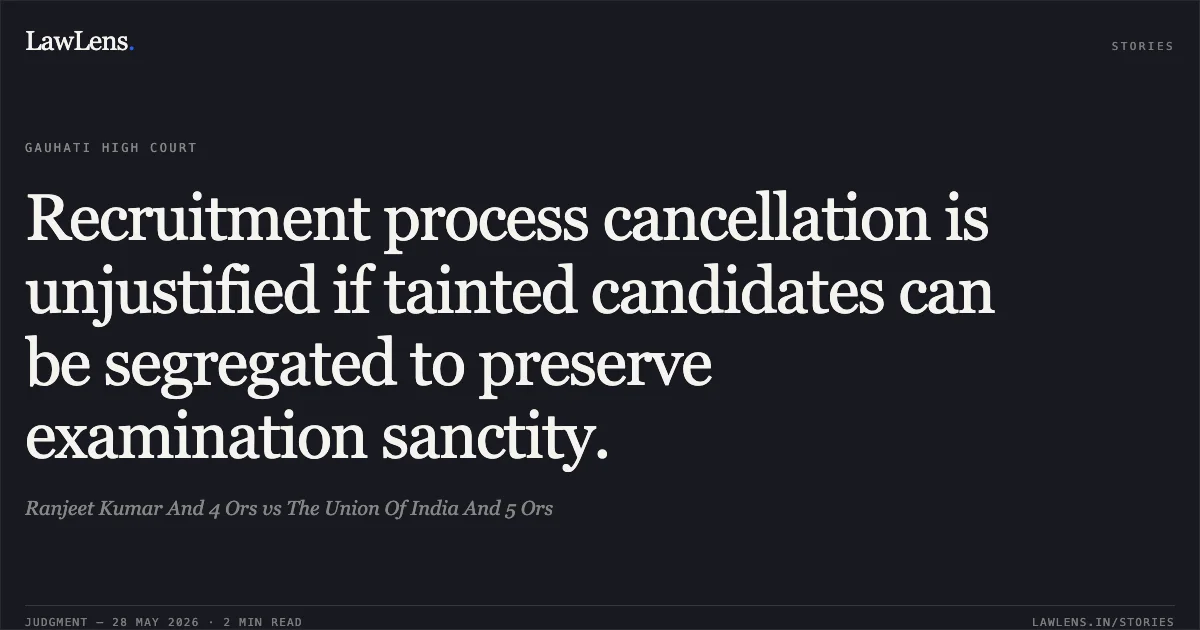
The Court applied the "systemic level" test for vitiation of exams, holding that cancellation is justified only if the sanctity of the process is compromised at a foundational level and it is impossible to separate "tainted" candidates from "untainted" ones.
Source reference: p. 7The Court relied on Sachin Kumar & Ors. v. DSSSB (2021) 4 SCC 631, which mandates that diligent applicants should not suffer for segregable malpractices.
Source reference: p. 6It further cited Inderpreet Singh Kahlon v. State of Punjab (2006) 11 SCC 356 and Vanshika Yadav v. Union of India (2024) 9 SCC 743 to reinforce the principle that "weeding out" is the preferred judicial remedy over mass cancellation, provided the irregularity is not systemic.
Source reference: p. 6-7The Court applied the Wednesbury principles of reasonableness and the proportionality test to administrative actions.
Source reference: p. 8Reasoning
The Court reasoned that the Railways' internal notes admitted that initial defects (answer keys and evaluation errors) had been fully remedied through re-evaluation.
Source reference: p. 4, 7The sole remaining ground for cancellation was a localized suspicion regarding the handwriting of only two candidates.
Source reference: p. 4, 7Applying the ratio from Sachin Kumar, the Court found that these two individuals could easily be segregated from the rest of the pool.
Source reference: p. 7Consequently, punishing all successful candidates for the suspected conduct of two individuals was deemed an "arbitrary and unreasonable exercise of power" that failed the proportionality test.
Source reference: p. 5, 8The Court observed that the CAT failed to notice that the irregularities were not "systemic," and therefore, the decision to nullify the entire process was not a "fair, reasonable, or well-balanced" exercise of discretion.
Source reference: p. 8Holding
The High Court set aside the Tribunal’s judgment dated 08.12.2025 and quashed the cancellation of the examination.
The Court held that the Railways must "weed out" the tainted candidates rather than scrap the process and directed the respondents to complete the selection process by segregating the cases of the two suspect candidates and taking the recruitment to its logical conclusion within three months.
Source reference: p. 8Original Court PDF
Ranjeet Kumar And 4 OrsvsThe Union Of India And 5 Ors
Click to open original judgment
Original judgment, available to read, download and summarize on LawLens.in