Facts
The petitioner, an Indian citizen, arrived at IGI Airport, New Delhi from Bangkok on 26.02.2024. Customs authorities detained a gold kada (120g) and a gold ring (8g), totaling 128g, which the petitioner claimed were personal effects
Source reference: p.1-2The Adjudicating Authority, via Order-in-Original (OIO) dated 28.06.2024, denied baggage allowance, declared the petitioner an ineligible passenger, and ordered absolute confiscation of the gold (valued at ₹7,43,835/-) plus a penalty of ₹75,000/- under Section 112
Source reference: p.2-3On appeal, the Commissioner of Customs (Appeals), via Order-in-Appeal (OIA) dated 27.06.2025, modified the absolute confiscation to allow redemption upon payment of a ₹75,000/- fine and applicable duty, while upholding the penalty
Source reference: p.3The Department challenged this via a revision petition, which was dismissed by the Revisional Authority on 05.03.2026, affirming the OIA
Source reference: p.3-5The petitioner then approached the High Court seeking the release of goods and waiver of warehouse charges
Source reference: p.1-2Issues
1. Whether the absolute confiscation of the impugned gold was justified given the nature of the items and the profile of the passenger
Source reference: p.4, para. 82. Whether the petitioner is entitled to a waiver of warehouse charges for the period following the appellate order allowing redemption
Source reference: p.5, para. 12Law Applied
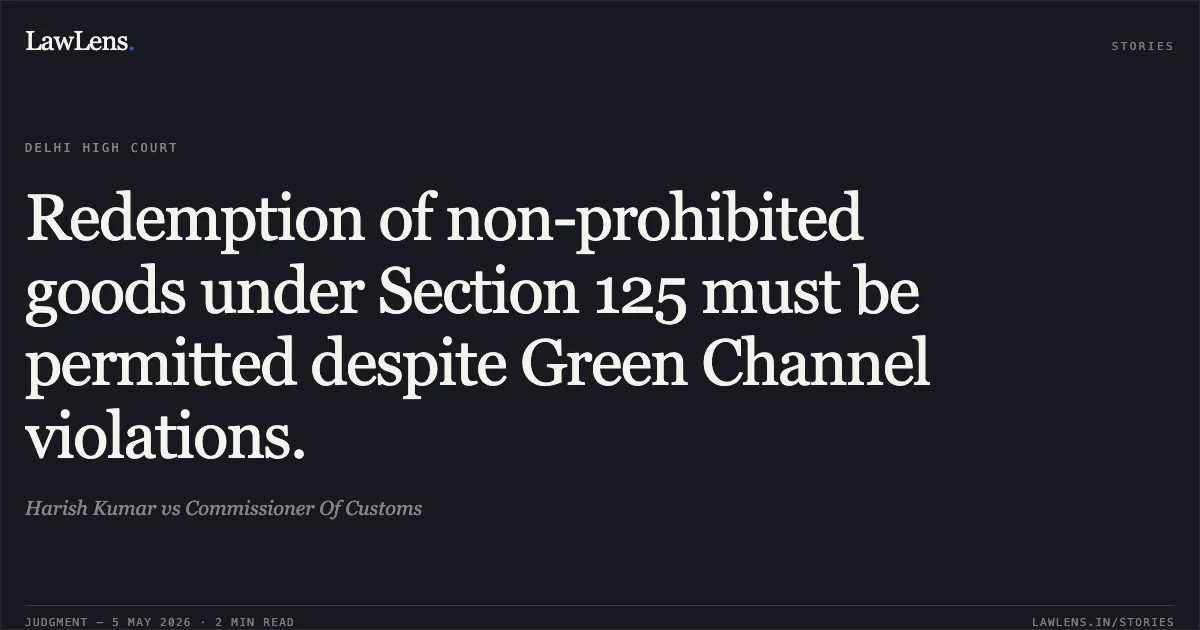
Section 125 of the Customs Act, 1962, which provides discretionary power to the adjudicating officer to offer a fine in lieu of confiscation for non-prohibited goods
Source reference: p.5The principle that absolute confiscation is not a mandatory consequence even for prohibited goods, and the exercise of discretion depends on the nature of the goods and the prohibition
Source reference: p.4, para. 7The Supreme Court precedent in Union of India & Ors. v. M/s Raj Grow Impex LLP & Ors. (2021) which established the guidelines and circumstances for exercising discretion in ordering redemption instead of absolute confiscation
Source reference: p.4, para. 7Reasoning
The Court noted that the Revisional Authority had correctly upheld the OIA, observing that the petitioner was the owner of the gold, the quantity was not "commercial," and there was no evidence of him being a "habitual offender" or part of a "smuggling syndicate"
Source reference: p.4, para. 8The Court reasoned that since the appellate authority had already exercised its discretion under Section 125 to permit redemption on 27.06.2025, the petitioner’s primary relief was already granted
Source reference: p.5, para. 10Regarding warehouse charges, the Court applied an equitable interpretation, holding that once a legal right to redeem the goods was established via the OIA, the petitioner should not be penalized with storage costs arising from subsequent litigation or delays
Source reference: p.5-6, para. 12Holding
The High Court disposed of the writ petition by affirming the OIA and the Revisional Authority's order.
It directed the Respondent to forthwith release the gold articles subject to the petitioner paying the applicable customs duty, a redemption fine of ₹75,000/-, and a penalty of ₹75,000/-
Source reference: p.5, para. 11Crucially, the Court granted a waiver of warehouse charges for the period from 27.06.2025 (date of OIA) until the actual date of release
Source reference: p.6, para. 12A compliance report was ordered to be submitted within three weeks
Source reference: p.6, para. 14Acts & Sections Cited
2 provisions across 1 statute referred to in this judgment. Each provision opens on LawLens.
Customs Act,19622
Original Court PDF
Harish KumarvsCommissioner Of Customs
Click to open original judgment
Original judgment, available to read, download and summarize on LawLens.in