Facts
The Appellant was convicted by the Trial Court on June 2, 2008, under Sections 363, 366, and 376 of the IPC for the kidnapping and rape of a 15-year-old minor in September 2002
Source reference: p. 1-2The prosecution alleged that the Appellant enticed the prosecutrix from her school, took her to various locations in Uttarakhand, and subjected her to sexual acts against her will
Source reference: p. 2The Appellant was sentenced to a maximum of 7 years of Rigorous Imprisonment (RI)
Source reference: p. 2Having served 5 years, 9 months, and 19 days of his sentence, the Appellant limited the scope of this appeal to the reduction of the sentence to the period already undergone
Source reference: p. 2-3He cited the loss of government employment, financial hardship, a 24-year long trial/appeal process, and family responsibilities as mitigating factors
Source reference: p. 3Issues
1. Whether the circumstances of the case, including the Appellant's period of incarceration and the complainant's non-objection, constitute "adequate and special reasons" under the proviso to Section 376 IPC to reduce the sentence below the prescribed minimum
Source reference: p. 7Law Applied
The Court primarily considered the application of the proviso to Section 376(2)(g) of the IPC (as it stood post-2013/pre-reform context contextually cited), which allows for a sentence less than the minimum for "adequate and special reasons"
Source reference: p. 3It relied on the precedent of Baldev Singh & Ors. v. State of Punjab (2011), which held that a long-standing dispute and a compromise between parties could warrant a reduced sentence under the said proviso
Source reference: p. 3Furthermore, the Court applied the guidelines from Sonadhar v. State of Chattisgarh (2021) regarding the disposal of appeals based on "sentence undergone" for convicts who have served more than half their fixed-term sentences
Source reference: p. 6Reasoning
The Court noted that the Appellant had undergone nearly his entire 7-year sentence (5 years, 9 months, and 19 days)
Source reference: p. 5, 7While the Trial Court had previously rejected personal hardships as "special reasons," the High Court found that the current landscape had changed: the Appellant faced extreme financial distress, lost his livelihood, and the complainant (the father) expressed no objection to the reduction
Source reference: p. 5, 7The Court reasoned that "adequate and special reasons" require a contextual interpretation, balancing the gravity of the offence against post-conviction developments and the lack of societal benefit in further incarceration
Source reference: p. 7-8It emphasized that since the Appellant had served a "substantial rather almost the entire sentence," the ends of justice would be met without further imprisonment
Source reference: p. 7Holding
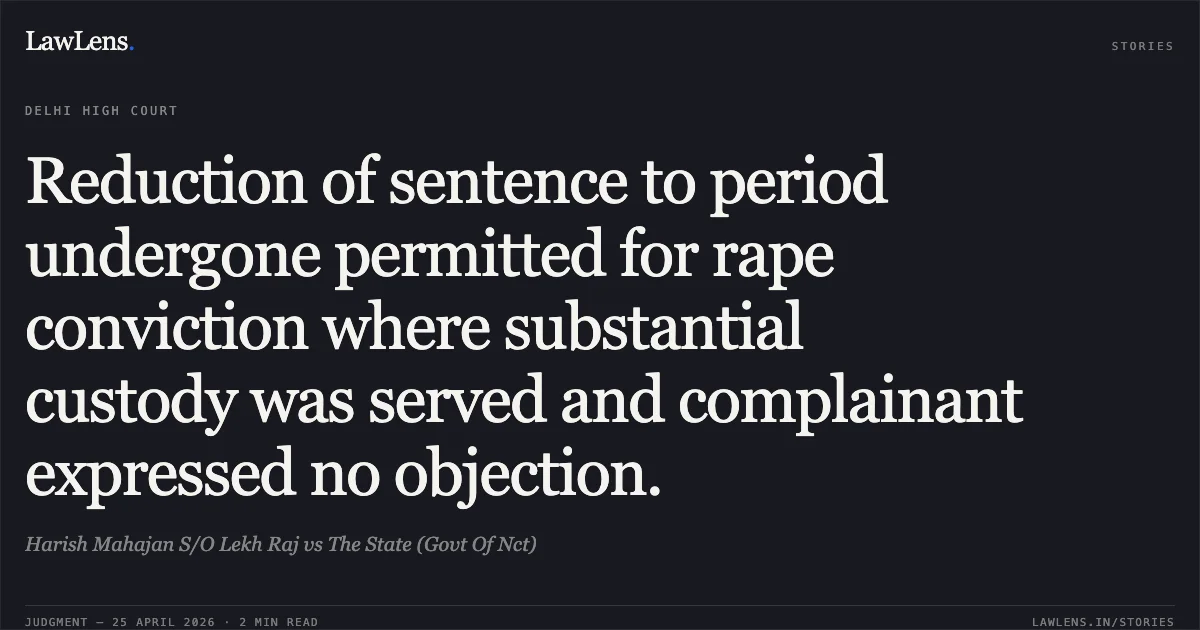
The Court upheld the conviction but modified the sentence to the period already undergone
To balance the reduction of the substantive sentence, the Court enhanced the fine under Section 376 IPC from ₹2,000 to ₹25,000, payable within one month, to be realized as arrears of land revenue in case of default. The appeal was disposed of accordingly
Source reference: p. 8Acts & Sections Cited
3 provisions across 1 statute referred to in this judgment. Each provision opens on LawLens.
Indian Penal Code, 18603
Original Court PDF
Harish Mahajan S/O Lekh RajvsThe State (Govt Of Nct)
Click to open original judgment
Original judgment, available to read, download and summarize on LawLens.in