Facts
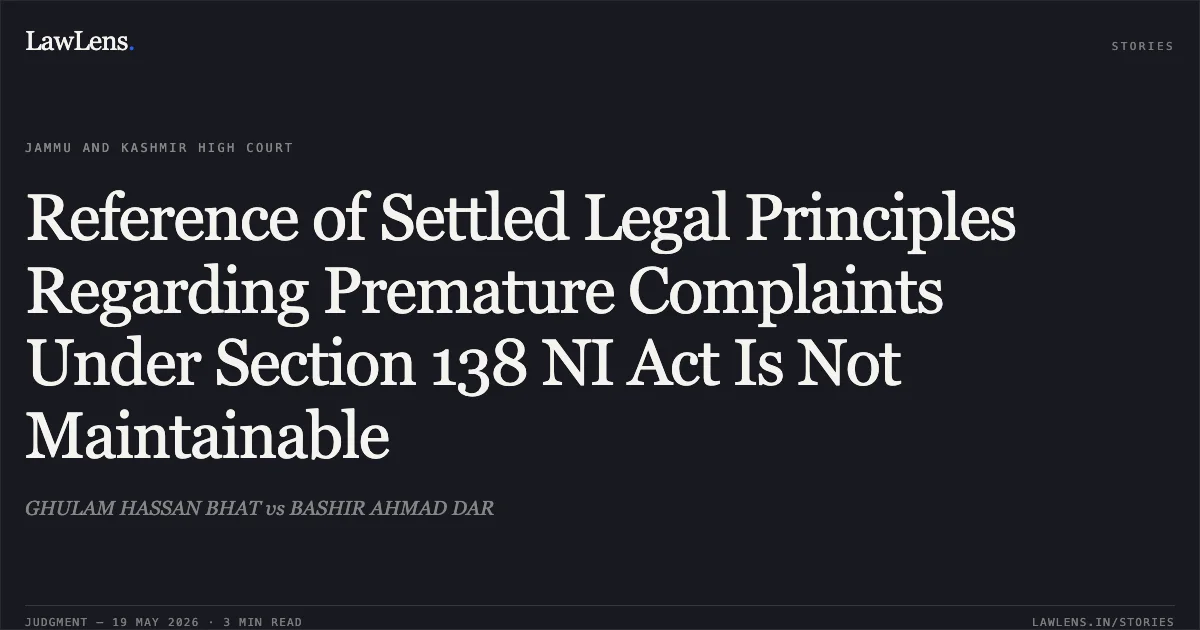
The Petitioner was convicted by the Judicial Magistrate 1st Class, Sumbal, under Section 138 of the Negotiable Instruments Act.
Source reference: para. 1In the appeal before the Additional Sessions Judge, Bandipora, the Petitioner raised an objection that the original complaint was premature as it was filed before the expiry of the mandatory fifteen-day notice period.
Source reference: para. 8Consequently, the Additional Sessions Judge made a reference to the High Court under Section 395 of the Cr.P.C., framing three questions of law regarding whether such a conviction can be set aside if the objection was raised for the first time during appeal, and whether Section 465 of the Cr.P.C. (curable irregularities) protects such a conviction.
Source reference: para. 2Issues
1. Whether the reference made by the Additional Sessions Judge falls within the ambit of Section 395 of the Cr.P.C.
Source reference: para. 32. Whether a question of law already settled by binding judicial precedents can be referred to the High Court under Section 395 of the Cr.P.C.
Source reference: para. 73. Whether the High Court is required to decide if prematurity of a complaint is a curable irregularity under Section 465 Cr.P.C. or an incurable jurisdictional nullity.
Source reference: para. 11Law Applied
The Court primarily applied Section 395 of the Cr.P.C., which permits a subordinate court to refer a case to the High Court only when it involves a question of the validity of an Act or a question of law that has not been previously decided by the High Court or Supreme Court.
Source reference: paras. 4-7The Court relied on Yogendra Pratap Singh v. Savitri Pandey (2014) 10 SCC 713 and Gajanand Burange v. Laxmi Chand Goyal (2022) to affirm that a complaint filed before the expiry of the 15-day notice period is not a complaint in the eyes of law.
Source reference: para. 9It also considered Section 465 of the Cr.P.C., which distinguishes between curable irregularities and incurable illegalities that vitiate a trial.
Source reference: para. 11Reasoning
The Court reasoned that Section 395(2) Cr.P.C. does not allow for the reference of every legal question; it is reserved for questions of law that have not yet been deliberated upon by superior courts.
Source reference: para. 7Since the Supreme Court in Yogendra Pratap Singh has already settled the law regarding the invalidity of premature complaints, there was no "virgin area" of law requiring a new determination.
Source reference: paras. 10-11Regarding the applicability of Section 465 Cr.P.C., the Court noted that it is the duty of the Appellate Court to apply existing judicial precedents to determine if the defect is a jurisdictional nullity or a curable error.
Source reference: para. 11The High Court declined to perform "legal research" for the subordinate court, stating that the Appellate Court must take its own call based on a "plethora of judgments" already available on the subject.
Source reference: para. 11Furthermore, the Court corrected the lower court's factual finding, noting that the Petitioner had indeed raised the jurisdictional objection in the memo of appeal and not merely at the final argument stage.
Source reference: para. 12Holding
The High Court held that no substantial or unsettled question of law arose in the case that necessitated a reference under Section 395 Cr.P.C.
The Court declined to answer the formulated questions and returned the reference, directing the Additional Sessions Judge, Bandipora, to proceed with the appeal in accordance with law and established precedents.
Source reference: para. 13Acts & Sections Cited
4 provisions across 2 statutes referred to in this judgment. Each provision opens on LawLens.
Code of Criminal Procedure, 19733
Negotiable Instruments Act, 18811
Original Court PDF
GHULAM HASSAN BHATvsBASHIR AHMAD DAR
Click to open original judgment
Original judgment, available to read, download and summarize on LawLens.in