Facts
The Petitioner and Respondent entered into Agreement No. 57/EE/SRDProject-1/PWD/2024-2025 on December 19, 2024.
Source reference: para. 1Clause 25 of the Agreement provided a multi-tier dispute resolution mechanism involving conciliation and arbitration.
Source reference: para. 2Following the emergence of disputes, the Petitioner invoked the arbitration clause via legal notice dated March 17, 2026, as required by Section 21 of the Arbitration and Conciliation Act, 1996.
Source reference: para. 3The Petitioner subsequently approached the Delhi High Court under Section 11 of the Act seeking the appointment of a Sole Arbitrator.
Source reference: para. 1The parties reached a consensus (ad idem) during proceedings that the dispute be referred to a Sole Arbitrator possessing specific technical qualifications stipulated in the contract.
Source reference: paras. 4-5Issues
1. Whether a Sole Arbitrator should be appointed under Section 11 of the Act given the existence of an arbitration agreement and the consent of the parties.
Source reference: paras. 4, 92. What is the permissible scope of judicial scrutiny by a Referral Court at the Section 11 stage.
Source reference: para. 6Law Applied
Section 11(6) of the Arbitration and Conciliation Act, 1996, regarding the court’s power to appoint arbitrators.
Source reference: para. 1Principles established by the Supreme Court in SBI General Insurance Co. Ltd. v. Krish Spinning (2024), which reconciled earlier 7-judge bench findings in Interplay Between Arbitration Agreements under Arbitration Act, 1996 & Stamp Act, 1899, In re.
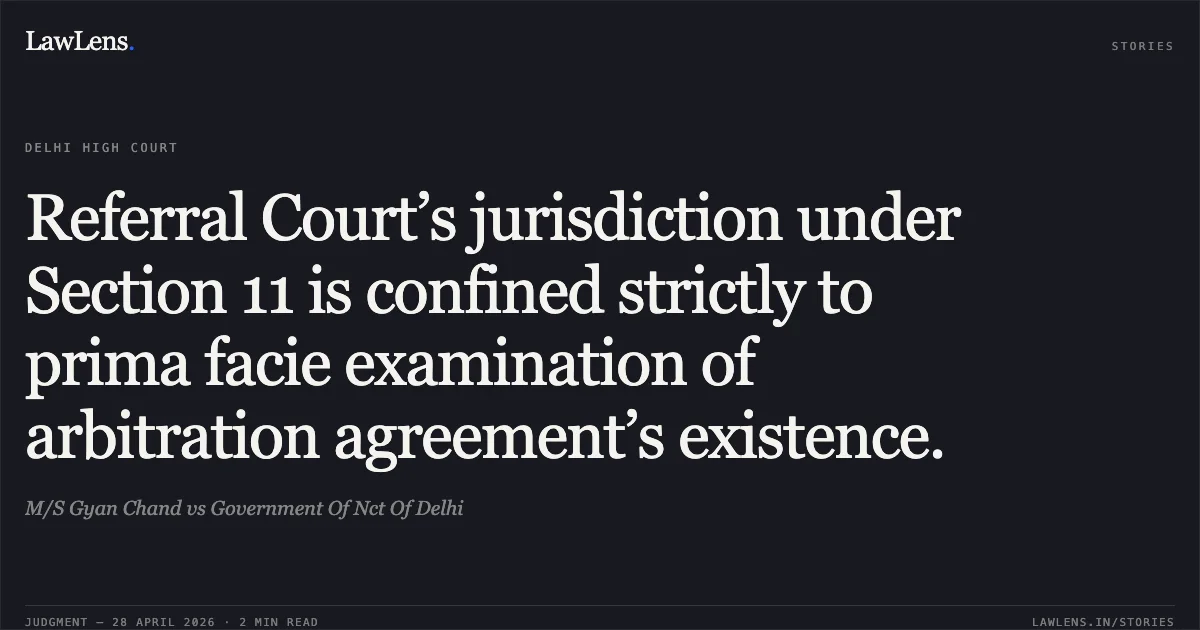
Source reference: para. 6Judicial intervention under Section 11 is confined solely to a prima facie examination of the existence of an arbitration agreement.
Source reference: para. 7The principle of "competence-competence" under Section 16, leaving questions of "accord and satisfaction" or frivolousness to the Arbitral Tribunal.
Source reference: paras. 119, 128Reasoning
The Court observed that the parties did not dispute the existence of the arbitration agreement or the fulfillment of the Section 21 notice requirement.
Source reference: paras. 3-4Applying the "facilitative and procedural" role defined in Krish Spinning, the Court limited its enquiry to the existence of the agreement, refusing to embark upon any "laborious enquiry" into the merits of the claims.
Source reference: paras. 7, 114The Court noted that since the parties explicitly agreed to refer the matter to an arbitrator who meets specific professional criteria (a Graduate Engineer of Chief Engineer rank), the court's duty was simply to give effect to this mutual intention.
Source reference: paras. 5, 9The Court emphasized that all contentions regarding the merits remain open for the arbitrator to decide, ensuring minimum judicial interference as intended by the legislature.
Source reference: paras. 15-16Holding
The Court allowed the petition and appointed Mr. Anand Kumar (Chief Engineer) as the Sole Arbitrator to adjudicate the disputes, valued at approximately Rs. 50,00,000/-.
The Court directed the Arbitrator to provide disclosures under Section 12(2) and fixed the fee structure in accordance with the Fourth Schedule of the Act; the parties were directed to share the arbitral costs equally, and the petition was formally disposed of.
Source reference: paras. 12-14, 18Acts & Sections Cited
9 provisions across 1 statute referred to in this judgment. Each provision opens on LawLens.
Arbitration and Conciliation Act, 1996
Original Court PDF
M/S Gyan ChandvsGovernment Of Nct Of Delhi
Click to open original judgment
Original judgment, available to read, download and summarize on LawLens.in