Facts
The Petitioners purchased a flat in Kolkata from Respondent Nos. 2 and 3 (original buyers), with Respondent No. 1 as the Owner/Vendor and Respondent No. 4 as the Developer, via an Agreement for Sale dated 30.03.2015.
Source reference: para. 3While the Petitioners paid the full consideration and took possession in 2015, the formal conveyance deed remained unexecuted despite repeated requests and exchanges of draft deeds.
Source reference: para. 3-5In 2023, Respondent No. 4 stopped maintenance activities, and on 19.08.2025, it expressly denied the liability to execute the deed.
Source reference: para. 5-6The Petitioners invoked the arbitration clause (Clause 9.1) on 10.09.2025, but the parties failed to agree on an arbitrator, specifically because the named arbitrator was alleged to be ineligible under Section 12(5) due to his prior representation of the Respondents.
Source reference: para. 7-8Respondent No. 4 opposed the Section 11(6) petition primarily on the ground that the claims were ex facie barred by limitation, asserting the cause of action arose in 2008 or 2015.
Source reference: para. 13Issues
1. Whether the referral court under Section 11(6) should refuse to appoint an arbitrator if the underlying claims are allegedly barred by limitation.
Source reference: para. 182. Whether the named arbitrator is ineligible and if the requirements for appointment of an independent arbitrator under Section 11(6) are satisfied.
Source reference: para. 22-25Law Applied
The court primarily applied Section 11(6) and 12(5) of the Arbitration and Conciliation Act, 1996.
Source reference: para. 1, 24It relied heavily on the precedent in SBI General Insurance Co. Ltd. v. Krish Spinning [2024 SCC OnLine SC 1754], which clarified that the court’s enquiry at the referral stage must be limited to the limitation of the Section 11(6) petition itself, rather than the underlying claims.
Source reference: para. 19It further integrated the principles from In Re: Interplay Between Arbitration Agreements... and the Indian Stamp Act regarding the narrow scope of judicial intervention at the pre-referral stage.
Source reference: para. 19-20The court also noted Article 137 of the Limitation Act, 1963, regarding the three-year period to file a Section 11 application.
Source reference: para. 20Reasoning
The Court rejected Respondent No. 4’s reliance on the "two-pronged test" from Arif Azim Co. Ltd. v. Aptech Ltd., noting that the limb requiring the court to examine if underlying claims are "dead" has been clarified and effectively overruled by the Supreme Court in Krish Spinning.
Source reference: para. 19-20The Court reasoned that any "intricate evidentiary enquiry" into whether the claims are time-barred—considering facts like continuing assurances and the date of unequivocal refusal—falls exclusively within the domain of the Arbitral Tribunal under the principle of competence-competence.
Source reference: para. 20-21For the Section 11(6) stage, the Court found: (a) a valid arbitration agreement exists (Clause 9.1); (b) the named arbitrator is prima facie ineligible under Section 12(5) read with the Seventh Schedule; and (c) the Section 11 petition itself was filed within three years of the failure to appoint an arbitrator following the Section 21 notice.
Source reference: para. 23-26Holding
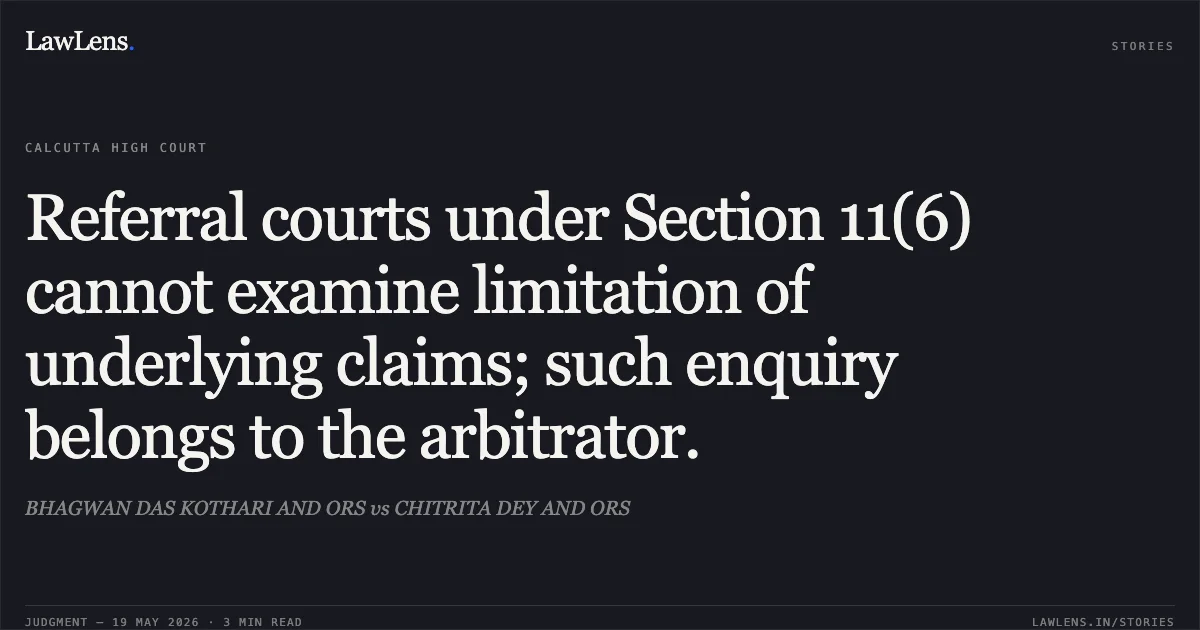
The Court allowed the petition and held that the referral court must not conduct a detailed limitation analysis of the underlying claims, leaving that question to the arbitrator.
The Court appointed Mr. Sounak Bhattacharya as the Sole Arbitrator. The arbitrator is directed to consider all objections, including limitation regarding individual claims, as preliminary issues. All questions on the merits of the dispute remain open for the tribunal's adjudication.
Source reference: para. 28, 29Acts & Sections Cited
5 provisions across 2 statutes referred to in this judgment. Each provision opens on LawLens.
Arbitration and Conciliation Act, 19963
Limitation Act, 19632
Original Court PDF
BHAGWAN DAS KOTHARI AND ORSvsCHITRITA DEY AND ORS
Click to open original judgment
Original judgment, available to read, download and summarize on LawLens.in


