Facts
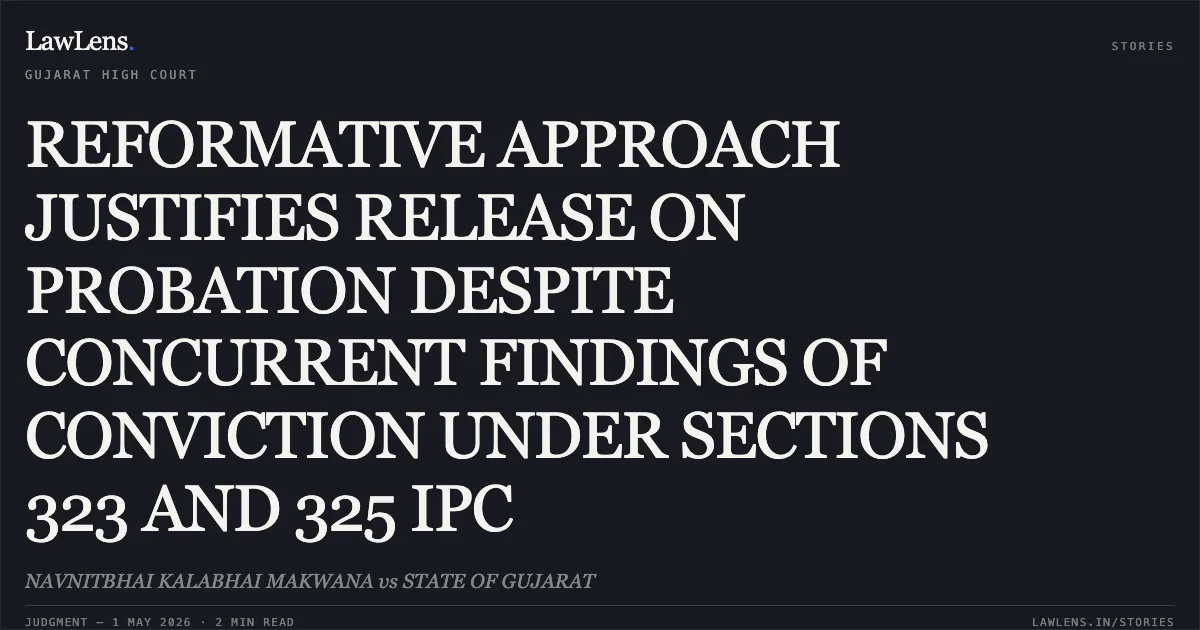
The applicants (accused) were convicted by the Judicial Magistrate First Class, Mehsana, in Criminal Case No. 4669 of 1999 for offenses involving unlawful assembly and voluntarily causing hurt/grievous hurt.
Source reference: p. 1-2Applicant No. 1 was convicted under Sections 147, 148, 149, and 325 of the IPC, while Applicant No. 2 was convicted under Sections 147, 148, 149, and 323 of the IPC.
Source reference: p. 1-2Their statutory appeal (Criminal Appeal No. 58 of 2007) was dismissed by the Additional Sessions Judge, Mehsana, on 26.03.2008, confirming the convictions.
Source reference: p. 2The applicants challenged these concurrent findings via the present revision application.
Source reference: p. 2During the pendency of the application, Applicant No. 3 expired, resulting in the abatement of proceedings against him.
Source reference: p. 1Issues
1. Whether the High Court, in its revisional jurisdiction, should interfere with the concurrent findings of conviction recorded by the lower courts.
Source reference: p. 32. Whether the applicants are entitled to the benefit of probation under the reformative approach of penology, considering the lapse of time since the incident.
Source reference: p. 3-4Law Applied
The court applied the principles governing revisional jurisdiction under Sections 397 read with 401 of the Code of Criminal Procedure, 1973 (CrPC).
Source reference: p. 3Amit Kapoor v. Ramesh Chander (2012) 9 SCC 460, which limits interference to cases of glaring procedural defects or manifest errors of law.
Source reference: p. 3Section 360(1) of the CrPC and Section 4 of the Probation of Offenders Act, 1958, emphasizing the reformative theory of punishment and the rehabilitation of first-time offenders.
Source reference: p. 4Reasoning
The Court observed that the revisional jurisdiction is discretionary and restricted; it cannot act as a court of appeal to re-appreciate evidence unless perversity is shown.
Source reference: p. 3Finding no jurisdictional error or miscarriage of justice in the lower courts' findings, the High Court upheld the conviction.
Source reference: p. 3The Court pivoted to a reformative approach, noting that 18 years had passed since the incident and the applicants had not engaged in further criminal activity.
Source reference: p. 3The Chief Probation Officer’s report dated 28.04.2026 confirmed the applicants’ good conduct and recommended probation.
Source reference: p. 3The Court reasoned that societal interest and justice are better served by rehabilitation than by enforcing harsh imprisonment for stale offenses where the offenders show clear signs of reform.
Source reference: p. 4Holding
The High Court maintained the conviction and sentence but directed that the applicants be released on probation of good conduct under Section 4 of the Probation of Offenders Act.
The applicants were ordered to execute a probation bond of Rs. 20,000/- each with one surety for a period of one year, during which they must maintain peace and appear for sentencing if called upon.
Source reference: p. 4The revision application was disposed of with a direction to submit the bonds to the trial court within 15 days.
Source reference: p. 4Acts & Sections Cited
9 provisions across 3 statutes referred to in this judgment. Each provision opens on LawLens.
Code of Criminal Procedure, 19733
Indian Penal Code, 18605
Probation of Offenders Act, 19581
Original Court PDF
NAVNITBHAI KALABHAI MAKWANAvsSTATE OF GUJARAT
Click to open original judgment
Original judgment, available to read, download and summarize on LawLens.in