Facts
The applicant was convicted by the learned 2nd Judicial Magistrate First Class, Deesa, in Criminal Case No. 1767 of 2016 for offences under Section 66(1)(b) of the Bombay Prohibition Act, 1949 and Section 185 of the Motor Vehicles Act, 1988, by judgment dated 27 September 2017.
Source reference: p.1, para. 2In Criminal Appeal No. 53 of 2017, the learned 4th Additional District Judge, Deesa, acquitted him of the offence under Section 185 of the Motor Vehicles Act but upheld his conviction under Section 66(1)(b) of the Bombay Prohibition Act.
Source reference: p.1, para. 2The appellate court imposed three months’ simple imprisonment and a fine of ₹500, with seven days’ simple imprisonment in default, and directed him to render community service by cleaning the Deesa Civil Hospital between 18 November and 17 December 2018 under Section 92 of the Act.
Source reference: p.2, para. 2.1Before the High Court, the applicant did not press the challenge to his conviction and confined the revision to the sentence and community-service directions.
Source reference: p.3, para. 3He relied on the passage of time, his age of approximately 19 years at the time of the incident, absence of other criminal antecedents, agricultural livelihood, and family responsibilities.
Source reference: pp.3–4, paras. 3.1, 4The State confirmed that he had not been involved in any other offence and had not undergone judicial custody.
Source reference: pp.5–6, paras. 5–6Issues
1. Whether, in light of the applicant’s age at the time of the offence, absence of criminal antecedents, passage of time, and non-incarceration, the sentence imposed for the offence under Section 66(1)(b) of the Bombay Prohibition Act, 1949, required modification?
Source reference: p.6, para. 72. Whether the direction to perform community service by cleaning the hospital, issued under Section 92 of the Bombay Prohibition Act, 1949, required modification, particularly in view of the subsequent deletion of Section 92 from the statute?
Source reference: pp.4, 8–9, paras. 4.1, 10–11Law Applied
The Court exercised its revisional jurisdiction under Sections 397 and 401 of the Code of Criminal Procedure, 1973, while noting that the applicant had confined the challenge to sentence and had accepted the concurrent findings of conviction.
Source reference: pp.1, 6–7, paras. 2, 8Section 66(1)(b) of the Bombay Prohibition Act, 1949, as applicable to a first conviction, prescribes imprisonment which may extend to six months and a fine which may extend to ₹1,000.
Source reference: p.7, para. 9Section 92 of the Act, which permitted corrective or community-service directions, was subsequently deleted by the Gujarat Prohibition (Amendment) Act, 2017, with effect from 19 December 2016; however, it was in force on the date of the incident, 11 May 2016.
Source reference: p.4, para. 4.1The Court applied sentencing discretion guided by the nature of the offence, the offender’s age, prior record, conduct, the passage of time, and reformative considerations.
Source reference: pp.7–9, paras. 9–11No judicial precedent was cited or relied upon in the judgment.
Source reference: no citationReasoning
The Court held that the conviction under Section 66(1)(b) had attained finality because the applicant expressly abandoned the challenge to conviction and contested only the sentence.
Source reference: p.7, para. 8Nevertheless, the Court found grounds to exercise discretion in sentencing because the offence dated back to 2016, the applicant was approximately 19 years old at the relevant time, had no other criminal antecedents, had not undergone judicial custody, and had remained free of further criminal involvement during the intervening years.
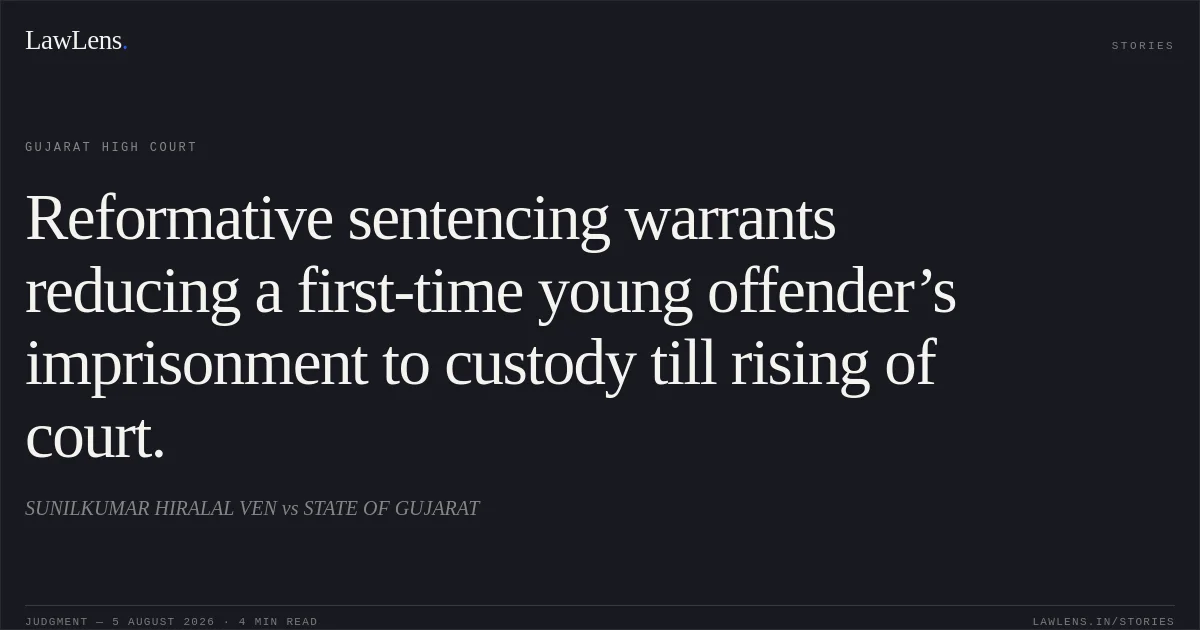
Source reference: pp.6–7, paras. 6, 9Balancing the statutory punishment with these mitigating circumstances, the Court substituted the custodial sentence with custody “till rising of the court” and increased the fine to ₹1,000.
Source reference: p.7, para. 9As to community service, the Court considered that the applicant was a young first-time offender and that a reformative measure addressing the consequences and social harms of prohibition offences would be more appropriate than hospital cleaning.
Source reference: pp.8–9, paras. 10–11It therefore modified the original direction and required the applicant, for three months, to periodically apprise students in specified educational institutions about the consequences of criminal involvement, the effects of contraband, and the consequences of undergoing criminal proceedings.
Source reference: p.9, para. 11The applicant was also directed to furnish a bond and report compliance to the concerned Magistrate.
Source reference: p.10, para. 12Holding
The Revision Application was partly allowed.
The conviction under Section 66(1)(b) of the Bombay Prohibition Act, 1949, was left undisturbed, but the sentence was modified: the applicant was directed to surrender before the concerned Magistrate on 11 August 2026 and remain in custody until rising of the court, and to deposit a fine of ₹1,000.
Source reference: p.7, para. 9The direction to perform cleaning services at Deesa Civil Hospital was replaced with a three-month obligation to educate students at the specified institutions regarding the consequences of prohibition-related offences, criminal proceedings, and contraband, subject to furnishing a bond and reporting compliance.
Source reference: pp.9–10, paras. 11–12The impugned appellate judgment was modified accordingly, and the proceedings were disposed of.
Source reference: p.10, paras. 13–14Acts & Sections Cited
4 provisions across 2 statutes referred to in this judgment. Each provision opens on LawLens.
Code of Criminal Procedure, 19733
Motor Vehicles Act, 19881
Original Court PDF
SUNILKUMAR HIRALAL VENvsSTATE OF GUJARAT
Click to open original judgment
Original judgment, available to read, download and summarize on LawLens.in