Facts
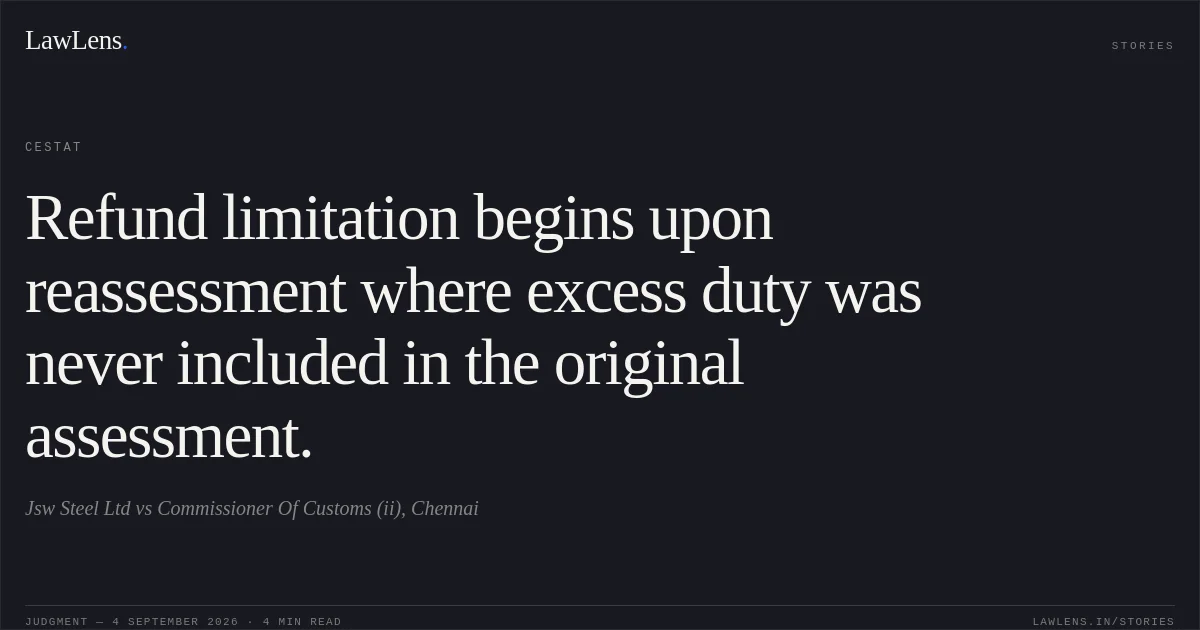
JSW Steel Ltd. exported non-alloy steel slabs under four shipping bills dated between 25 June and 11 July 2008. Although the shipping bills were treated as duty-free in the electronic records, JSW paid export duty at 15% of the declared FOB value.
Source reference: para. 2Following CBEC Circular No. 18/2008-Cus. dated 10 November 2008, which clarified the method of computing export duty by treating the FOB price as the cum-duty price until 31 December 2008, JSW claimed that it had paid excess export duty of ₹1,61,96,066 and filed a refund application on 30 January 2009.
Source reference: para. 2The initial refund claim was rejected as time-barred. In the first round of proceedings, the Tribunal remanded the matter for examination of the applicability of Section 27 of the Customs Act, 1962.
Source reference: para. 2On remand, the adjudicating authority sanctioned the refund, holding that the shipping bills had subsequently been corrected and the duty re-quantified on 21 September 2015.
Source reference: para. 3The Commissioner (Appeals), however, allowed the Revenue’s appeal and held that limitation ran from the date of payment of duty in 2008. JSW’s separate claim for interest was also rejected.
Source reference: paras. 4–6Issues
Whether the refund claim of ₹1,61,96,066 was barred by limitation under Section 27 of the Customs Act, 1962, or whether limitation commenced from the reassessment/correction of the shipping bills on 21 September 2015?
Source reference: paras. 11, 15–16Whether the excess amount paid by JSW could be treated as an amount outside the scope of Section 27 on the grounds of mistake of law or Article 265 of the Constitution?
Source reference: paras. 12–14Whether JSW was entitled to interest under Section 27A, and, if so, from what date was interest payable?
Source reference: paras. 11, 19–21Law Applied
Section 27 of the Customs Act, 1962 governs refund claims for customs duty and prescribes the applicable limitation period; under Section 2(2), as then in force, “assessment” included reassessment, while Section 27(1B)(c) addressed cases involving reassessment.
Source reference: para. 15Section 51 requires the proper officer to permit export clearance only after satisfaction that the duty assessed has been paid.
Source reference: para. 15Section 27A requires payment of interest where an ordered refund is not made within three months of receipt of the refund application.
Source reference: no citationIn Mafatlal Industries Ltd. v. Union of India, 1997 (89) E.L.T. 247 (S.C.), the Supreme Court held that claims for refund arising from misinterpretation or misapplication of law must be pursued under the special statutory refund mechanism and cannot bypass Section 27 by invoking Section 17 of the Limitation Act or Article 265.
Source reference: paras. 12–14Commissioner of Customs (Import) v. Indian Farmers Fertiliser Co-operative Ltd., 2009 (243) E.L.T. 687 (Bom.), and Keshari Steels v. Collector of Customs, 2000 (115) E.L.T. 320 (Bom.), establish that where assessment is required to be rectified, the refund claim cannot be treated as time-barred before such rectification.
Source reference: para. 16ITC Ltd. v. Commissioner of Central Excise, 2019 (368) E.L.T. 216 (S.C.), prevents a refund authority from reopening a final assessment, but does not apply where the disputed amount was never part of the original assessment.
Source reference: para. 16Under Ranbaxy Laboratories Ltd. v. Union of India, 2011 (273) E.L.T. 3 (S.C.), interest ordinarily runs from the expiry of three months from receipt of the refund application, subject to the refund amount being ascertained and refundable.
Source reference: para. 19Reasoning
The Tribunal rejected JSW’s attempt to avoid Section 27 altogether through the doctrines of mistake of law and Article 265. Applying Mafatlal Industries, it held that a refund claim based on alleged erroneous computation of duty must remain within the statutory framework of Section 27.
Source reference: paras. 12–14However, on the facts, the Tribunal found that the amount paid in excess of the figure reflected in the electronic shipping bills, Let Export Orders, and other contemporaneous assessment records had not been assessed by the proper officer in 2008.
Source reference: para. 15Although payment of the amount reflected in the EDI system was necessary for grant of export clearance under Section 51, the additional amount paid by challan was not part of the original assessment.
Source reference: para. 15The Export Department’s Note dated 21 September 2015 recomputed the duty pursuant to the Board’s Circular and the Tribunal’s remand order. That correction constituted reassessment for purposes of Section 27(1B)(c), and the refund claim, filed before the reassessment, could not be treated as time-barred.
Source reference: para. 16The Tribunal distinguished ITC Ltd. because the present case did not involve reopening a final assessment; rather, it concerned an excess amount that had never formed part of the assessment.
Source reference: para. 16As to interest, the Tribunal held that the excess amount became ascertainable only on 21 September 2015. Therefore, although Ranbaxy applied in principle, the three-month period under Section 27A had to be calculated from that date rather than from the original 2009 refund application.
Source reference: paras. 19–20Holding
The Tribunal held that JSW’s refund claim was not time-barred. The Note dated 21 September 2015 constituted reassessment, and the refund of ₹1,61,96,066 sanctioned by the adjudicating authority was upheld.
The Commissioner (Appeals)’s order was set aside, and Appeal No. C/41996/2016 was allowed.
Source reference: paras. 16–18JSW was also held entitled to interest under Section 27A on the refund amount from 22 December 2015, being the day after expiry of three months from the reassessment date, until the date of actual refund, at the notified rate.
Source reference: paras. 20–22Appeal No. C/41997/2016 was allowed to that extent.
Source reference: paras. 20–22Acts & Sections Cited
11 provisions across 4 statutes referred to in this judgment. Each provision opens on LawLens.
Central Excise Act, 19441
Indian Contract Act, 18721
Limitation Act, 19631
Original Court PDF
Jsw Steel LtdvsCommissioner Of Customs (ii), Chennai
Click to open original judgment
Original judgment, available to read, download and summarize on LawLens.in