Facts
The appellant challenged an order dated 25.03.2026 passed by the Special Judge (SC/ST Act), Lakhimpur Kheri, which took cognizance and summoned the appellant for offences under Section 69 of the Bharatiya Nyaya Sanhita (BNS), 2023, and Sections 3(1)(r), 3(1)(s), and 3(2)(v) of the SC/ST Act
Source reference: para. 2The appellant contended that the trial court ignored its previous order dated 29.10.2025, which had refused judicial remand for the same offences
Source reference: para. 3It was further argued that the Investigating Officer circumvented that judicial order and that the material on record failed to disclose the victim’s caste status or the specific ingredients of the alleged crimes
Source reference: paras. 4-5Issues
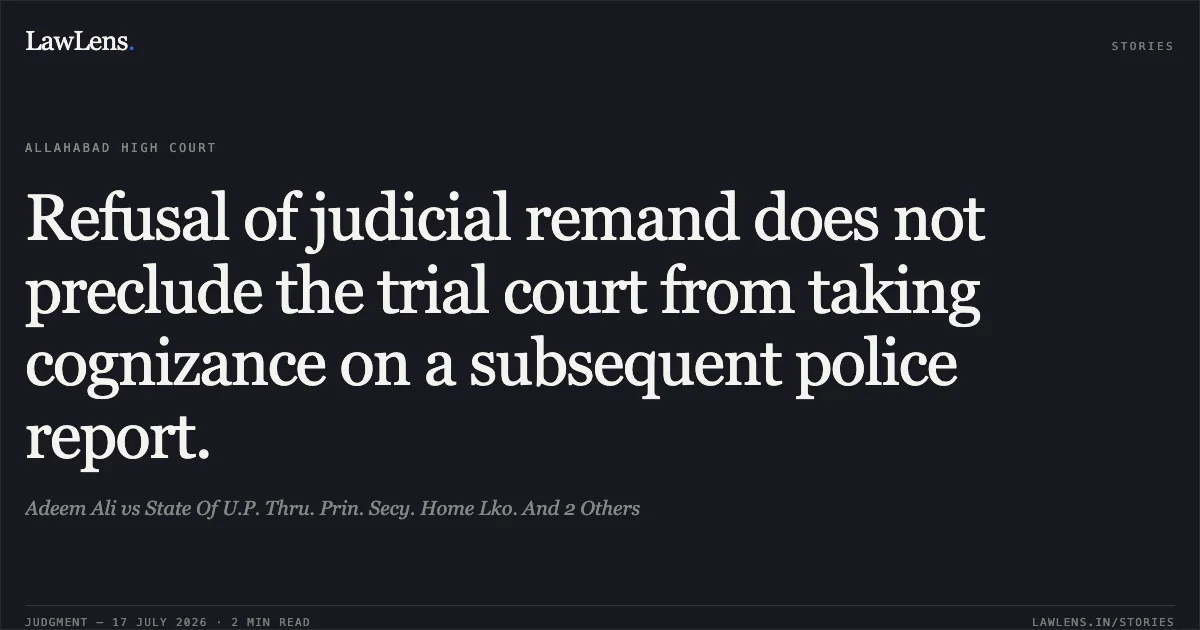
1. Whether an order refusing judicial remand at an earlier stage precludes the trial court from subsequently taking cognizance and summoning the accused based on a police report
Source reference: para. 122. Whether the Court, at the stage of taking cognizance, is required to conduct a meticulous appreciation of evidence or resolve factual disputes regarding the ingredients of the offences
Source reference: para. 8Law Applied
The Court applied Section 210 of the BNSS, 2023, regarding "cognizance" as the application of judicial mind to take notice of an offence, and Section 227 of the BNSS regarding "summoning"
Source reference: para. 8It relied on Bhushan Kumar v. State (NCT of Delhi) (2012) 5 SCC 424, establishing that a summoning order need not be elaborate or contain explicit reasons if the Magistrate has applied his mind to the police report
Source reference: para. 9Regarding the SC/ST Act and Section 69 BNS, the court referenced Hitesh Verma v. State of Uttarakhand (2020) 10 SCC 710 and Pramod Suryabhan Pawar v. State of Maharashtra (2019) 9 SCC 608, which hold that specific ingredients like caste-based intent and "false promise of marriage" are matters of factual determination to be tested at trial, not at the threshold of cognizance
Source reference: para. 14Reasoning
The Court reasoned that cognizance and summoning are conceptually separate stages where the court only examines if a prima facie case exists, rather than evaluating the probability of conviction
Source reference: para. 8It held that the trial judge's order was valid because it recorded that the police report and statements disclosed sufficient grounds for proceeding
Source reference: para. 11Crucially, the Court clarified that an order refusing judicial remand does not adjudicate the legality of the investigation or act as a final determination on the merits of the charges; therefore, it does not bar the Investigating Officer from submitting a charge-sheet or the court from taking cognizance
Source reference: para. 13Arguments regarding the victim's caste status or the lack of bad faith in a promise of marriage were deemed matters of evidence to be adjudicated during trial
Source reference: paras. 15-16Holding
The High Court dismissed the appeal, holding that there was no infirmity in the impugned order dated 25.03.2026
The Court held that an earlier refusal of judicial remand does not curtail the statutory authority of the investigator or the trial court's jurisdiction to take cognizance
Source reference: para. 13The trial court was directed to proceed uninfluenced by any observations made in this judgment
Source reference: para. 18Acts & Sections Cited
7 provisions across 4 statutes referred to in this judgment. Each provision opens on LawLens.
Bharatiya Nyaya Sanhita, 20231
Scheduled Castes and the Scheduled Tribes (Prevention of Atrocities) Act, 19891
Bharatiya Nagarik Suraksha Sanhita, 20234
Code of Criminal Procedure, 19731
Original Court PDF
Adeem AlivsState Of U.P. Thru. Prin. Secy. Home Lko. And 2 Others
Click to open original judgment
Original judgment, available to read, download and summarize on LawLens.in