Facts
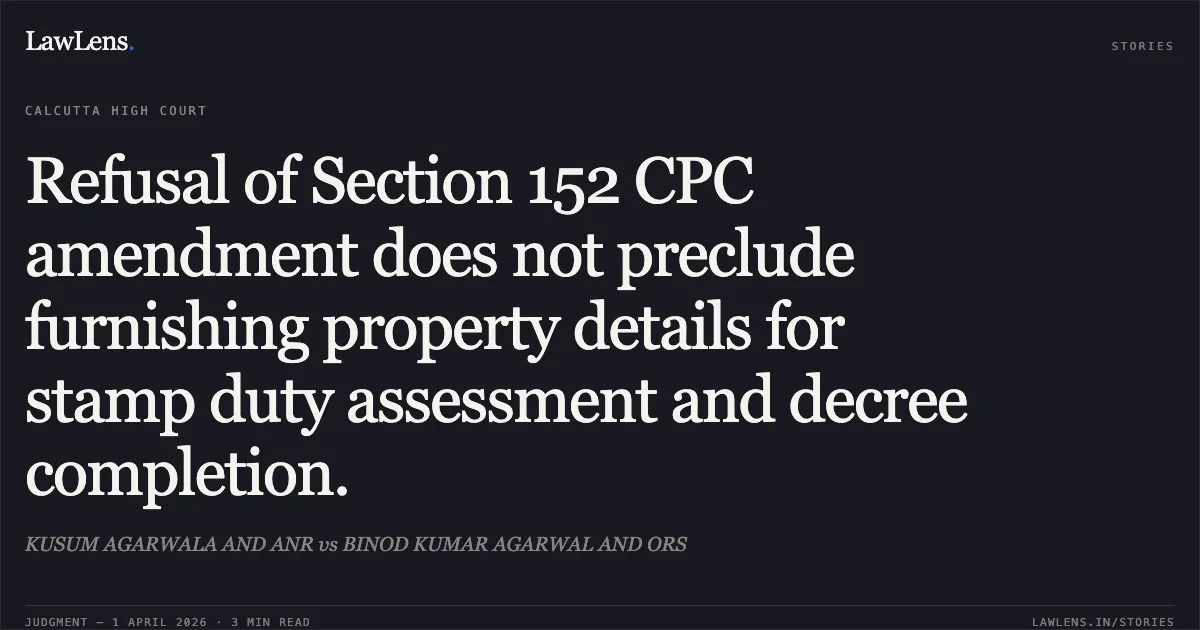
A consent decree was passed by a Division Bench on May 22, 1997, based on a "Mittal Settlement" for the partition of properties.
Source reference: para 1, 14While the settlement identified the properties, it lacked technical descriptions (title deed details/schedules), preventing the Collector from assessing the stamp duty necessary for drawing up and completing the decree.
Source reference: para 2, 21In 1999, an application by Defendant No. 1 to alter the decree under Section 152 of the CPC was dismissed by the High Court and subsequently by the Supreme Court in 2009, on the grounds that the request did not fall within the scope of correcting clerical or arithmetical errors.
Source reference: para 4, 15-16However, a later coordinate Bench order dated April 3, 2019, directed the Department to draw up the decree by collecting particulars from the pleadings and records.
Source reference: para 18-19In the present application, Defendant No. 1 sought to provide the necessary technical details via a supplementary affidavit to facilitate the Collector's assessment of stamp duty.
Source reference: para 2-3Issues
Whether the provision of technical property details for stamp duty assessment constitutes an impermissible modification of the decree, in light of the prior rejection of a Section 152 CPC application by the Supreme Court.
Source reference: para 16, 23Whether the doctrine of merger and principles of finality preclude the Court from accepting technical details provided through a supplementary affidavit.
Source reference: para 9-11, 23-24Law Applied
Section 152 of the Code of Civil Procedure, 1908, which governs the correction of clerical or arithmetical mistakes in judgments or decrees.
Source reference: para 4, 16Doctrine of Merger as discussed in Kunhayammed & Ors. v. State of Kerala, which stipulates that a lower court's order merges into the order of the superior court.
Source reference: para 9, 23The principle from State Bank of India v. Ram Chandra Dubey, prohibiting the revival of rejected claims.
Source reference: para 10, 25Rule 11 of Chapter 16 of the Original Side Rules of the Calcutta High Court, which allows the Department to include short recitals and particulars when drawing up a decree.
Source reference: para 19-20Reasoning
The Court distinguished between an application to alter a decree under Section 152 CPC and the ministerial act of drawing up and completing a decree.
Source reference: para 17, 25It reasoned that the 1999/2009 rejections were based strictly on the technical limits of Section 152 and did not bar parties from enjoying the "fruits of the decree".
Source reference: para 17Furthermore, the 2019 coordinate Bench judgment—which was not challenged—expressly authorized the Department to collect particulars from the record to finalize the decree.
Source reference: para 18-19The Court found that the technical details in the supplementary affidavit were not "new" but existed within the broader pleadings and records of the case; thus, their disclosure was not an "improvement" of the case but a necessity for the Collector to fulfill the statutory requirement of assessing stamp duty.
Source reference: para 22, 24Consequently, the doctrine of merger was inapplicable as the current prayer for completion of the decree was distinct from the previously rejected prayer for modification.
Source reference: para 23Holding
The Court held that the parties cannot be left remediless and must be permitted to finalize the decree.
It directed the parties to file the requisite Form No. 1 before the Collector within a fortnight, incorporating the technical details provided in the supplementary affidavit.
Source reference: para 26The Collector was ordered to assess the stamp duty and submit a report to the High Court within four weeks.
Source reference: para 26All objections regarding the doctrine of merger and the nature of the supplementary affidavit were rejected.
Source reference: para 23-25Prayers for a stay of this order were refused.
Source reference: para 28Acts & Sections Cited
4 provisions across 1 statute referred to in this judgment. Each provision opens on LawLens.
Code of Civil Procedure, 19084
Original Court PDF
KUSUM AGARWALA AND ANRvsBINOD KUMAR AGARWAL AND ORS
Click to open original judgment
Original judgment, available to read, download and summarize on LawLens.in