Facts
The appeals arose from common adjudication proceedings concerning a Show Cause Notice dated 22.12.2020 issued in relation to imports made by M/s Radhey Shyam Rishipal Factory. The appellants, including the firm, its partner Deepak Kumar and Radhey Shyam, participated in the proceedings through counsel, but did not file a reply despite repeated opportunities. The Principal Commissioner consequently passed Order-in-Original No. 19/2021 dated 07.12.2021, re-determining the value of the imported goods, demanding differential customs duty and imposing penalties.
Source reference: paras. 4–6The Department stated that the order was dispatched to the address available on record, electronically forwarded to the appellants’ counsel on 14.12.2021, and displayed on the departmental notice board. The appellants claimed that they had not received the order and became aware of it only when their bank accounts were frozen on 27.02.2024. They obtained a copy of the order by email on 02.07.2024 and filed appeals before the CESTAT on 01.08.2024.
Source reference: paras. 7–10As the appeals were delayed by approximately 968 days, the appellants filed applications for condonation of delay. The CESTAT found that the appellants had not explained their prolonged inaction, had failed to disclose the email communication to their counsel, and had not made any enquiry regarding the outcome of the adjudication proceedings for nearly three years. It rejected the delay-condonation applications and dismissed the appeals by Common Miscellaneous Order Nos. 50042–50044/2026 dated 07.01.2026.
Source reference: paras. 11–15Issues
Whether the CESTAT’s refusal to condone the approximately 968-day delay involved an error of law, perversity, or disregard of material evidence giving rise to a substantial question of law under Section 130 of the Customs Act, 1962?
Source reference: paras. 24–27Whether the appellants established “sufficient cause” for the delay by contending that the Order-in-Original had not been served upon them until 02.07.2024, notwithstanding its dispatch and electronic communication to their counsel in December 2021?
Source reference: paras. 27, 30, 35–37Whether the appellants’ failure to enquire about the outcome of proceedings for nearly three years, and the subsequent omission to disclose the email communication to counsel, justified rejection of the applications for condonation of delay?
Source reference: paras. 35–46Law Applied
Section 129A(3) of the Customs Act, 1962 prescribes three months for filing an appeal before the CESTAT from the date on which the order is communicated, while Section 129A(5) permits condonation where “sufficient cause” is shown. Section 130 restricts the High Court’s appellate jurisdiction to cases involving a “substantial question of law”; it does not ordinarily permit re-appreciation of factual findings or substitution of the Tribunal’s discretionary assessment.
Source reference: paras. 24–27Applying Santosh Hazari v. Purushottam Tiwari, (2001) 3 SCC 179, the Court held that a substantial question of law must be debatable, material to the parties’ rights and the outcome, and not merely an invitation to reassess evidence; a factual finding may qualify only if perverse, unsupported by evidence, or founded on an erroneous legal approach.
Source reference: para. 25Under Esha Bhattacharjee v. Managing Committee of Raghunathpur Nafar Academy, (2013) 12 SCC 649, liberal construction of “sufficient cause” remains subject to bona fides, diligence and a satisfactory explanation for the entire delay.
Source reference: para. 28Basawaraj v. Special Land Acquisition Officer, (2013) 14 SCC 81 establishes that negligence, inaction or lack of bona fides disentitles a party to condonation and that limitation cannot be extended on equitable grounds.
Source reference: para. 29The principle in Rafiq v. Munshilal, (1981) 2 SCC 788, that a diligent litigant should not ordinarily suffer for counsel’s default, applies only where the litigant itself has acted with due diligence.
Source reference: paras. 38–39Reasoning
The Court held that the CESTAT had assessed the entire factual record rather than relying solely on the email sent to counsel. The appellants admittedly knew of the adjudication proceedings, were represented through counsel, and had obtained repeated opportunities to file their defence, yet made no enquiry regarding the outcome after the hearing concluded.
Source reference: paras. 31–37The Department had attempted service at the address used during the proceedings, forwarded the order to the counsel who had represented the appellants, and displayed it on the notice board.
Source reference: para. 36Even assuming that the appellants personally received the order only on 02.07.2024, that circumstance did not explain their complete inaction between December 2021 and February 2024.
Source reference: paras. 35, 45–46The subsequent filing of the appeals on 01.08.2024 also did not cure the earlier delay, particularly as the condonation applications were filed only after the Registry pointed out the defect.
Source reference: para. 40The appellants’ reliance on counsel’s alleged failure to communicate the order was insufficient because the same counsel filed the appeals and did not explain why the departmental emails had not been disclosed; moreover, the appellants’ own lack of diligence independently remained unexplained.
Source reference: paras. 41–46The CESTAT’s conclusion was therefore based on relevant material and could not be characterised as perverse or legally erroneous.
Source reference: paras. 47–50Holding
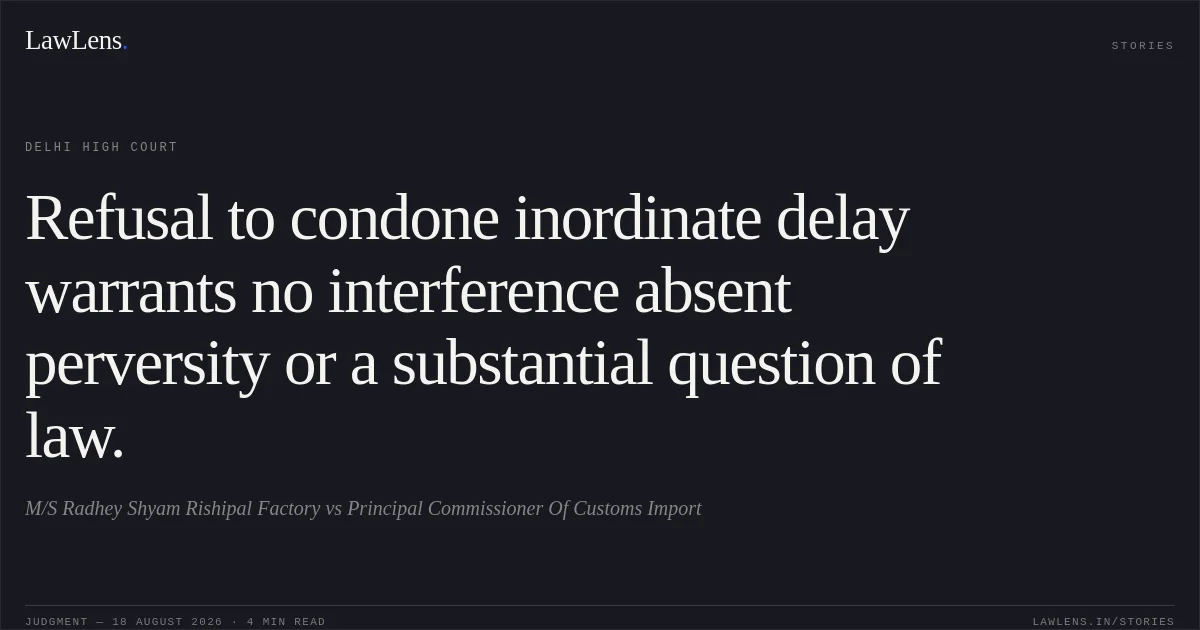
The High Court answered the issues against the appellants. It held that the CESTAT’s refusal to condone the 968-day delay was a reasoned exercise of discretion based on the appellants’ negligence, prolonged inaction, failure to enquire about the proceedings, and failure to satisfactorily explain the entire period of delay.
No substantial question of law arose under Section 130 of the Customs Act, 1962. Accordingly, CUSAA Nos. 89, 90 and 92 of 2026 were dismissed, and all pending applications were disposed of.
Source reference: paras. 51–53Acts & Sections Cited
2 provisions across 1 statute referred to in this judgment. Each provision opens on LawLens.
Customs Act,19622
Original Court PDF
M/S Radhey Shyam Rishipal FactoryvsPrincipal Commissioner Of Customs Import
Click to open original judgment
Original judgment, available to read, download and summarize on LawLens.in