01Facts
The petitioner's father worked as a construction labourer under various building contractors. He registered as a construction worker with the Karnataka Building and Other Construction Workers Welfare Board and was issued an identity card.
¶ 3He died on 06.02.2023, and his last rites were performed on 07.06.2023.
¶ 4The petitioner, as son, applied for funeral assistance on 07.06.2023.
¶ 4Respondent No. 1 verified the deceased's credentials and obtained a report (Annexure-C) stating that the deceased was an agriculturist.
¶ 5On the basis of that report, Respondent No. 2 rejected the claim by order dated 18.10.2023 (Annexure-D).
¶ 5The petitioner's appeal before Respondent No. 1 was also rejected by order dated 09.02.2024 (Annexure-G), after notices were issued to three contractors and reliance was placed on the same report.
¶ 5The Court noted that the report did not state the date of the labour inspector's visit or the names of the villagers whose statements were recorded, and that it was obtained without the petitioner's knowledge.
¶ 6The petitioner sought certiorari quashing both orders and mandamus directing payment of funeral assistance.
pp. 2–302Issues
i.1. Whether the rejection of the funeral assistance claim, based solely on an unparticularised official report describing the deceased as an agriculturist, is sustainable where the deceased was registered as a construction worker and held an identity card under the Karnataka Building and Other Construction Workers Welfare Board.
¶ 6 · ¶ 7ii.2. Whether the petitioner is entitled to a writ of mandamus directing payment of funeral benefits.
¶ 7 · Order (iii)03Law Applied
The administrative-law principle that a decision affecting a claimant's entitlement must be based on material that is disclosed, particularised, and verifiable, and that an unexplained, unsupported entry in an official report cannot defeat a claim.
¶ 6The claimant's registration with the Karnataka Building and Other Construction Workers Welfare Board and the issuance of an identity card are treated as conclusive of the deceased's status as a construction worker for the purpose of the claim.
¶ 7The writ jurisdiction under Articles 226 and 227 of the Constitution of India, invoked by the petitioner.
p. 2The judgment does not cite any specific statutory provision, rule, or precedent.
04Reasoning
The Court first found that the Annexure-C report was defective. It did not state the date of inspection, did not name the villagers whose statements supported the finding, and was obtained without the petitioner's knowledge. The Court held that such a report cannot be the basis for rejecting the claim merely because it records, in general terms, that the deceased was an agriculturist.
¶ 6The Court contrasted this unverified material with the documented record: the deceased's registration with the Welfare Board and the identity card issued to him. Against that record, the rejection was held to be "without any basis and without any enquiry".
¶ 7The Court concluded that both the original rejection and the appellate order were unsustainable. It did not remit the matter for fresh enquiry and instead directed payment of the benefits.
Order (iii)05Holding
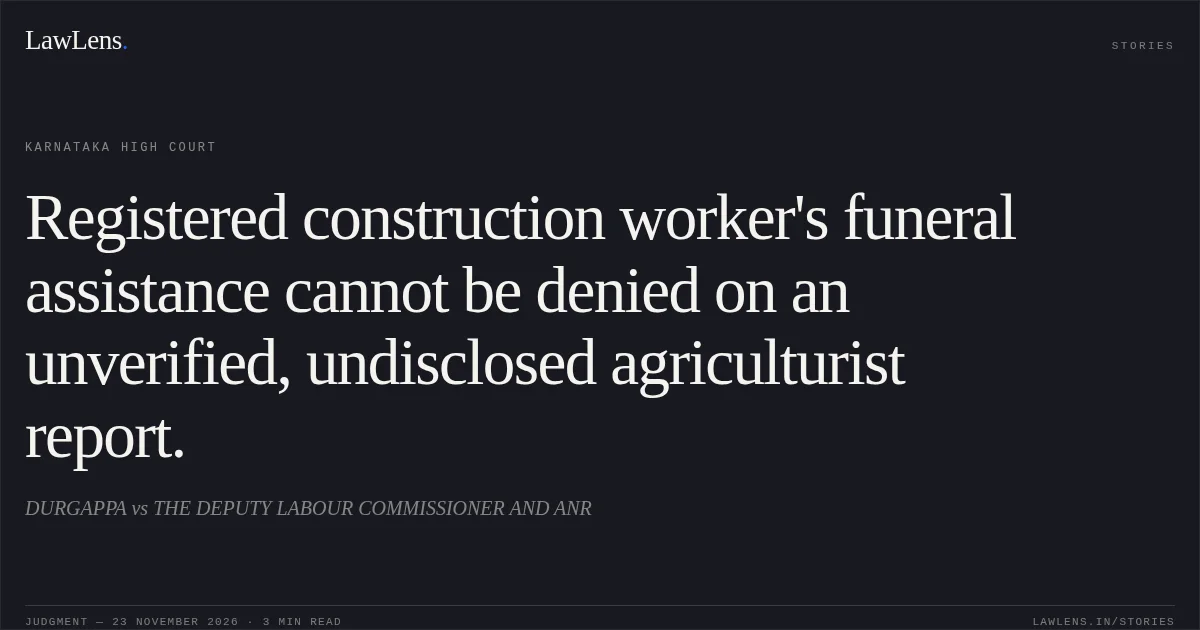
The rejection of funeral assistance could not rest on an undisclosed and unparticularised report that contradicted the deceased's registration and identity card as a construction worker.
¶ 6 · ¶ 7The writ petition is allowed. The order dated 18.10.2023 (Annexure-D) passed by Respondent No. 2 and the order dated 09.02.2024 (Annexure-G) passed by Respondent No. 1 are set aside.
Order (i)–(ii)A writ of mandamus is issued directing the respondent authorities to pay the funeral benefits sought by the petitioner within three months from receipt of a copy of the order.
Order (iii)Original Court PDF
DURGAPPAvsTHE DEPUTY LABOUR COMMISSIONER AND ANR
Click to open original judgment
Original judgment, available to read, download and summarize on LawLens.in