Facts
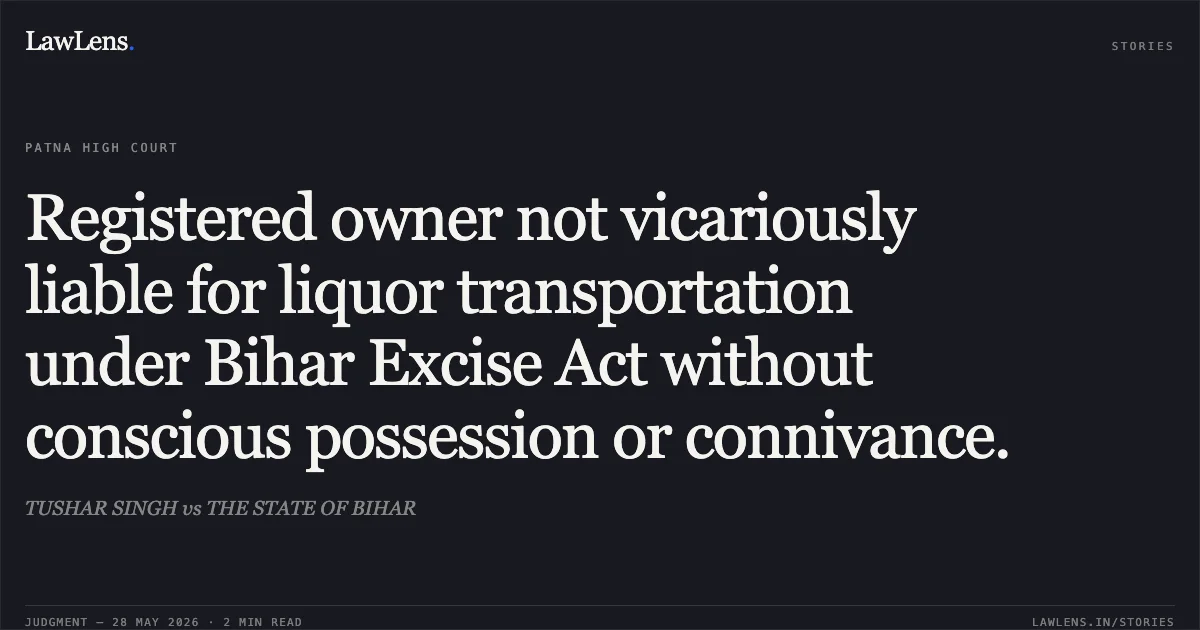
The petitioner, Tushar Singh, sought the quashing of a cognizance order dated 02.11.2021 for an offence under Section 30(a) of the Bihar Prohibition and Excise Act, 2016
Source reference: para. 2On 15.09.2021, a vehicle registered in the petitioner's name was intercepted at a Bihar-UP border check-post
Source reference: para. 3The vehicle was occupied only by the driver, Suresh Paswan, who was found in possession of three bottles of whiskey
Source reference: para. 3-4The driver confessed the liquor was for his personal use and did not implicate the petitioner
Source reference: para. 4The petitioner was neither present nor near the site of seizure, but was prosecuted solely due to his status as the registered owner of the vehicle
Source reference: para. 5Issues
1. Whether the mere fact of being the registered owner of a vehicle, without knowledge, connivance, or participation in the act of transporting liquor, creates criminal liability under Section 30(a) of the Act?
Source reference: para. 9(i)2. Whether the cognizance taken constitutes an abuse of the process of the Court warranting interference under Section 482 of the Cr.P.C.?
Source reference: para. 9(ii)Law Applied
The court relied on the fundamental principle that criminal liability is personal and requires the concurrence of actus reus and mens rea unless a statute specifically provides for vicarious liability
Source reference: para. 13It applied Section 482 of the Code of Criminal Procedure, 1973, identifying that inherent powers must be exercised when FIR allegations, taken at face value, do not constitute an offence, citing State of Haryana v. Ch. Bhajan Lal
Source reference: para. 12The court interpreted Section 30(a) and Section 37 (Presumption of guilt) of the Bihar Prohibition and Excise Act, 2016, noting that the Act does not create absolute vicarious liability for vehicle owners
Source reference: para. 8It further referenced the doctrine of "conscious possession" from Raj Kumar Singh v. State of Bihar and constitutional protections under Articles 14 and 300A as highlighted in Sharad Navnath Gange v. State of Bihar
Source reference: para. 16, 18Reasoning
The Court observed that the petitioner was entirely absent from the scene and had no "conscious possession" or control over the illicit items
Source reference: para. 14, 16It reasoned that vicarious liability is an exception in criminal law and the 2016 Act—while providing for liability of family members or occupants in specific sections—contains no provision imputing the driver’s acts to a vehicle owner based solely on registration
Source reference: para. 8The Court rejected the State’s reliance on the Section 37 presumption, clarifying that a presumption is an evidentiary tool for trial and cannot be used as a "bootstrapping device" to sustain cognizance where no prima facie material connecting the owner to the crime exists
Source reference: para. 17Since the driver’s confession pointed to personal use and the quantity was small, no commercial nexus or connivance by the owner could be inferred
Source reference: para. 19-20Holding
The Court held that the petitioner’s implication was legally unsustainable as ownership alone does not satisfy the requirements of a criminal charge under Section 30(a) of the Act
Consequently, the application was allowed, and the order of cognizance dated 02.11.2021 was quashed
Source reference: para. 21Acts & Sections Cited
7 provisions across 2 statutes referred to in this judgment. Each provision opens on LawLens.
Code of Criminal Procedure, 19731
BIHAR PROHIBITION AND EXCISE ACT, 20166
Original Court PDF
TUSHAR SINGHvsTHE STATE OF BIHAR
Click to open original judgment
Original judgment, available to read, download and summarize on LawLens.in