Facts
On June 18, 2020, Y. Hanumantha died from injuries sustained in an accident involving a motorcycle (KA-53-E-9431)
Source reference: para. 5The claimants (wife, children, and mother) filed for compensation, asserting the deceased earned income from a JCB business and a wine shop
Source reference: para. 5Respondent No. 1 (Sunil Kumar), the registered owner (RC owner), contended he had sold the vehicle to Respondent No. 2 (Shabrez) in 2011 via a delivery note (Ex.R4)
Source reference: para. 5.1, 6Respondent No. 2 denied the purchase
Source reference: para. 5.2The Motor Accident Claims Tribunal (MACT) awarded Rs. 33,07,940, holding both the RC owner and the custodian (Respondent No. 2) jointly liable
Source reference: para. 5.4The MACT calculated income by averaging three years of tax returns and omitted future prospects
Source reference: para. 5.5All parties appealed: the owner regarding liability, the custodian regarding joint liability, and the claimants seeking enhancement
Source reference: para. 3Issues
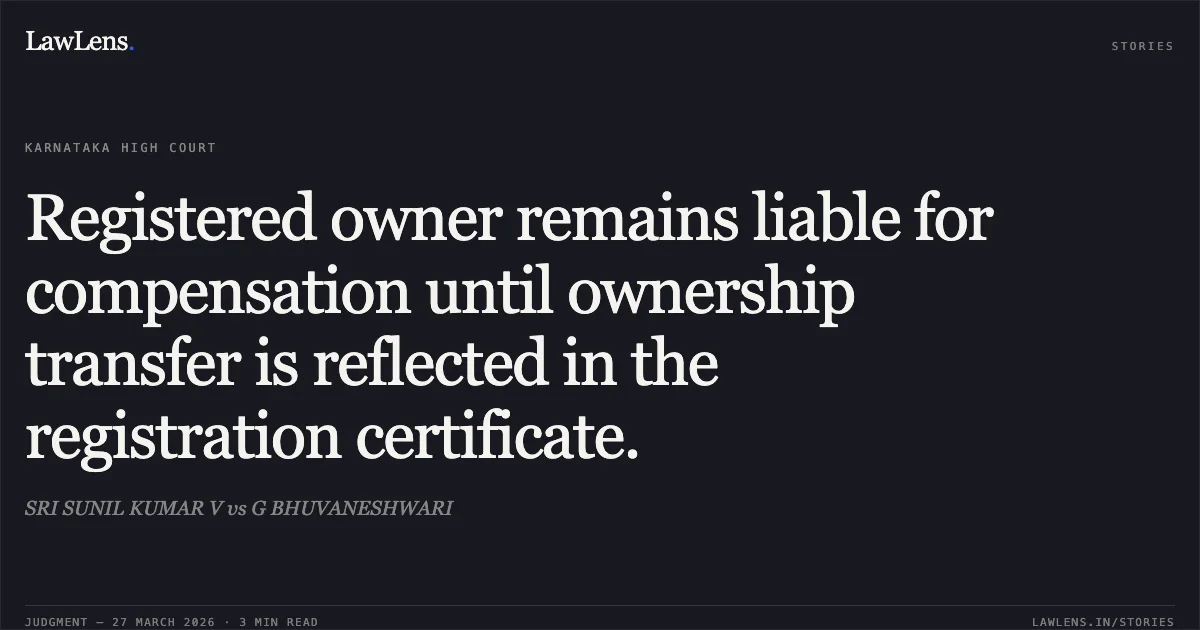
1. Whether the registered owner remains liable for compensation despite an alleged private sale of the vehicle when the transfer is not reflected in the RC records
Source reference: para. 102. Whether the income for compensation should be assessed based on the average of multiple years' tax returns or the highest income from the last return filed prior to the accident
Source reference: para. 113. Whether the claimants are entitled to future prospects and a 10% increment on conventional heads under the prevailing legal framework
Source reference: para. 12.1, 12.3Law Applied
The court primarily applied the principle from Brij Bihari Gupta v. Manmeet and others, establishing that liability remains with the owner named in the registration certificate unless the transfer is officially reflected therein
Source reference: para. 10.2Regarding income assessment, the court distinguished between Beena Jain and others v. P. Antom, which favors averaging income when returns show a decrease, and Anoop Maheshwari v. Oriental Insurance Company Ltd., which supports using the last return if it shows a gradual, consistent increase filed before the accident
Source reference: para. 11.4, 11.6The court further relied on National Insurance Company Limited v. Pranay Sethi, mandating a 25% addition for future prospects for those aged 40–50 and a 10% increment on conventional heads every three years
Source reference: para. 12.1, 12.3Reasoning
The Court set aside the MACT’s finding of joint liability, ruling that since Respondent No. 1 was the RC owner at the time of the accident and the sale to Respondent No. 2 was disputed and unproven by corroborative evidence, the RC owner alone is liable
Source reference: para. 10.1, 10.3On quantum, the Court found that the deceased’s tax returns showed a "gradual increase" rather than a "windfall"
Source reference: para. 11.2, 11.5Applying Anoop Maheshwari, the Court held that the MACT erred in averaging the returns and should have used the last return (AY 2018–19) filed before the accident as the most accurate reflection of income
Source reference: para. 11.7Finally, the Court corrected the omission of future prospects (adding 25%) and applied the mandatory 10% escalation to funeral expenses, loss of estate, and consortium, as more than three years had passed since the Pranay Sethi benchmarks were established
Source reference: para. 12.2 - 12.4Holding
The Court partly allowed the claimants’ appeal and the cross-objection, while dismissing the owner’s appeal
It held that Respondent No. 1 (the RC owner) is solely liable to pay the compensation
Source reference: para. 13(iii)The total compensation was enhanced from Rs. 33,07,940 to Rs. 47,15,100, representing an increase of Rs. 14,07,160
Source reference: para. 12.4, 13(ii)The Court ordered the owner to deposit the enhanced amount with interest within six weeks
Source reference: para. 13(v)Original Court PDF
SRI SUNIL KUMAR VvsG BHUVANESHWARI
Click to open original judgment
Original judgment, available to read, download and summarize on LawLens.in